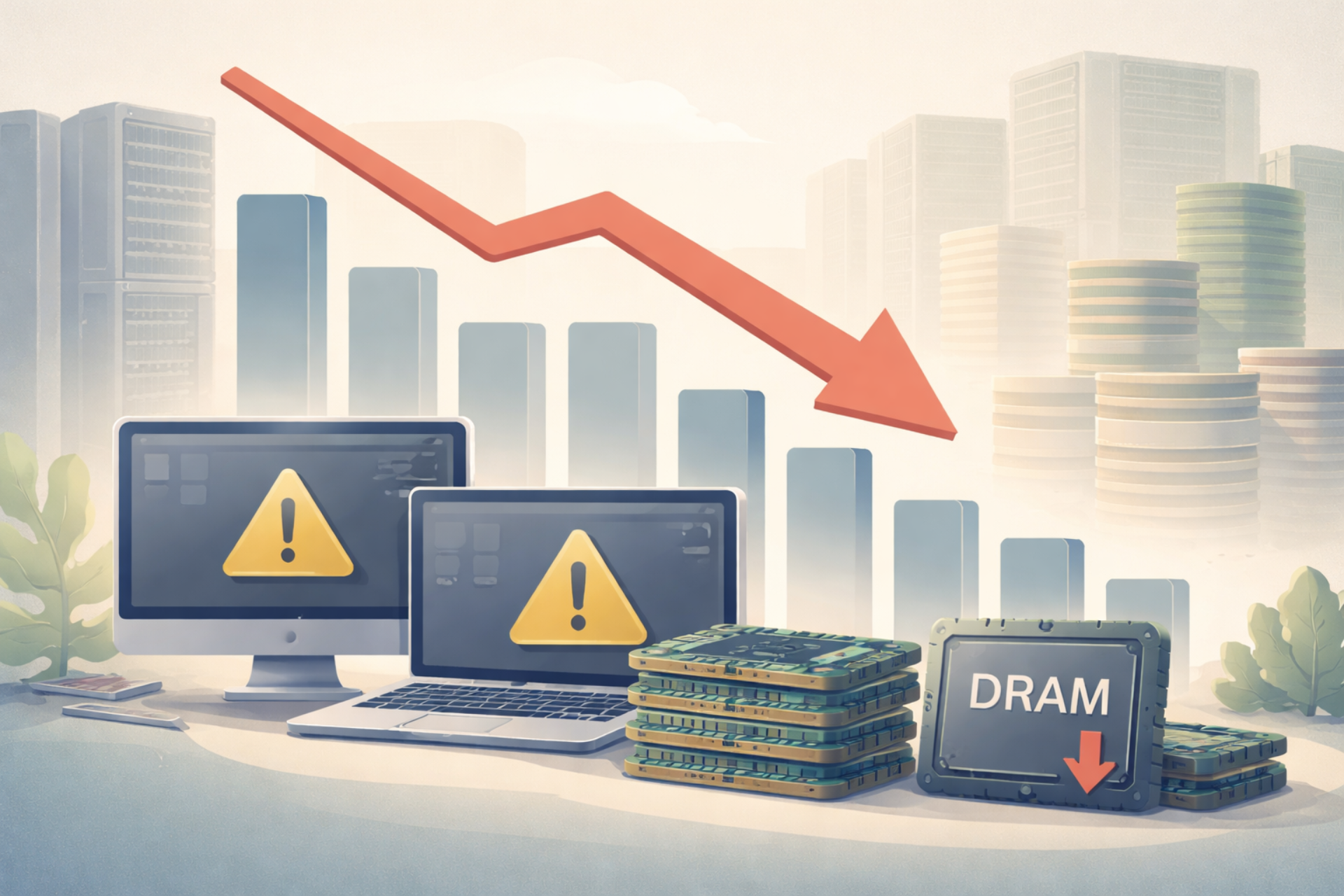
December 31, 2025 Global PC shipments could fall by as much as 9 per cent in 2026 as worsening memory shortages collide with rising costs and weakening consumer demand, according to a newly revised outlook from International Data Corporation (IDC). The research firm has sharply downgraded its expectations just weeks after issuing a far milder forecast. The new scenarios suggest the downturn could rival some of the worst years in PC market history.
IDC said its November projection of a roughly 2.5 per cent decline in PC shipments is no longer realistic. Under newly modelled pessimistic conditions, the firm now sees a contraction of up to 9 per cent next year, with even its moderate scenario pointing to a 5 per cent decline. While IDC has not formally replaced its official forecast, the firm’s latest analysis signals a sharp deterioration in market conditions.
At the core of the downgrade is a global memory shortage that has intensified since mid-October. Demand from hyperscalers building AI infrastructure has surged, pulling DRAM and NAND production toward higher-margin enterprise products such as high-bandwidth memory and dense DDR5 modules. IDC stressed this is not a short-term supply squeeze but a structural reallocation of silicon capacity that could persist for years.
The impact is already spreading beyond servers. In smartphones, where memory is a significant component of bill-of-materials costs, IDC warns that manufacturers may be forced to raise prices, reduce specifications or both. That shift could reverse a decade-long trend of bringing flagship-level memory into mid-range devices. As a result, IDC now sees downside risk of a global smartphone market contraction of up to 5 per cent in 2026, alongside longer replacement cycles.
The PC market, however, faces the most severe consequences. Rising DRAM and SSD prices are colliding with two forces that were expected to boost demand: the Windows 10 end-of-support refresh cycle and the industry’s push toward so-called “AI PCs.” IDC estimates that average selling prices for PCs could rise between 6 per cent and 8 per cent under pessimistic assumptions, while unit shipments decline sharply.
Large OEMs such as Dell, HP, Lenovo and ASUS are expected to cope better due to scale and long-term supply agreements. Smaller regional brands, white-box vendors and DIY PC builders are far more exposed, particularly in gaming systems where high memory configurations are standard.
There is also growing tension between AI marketing and economic reality. AI-branded PCs typically require more RAM, with some platforms setting 16GB as a minimum and premium models targeting 32GB or more. Yet memory is precisely the component becoming scarcer and more expensive, at a time when consumer enthusiasm for AI features has been mixed.