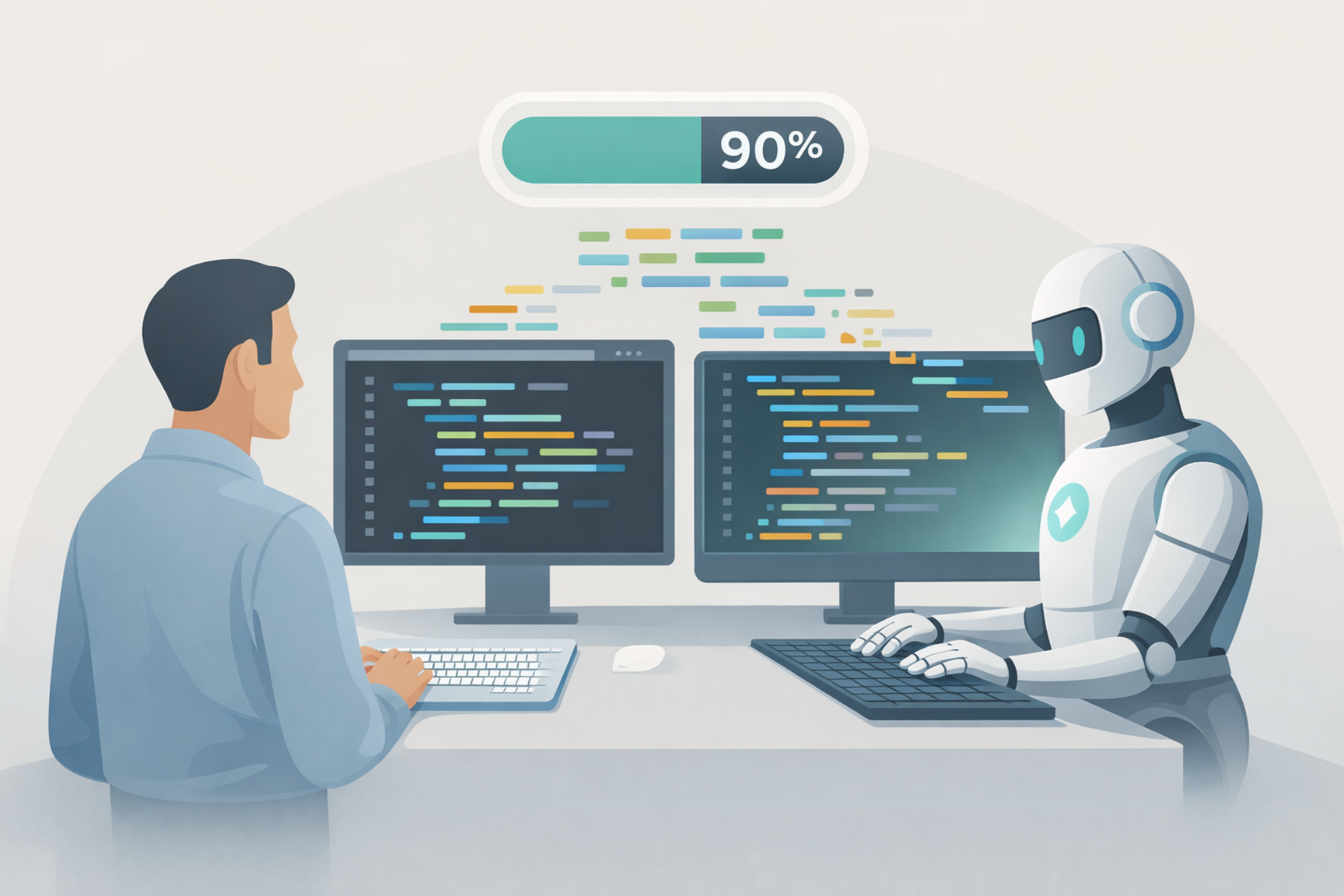
January 14, 2026 Anthropic says that more than 90 per cent of the software powering new versions of Claude is generated by Claude, marking a shift in how large-scale systems are built and maintained.
What began as a bold prediction in early 2025 has now hardened into an operational reality, with AI systems increasingly responsible for writing the code that produces their own successors.
Anthropic CEO Dario Amodei first floated the idea publicly last March, predicting that AI would be writing 90% of production code within six months. At the time, the claim was met with skepticism, particularly from engineers who questioned whether generative models could handle the edge cases, security risks and long-term maintenance demands of real-world software.
By October, Amodei told Salesforce CEO Marc Benioff that the forecast had already materialized across much of Anthropic’s internal work. “Within Anthropic and within a number of companies that we work with, that is absolutely true now,” he said, while cautioning against interpreting the shift as a signal that human engineers are becoming obsolete.
Rather than shrinking engineering teams, Anthropic says AI-driven coding has changed what engineers spend their time doing. “If Claude is writing 90% of the code, what that means, usually, is you need just as many software engineers,” Amodei said. “They can focus on the 10% that’s editing the code or writing the 10% that’s the hardest, or supervising a group of AI models.”
The recursive nature of the change became even clearer late last year. Boris Cherny, the creator of Anthropic’s Claude Code developer tool, disclosed that every line of code he personally shipped in December 2025 was written by Claude. Internally, Anthropic estimates that roughly 90 per cent of Claude Code’s own codebase is AI-generated, a feedback loop that researchers say could accelerate progress faster than traditional development cycles.
That dynamic was on display earlier this week when Anthropic launched Cowork, a new file automation feature reportedly built in about ten days using Claude Code itself.
The shift is rippling beyond Anthropic. At Y Combinator, president Garry Tan has said that a quarter of founders in the accelerator’s 2025 winter batch generate up to 95 per cent of their code with AI tools. At the same time, researchers warn the productivity gains may come with trade-offs. A Stanford study published last year found entry-level software employment has dropped nearly 20 per cent since late 2022, even as demand for experienced engineers has held steady.
Amodei has suggested the next phase may arrive quickly. By March 2026, he previously predicted, AI could be writing “essentially all” code. Whether that timeline holds or not, Anthropic’s experience suggests the industry has already crossed a threshold.