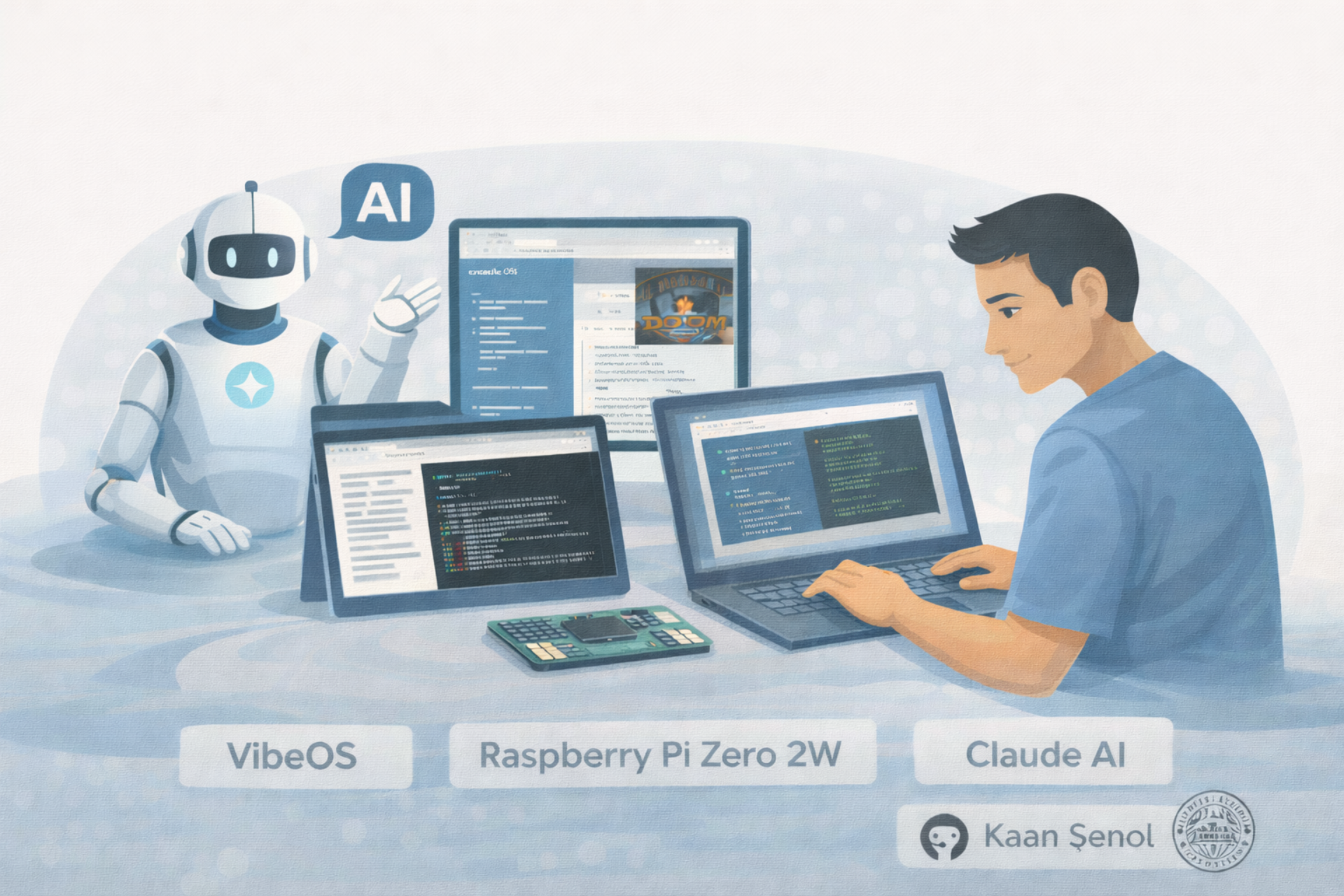
January 20, 2026 A computer engineering student has built a working operating system that boots on real ARM hardware using Anthropic’s latest Claude model to generate nearly all of the code. The experimental project, called VibeOS, runs on both QEMU emulation and a Raspberry Pi Zero 2W, and was developed by Kaan Şenol, a student at the Polytechnic University of Turin.
Despite being created in just a few weeks, the system includes a graphical interface, a web browser, a C compiler and Python support among others. “VibeOS runs in QEMU aarch64 and Raspberry Pi Zero 2W. It browses the web, runs Doom, and has a C compiler and Python,” Şenol explained.
Şenol told MyBroadband that the entire operating system was produced through 64 documented sessions with Claude, using Anthropic’s paid Claude Max 5x plan and Google’s Gemini Pro, which was available to him for free as a student.
Those session logs, which are now stored in the VibeOS GitHub repository, were not originally planned. Claude automatically converted a running notes file, claude.md, into structured logs that recorded the evolution of the project. Unexpectedly, those logs became a tool in their own right.
The project sits at the edge of what is sometimes called “vibe coding,” a term coined by Andrej Karpathy to describe software development driven primarily by AI prompts rather than manual coding.
Under the strictest definition, vibe coding involves no direct code review or editing by the developer. As Şenol explained, “AI is not that good. But still, I don’t know systems development and I did not write any code at all. It was mostly breaking things up into smaller steps for Claude.”
One of the more unusual lessons from the experiment was that large language models appear to perform better when they are, in a sense, encouraged. Şenol described deliberately having Claude reread prior work at the start of each session to keep it aligned and confident. That approach, he believes, prevented the model from slipping into what he called “demo mode.”
While VibeOS works, it comes with serious limitations. Networking only functions under emulation, there is no memory protection and any application can freely access system resources. The browser can display plaintext pages but modern websites routinely crash the OS. Debugging also required creative tooling.
Despite the flaws, the scope of the finished system surprised even its creator. “Currently, it has a bunch of coreutils, Python, a browser made in Python, a C compiler, a code editor, Doom, an image viewer, and a music player,” Şenol said.
Şenol says he doesn’t plan to continue developing VibeOS. However, he believes the project offers a realistic picture of what agentic coding tools can and cannot do today.