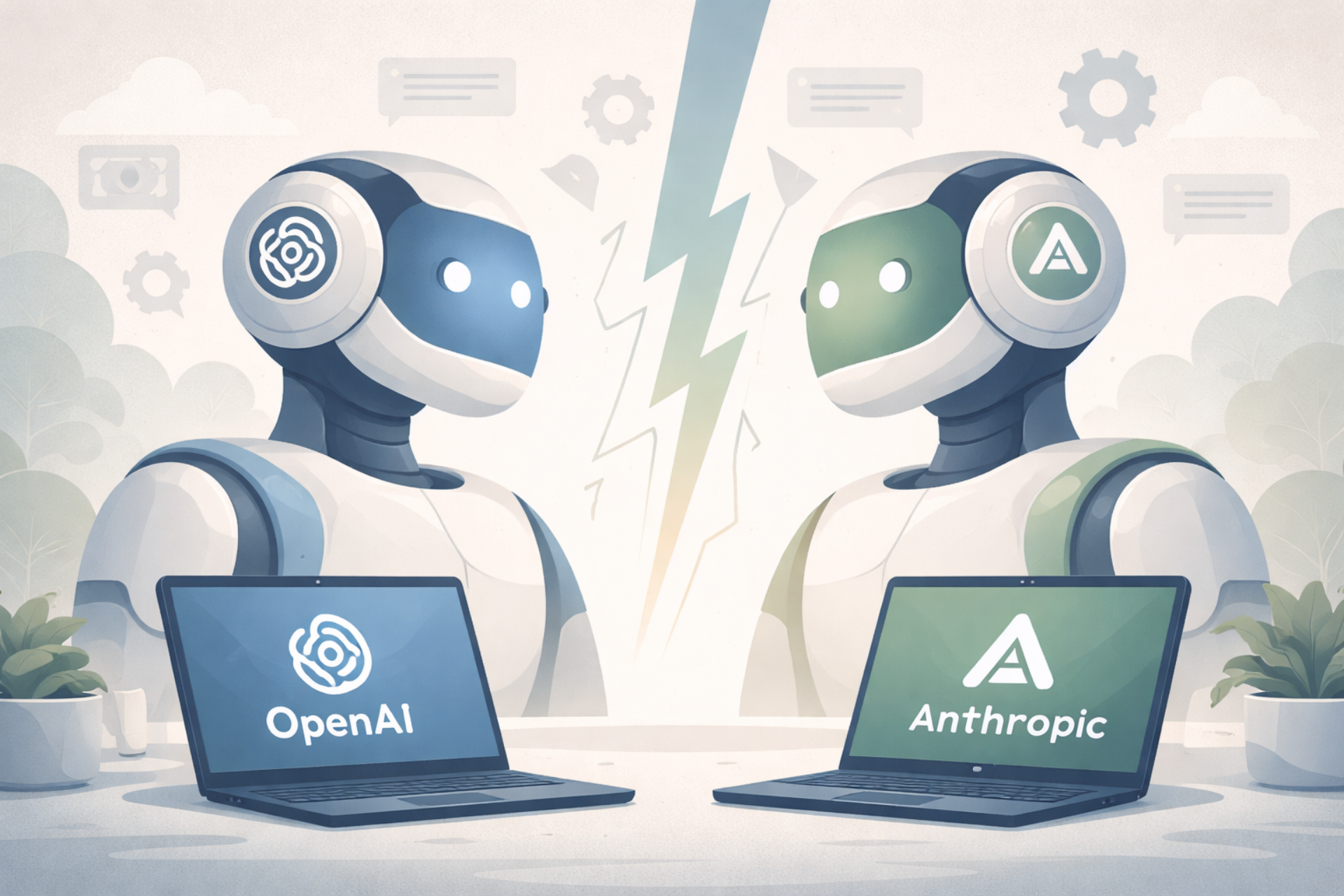
February 6, 2026 The competition between OpenAI and Anthropic intensified this week after both companies unveiled new artificial intelligence models on the same day. Anthropic launched Anthropic’s Claude Opus 4.6, while OpenAI released GPT-5.3-Codex, with each positioning its model as a leap forward in agent-based coding and long-running work tasks.
The near-simultaneous releases highlighted how closely matched the two rivals have become as AI development shifts from chatbots toward systems that can plan, reason and act autonomously over extended periods.
Anthropic said Claude Opus 4.6 improves significantly on its predecessor’s coding abilities, allowing it to work more reliably across large codebases, sustain agentic tasks for longer and better detect and correct its own errors. For the first time in Anthropic’s Opus line, the model also introduces a one-million-token context window in beta, enabling it to process and retain far larger volumes of information in a single session.
Beyond software development, Anthropic said the model can handle complex financial analysis, research and document creation, particularly within its Cowork environment, where Claude is designed to manage multiple tasks autonomously.
The company said Opus 4.6 achieved top scores on several industry benchmarks, including Terminal-Bench 2.0 for agentic coding and Humanity’s Last Exam, a multidisciplinary reasoning test. Anthropic also said the model outperformed competing systems on evaluations tied to economically valuable knowledge work.
OpenAI, meanwhile, framed GPT-5.3-Codex as its most capable coding-focused agent to date. The model builds on earlier GPT-5.2 Codex releases, combining advanced programming skills with broader reasoning and professional knowledge. OpenAI said this allows the system to take on long-running tasks involving research, tool use and complex execution, while still letting users guide its work without losing context.
The release was accompanied by a new standalone Codex desktop app aimed at streamlining AI-assisted coding workflows. OpenAI said the model is faster and more resource-efficient than previous versions. The company also said the model can manage sophisticated programming tasks through plain-language instructions.
OpenAI chief executive Sam Altman said developers are increasingly shifting toward workflows in which they oversee teams of AI agents rather than writing every instruction themselves, a trend both companies are now racing to support.
Safety featured prominently in OpenAI’s announcement. The company said GPT-5.3-Codex is being deployed with heightened safeguards under its preparedness framework, including precautions related to cybersecurity capabilities, even as it stops short of classifying the model as fully high-risk.
Anthropic, for its part, said Claude Opus 4.6 maintains a safety profile on par with or better than other frontier models, with low rates of misaligned behaviour across evaluations.
The rivalry between the two firms dates back to 2021, when a group of former OpenAI researchers left to form Anthropic with a focus on building more controlled and safety-oriented AI systems. That philosophical split has increasingly played out in public messaging as well as product design.
This week’s launches came after Anthropic rolled out advertisements positioning Claude as ad-free, a contrast to OpenAI’s recent move to introduce advertising for free ChatGPT users. Altman has defended the decision against arguments that blending ads into answers would undermine trust. According to him, ads will be clearly labelled and will not influence ChatGPT’s responses.