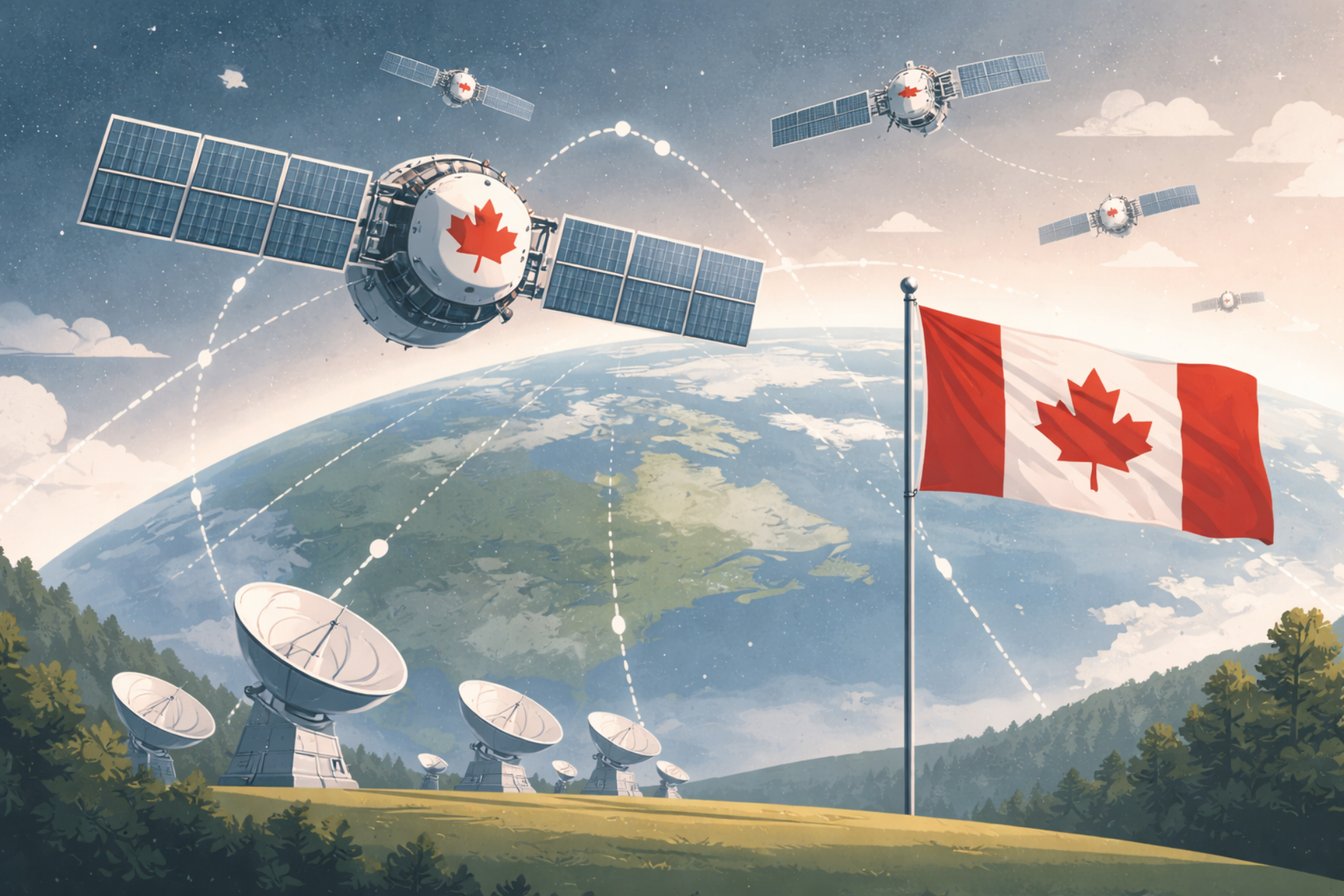
March 10, 2026 Canada is moving forward with a domestically built low-Earth-orbit (LEO) satellite network that Prime Minister Mark Carney says will be critical for national security and communications infrastructure. The system, expected to launch next year, is designed to provide secure global connectivity while reducing reliance on foreign satellite providers such as Elon Musk’s Starlink.
Speaking to Australia’s parliament, Carney said satellite communications have become essential to modern defence and emergency response. “Satellite communications are now a fundamental requirement for security and strategic autonomy,” he said, adding that Canada is working with international partners to develop “a deep and resilient system we can all share and control in our own territories.”
The network referenced by Carney is Telesat Lightspeed, a planned constellation of nearly 200 LEO satellites. The project received a $2.14-billion federal loan in 2024 aimed at expanding internet and 5G access across Canada, including in remote and Indigenous communities that currently lack reliable connectivity.
Much of that connectivity gap has been filled in recent years by Starlink, which operates thousands of satellites at roughly 600 kilometres above Earth and has become one of the largest internet providers in Canada. According to a 2025 report from the Global Media and Internet Concentration Project, Starlink is currently the sixth-largest internet provider in the country.
Telesat’s approach differs from many existing LEO networks. Its satellites are planned to operate at about 1,300 kilometres in altitude, a design intended to reduce congestion in increasingly crowded low-Earth orbit while maintaining high-speed communications coverage.
Researchers say sovereign satellite capacity is becoming strategically important as governments look to secure communications infrastructure. Susan Skone, a satellite technology researcher at the University of Calgary, said countries are racing to develop their own LEO constellations.
“It’s great, frankly, that Canada is being assertive about having our own capabilities … because what’s not great is if somebody from another country can turn that (network) off at will, and we don’t control it,” she said.
The strategic interest reflects lessons from recent geopolitical tensions. Carney referenced restrictions placed on Ukraine’s military use of Starlink during its war with Russia, highlighting the risks of relying on privately controlled satellite networks.
For now, Starlink remains a primary connectivity option for remote regions across Canada. Experts note that until the Lightspeed network becomes operational, it remains the most practical solution for delivering broadband to many rural and northern communities.