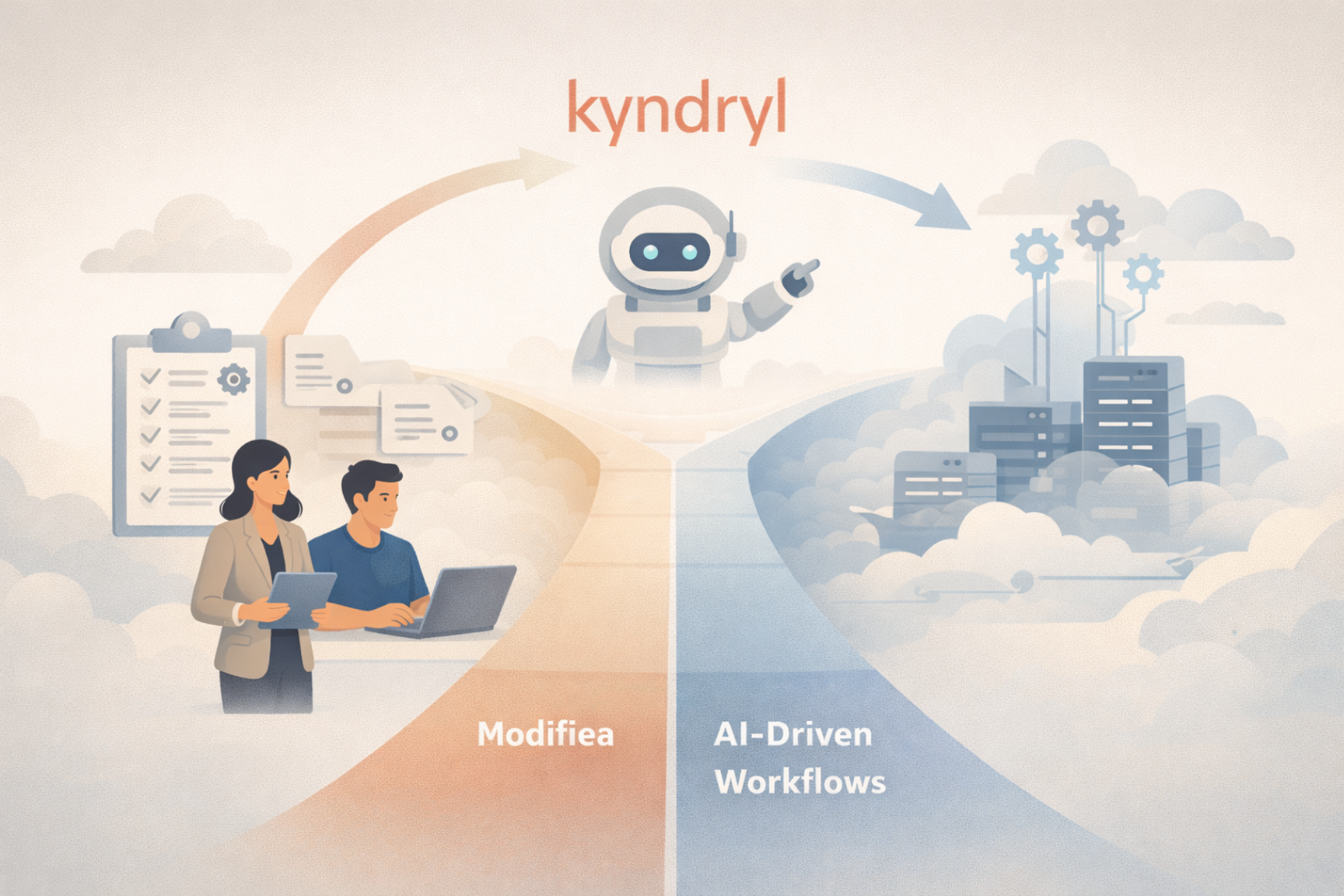
April 9, 2026 Kyndryl has introduced a new Agentic Service Management offering designed to help enterprises transition from traditional IT service operations to autonomous, AI-driven workflows. The framework combines structured assessments, governance models and implementation blueprints, as many organisations struggle to turn heavy AI investments into measurable outcomes.
The launch directly targets a growing mismatch between AI capability and enterprise readiness. According to Kyndryl’s Readiness Report, more than two-thirds of organisations are investing significantly in AI, yet nearly half fail to achieve meaningful returns because their workflows, governance and operational controls remain rooted in pre-AI systems.
At the centre of the issue is how enterprise IT environments are built. Most systems were designed for human-led processes – tickets, manual approvals and tool-based operations – not for autonomous agents executing tasks across hybrid and multi-cloud infrastructure.
“Most enterprise environments were built for people running tickets and tools, not for fleets of autonomous agents executing tasks across hybrid and multi-cloud estates — and this mismatch is limiting AI from moving out of pilots to outcomes,” said Kris Lovejoy, Global Head of Strategy at Kyndryl.
Kyndryl’s Agentic Service Management aims to close that gap by introducing a structured maturity model. Delivered through Kyndryl Consult, the assessment evaluates an organisation’s current state across service management, AI governance, security and operations. It benchmarks existing policies, controls and workflows against emerging industry standards, including ISO 42001, to determine readiness for agentic AI environments.
The output is a tailored gap analysis and phased roadmap that helps organisations adopt agentic IT service management in stages. The framework emphasises that while AI agents can operate autonomously, human oversight remains essential for governance, risk management and service accountability. The goal is to enable autonomy where appropriate without removing control.
To support this, Kyndryl is also offering Agentic AI Digital Trust as a standalone service. This component focuses on governance and risk reduction, providing a security-first framework for managing how AI agents behave in production environments. It is particularly aimed at regulated industries, where compliance, data classification and protection requirements are critical barriers to scaling AI systems.
The company positions this dual approach of maturity assessment plus governance layer as necessary to move enterprises beyond experimentation. While AI models are advancing rapidly, the surrounding infrastructure often cannot support them reliably, creating a bottleneck that prevents real-world deployment at scale.
Kyndryl’s strategy is also informed by its own internal operations. The company is applying Agentic Service Management within its service delivery systems, integrating these capabilities into its Kyndryl Bridge platform. This builds on an existing automation foundation that already executes nearly 200 million automated actions each month through more than 8,000 certified playbooks.
These internal deployments are intended to demonstrate how agentic AI can enhance operational intelligence while still keeping humans in the loop for decision-making and oversight across mission-critical systems.
Kyndryl, which provides advisory, implementation and managed services to thousands of customers in more than 60 countries, is positioning this framework as a way to standardise that transition. Rather than treating agentic AI as an experimental layer on top of existing systems, the company is framing it as an operational transformation that requires new controls, repeatable practices and measurable stages of adoption.