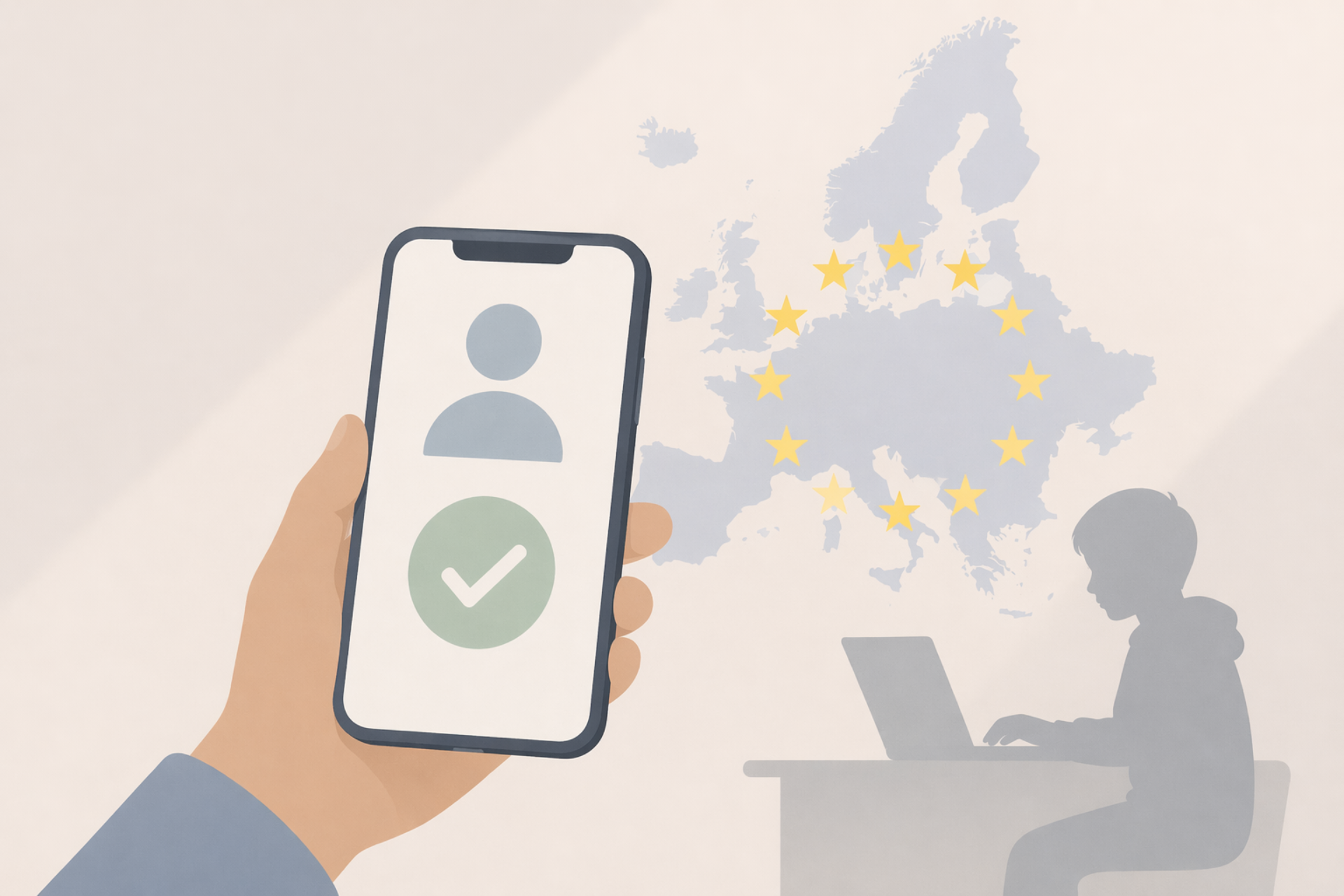
April 16, 2026 The European Union said it will soon roll out a bloc-wide age-verification app designed to confirm users’ ages when accessing online services. The system is positioned as a foundation for enforcing stricter protections for minors online, including potential restrictions on social media access.
European Commission President Ursula von der Leyen said the app is technically ready and will allow users to prove their age in a similar way to presenting identification for age-restricted purchases. “This app will allow users to prove their age when accessing online platforms, just like shops ask for proof of age for people buying alcoholic beverages,” she said at a press conference.
The rollout is part of a broader regulatory push across Europe to tighten controls on how minors use digital platforms. Von der Leyen confirmed that countries including Ireland, Spain, France, Cyprus, Denmark, Greece and Italy are already planning to adopt the system, alongside a coordinated effort to deliver EU-wide recommendations on children’s online safety by the summer.
The initiative reflects growing global momentum around age restrictions on social media. A landmark Australian law that came into force in December 2025 effectively barred users under 16 from accessing such platforms, and at least 15 European governments have introduced or proposed similar measures. The EU’s approach aims to standardise enforcement across member states rather than relying on fragmented national systems.
Privacy concerns remain central to the debate. Critics argue that mandatory age verification could evolve into large-scale surveillance infrastructure, particularly if sensitive identity data is stored or reused. EU officials say the app will be “completely anonymized” and built using the same privacy-preserving principles as the bloc’s COVID-19 digital certificate system, which later informed similar frameworks globally.
The Commission has also signalled that compliance will be enforced. “Online platforms can easily rely on our age verification app, so there are no more excuses,” von der Leyen said, adding that the EU would take a strict approach to companies that fail to meet its standards for protecting children.
The implications extend beyond Europe. Past EU regulations, including cookie consent rules, have influenced global platform design as companies opt to apply a single standard across regions. In the United States, federal regulation remains less coordinated, but individual states such as California, Utah, Louisiana and Texas have introduced laws requiring age checks at the device or platform level.
At the same time, legal pressure on social media companies is increasing. Recent U.S. court rulings have held platforms accountable for harms affecting minors, including exposure to predators and the impact of addictive design features.
The EU’s age-verification system adds a new layer to that evolving landscape, placing enforcement responsibility not only on platforms but also on shared infrastructure designed to standardise how age is verified across digital services.