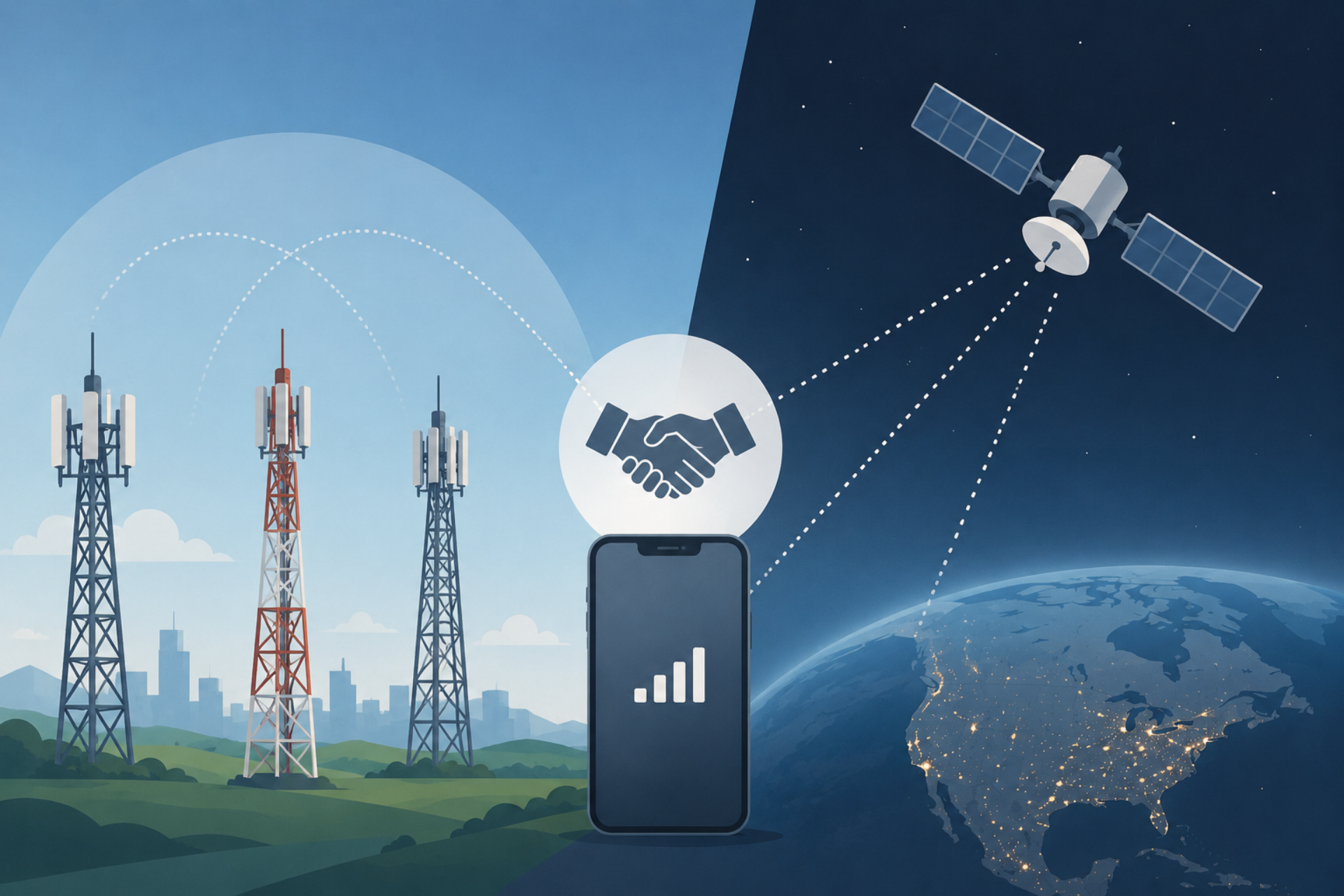
May 19, 2026 America’s three largest wireless carriers, AT&T, T-Mobile and Verizon, have agreed in principle to form a joint venture aimed at expanding satellite-based direct-to-device connectivity across the United States. The move is widely seen as a direct response to SpaceX and its rapidly growing Starlink Mobile service.
The proposed alliance would pool spectrum resources from the three carriers to accelerate deployment of direct-to-device (D2D) technology, which allows standard smartphones to connect directly to satellites without requiring additional hardware. In effect, satellites would function like cell towers in orbit, extending coverage beyond traditional network limits.
The timing of the announcement has drawn attention across the industry. SpaceX has been steadily building momentum in the satellite-to-phone space, launching its Starlink Mobile service commercially in July 2025 through a partnership with T-Mobile. The service initially focused on messaging before expanding toward broadband data capabilities.
SpaceX further strengthened its position by securing access to wireless spectrum through a $17 billion deal with EchoStar, enabling faster satellite-to-phone connectivity. Its next-generation Starlink V2 satellites are expected to significantly increase performance, delivering up to 100 times the data density of earlier systems, with custom silicon and phased array antennas boosting throughput.
The reaction from SpaceX was immediate. Company president and COO Gwynne Shotwell publicly framed the situation as a “David and Goliath” battle, suggesting the joint effort by the three carriers was a response to Starlink’s growing influence. SpaceX’s vice president of satellite policy, David Goldman, raised questions about whether such coordination between major carriers could trigger antitrust scrutiny.
Industry analysts have also questioned the substance behind the announcement. According to LightShed Partners, the agreement appears more symbolic than operational at this stage. The joint venture currently lacks a finalized structure, defined financial commitments or a deployment timeline, factors that could delay its ability to compete meaningfully.
The context surrounding the announcement adds to that skepticism. SpaceX is reportedly preparing for a potential public listing as early as June, targeting what could become one of the largest IPOs in history. Meanwhile, Starlink has already reached more than 9 million subscribers across 155 countries and secured 59 carrier partnerships globally.
These developments suggest that the competitive landscape is shifting quickly. While the carriers’ joint venture represents a coordinated attempt to respond, it is entering a market where Starlink has already established scale, partnerships, and technical momentum.
At its core, the battle is about control of the next layer of connectivity. Traditional telecom networks rely on ground-based infrastructure, while satellite-based systems promise broader coverage, especially in remote or underserved areas. Direct-to-device technology removes the need for specialized hardware, making it easier to integrate into existing consumer devices.