May 19, 2026
Linus Torvalds says AI bug reports are overwhelming Linux security efforts
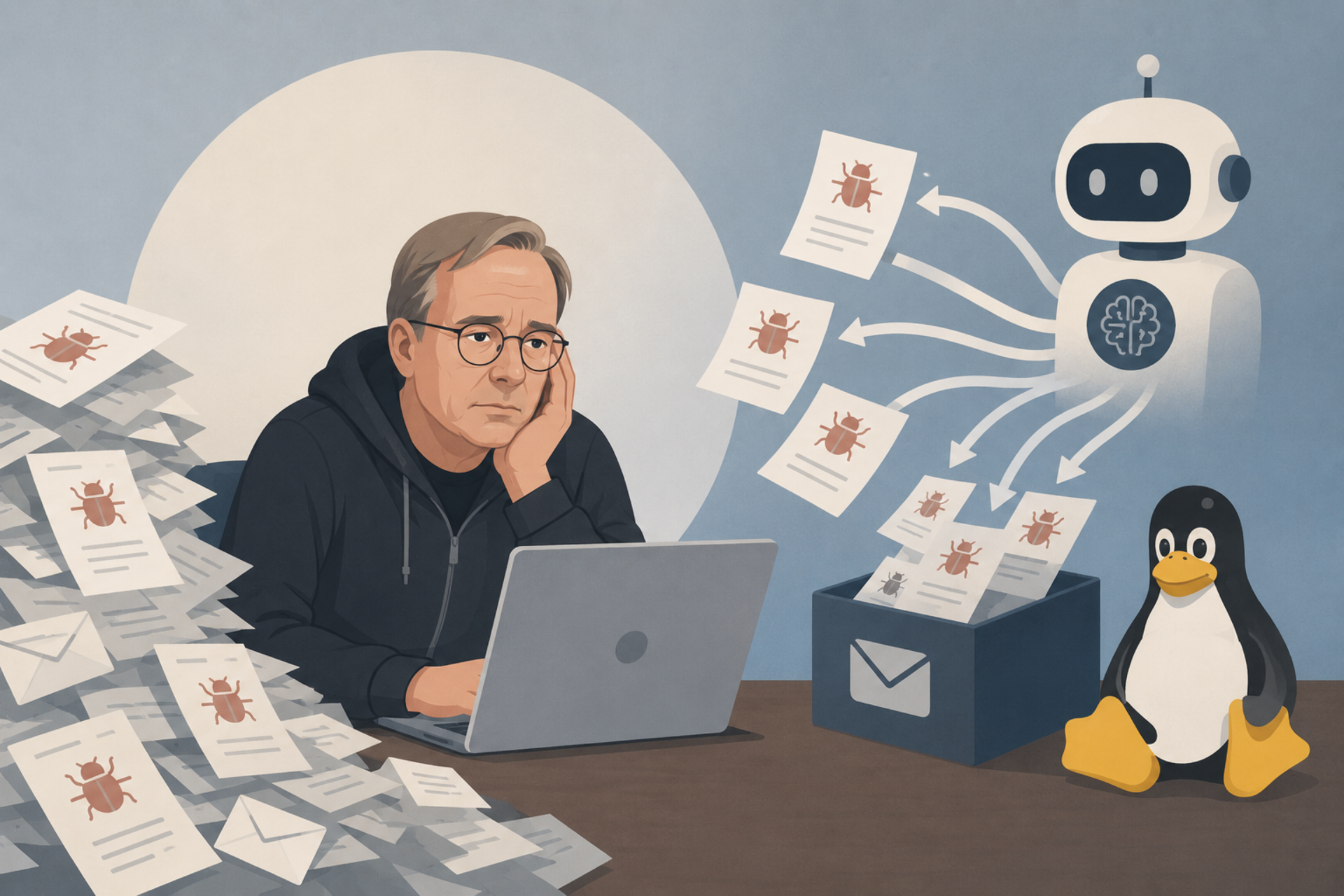
Linus kernel creator and lead developer Linus Torvalds says the Linux kernel’s security mailing list has become “almost entirely unmanageable” due to a surge of AI-generated bug reports flooding the system. The problem, he explained, is that multiple researchers using the same AI tools are submitting duplicate findings, overwhelming maintainers with repetitive reports.
Torvalds made the comments in his weekly kernel update while announcing release candidate four for Linux 7.1, which he described as progressing normally. But alongside the routine development update, he highlighted a growing operational issue: the sheer volume of AI-assisted submissions is creating more noise than value.
According to Torvalds, maintainers are now spending significant time triaging duplicate reports rather than addressing new issues. Much of the work involves redirecting submissions to the appropriate developers or pointing out that the reported bugs have already been fixed, sometimes weeks or months earlier. This constant back-and-forth, he suggested, is slowing down meaningful progress.
A key part of the problem is how these reports are being handled. Because the security mailing list is private, contributors cannot see what others have already submitted. That lack of visibility, combined with widespread use of similar AI tools, results in multiple people independently reporting the same issue without knowing it has already been addressed.
Torvalds described this cycle as “pointless churn,” arguing that it creates unnecessary overhead without improving software quality. In his view, AI-detected bugs are typically not sensitive or undiscovered in a meaningful sense, making their handling in a restricted channel inefficient.
Despite the criticism, Torvalds did not dismiss AI tools outright. He acknowledged their usefulness but emphasized that their value depends on how they are used. Simply generating and submitting raw findings, he argued, is not enough.
Instead, he urged contributors to go beyond automated detection. Developers who find bugs using AI should verify the issue, check existing discussions, and ideally provide a fix or patch. Without that additional effort, he suggested, such reports contribute little to the project.
His message to contributors was direct: adding value means understanding the code and the problem, not just passing along automated output. Reports that lack context or verification, he implied, create more work for maintainers rather than reducing it.
The comments show a broader tension within the open-source community as AI tools become more widely adopted. While they can accelerate bug discovery, they also introduce new challenges in coordination, duplication and signal-to-noise ratio.
Not everyone in the Linux ecosystem shares Torvalds’ concerns. Greg Kroah-Hartman, another prominent kernel maintainer, has recently described AI as increasingly useful for the free and open-source software community. His perspective suggests that, when used effectively, these tools can enhance development rather than hinder it.
Torvalds’ remarks, however, make clear that without disciplined usage, AI can create as many problems as it solves.