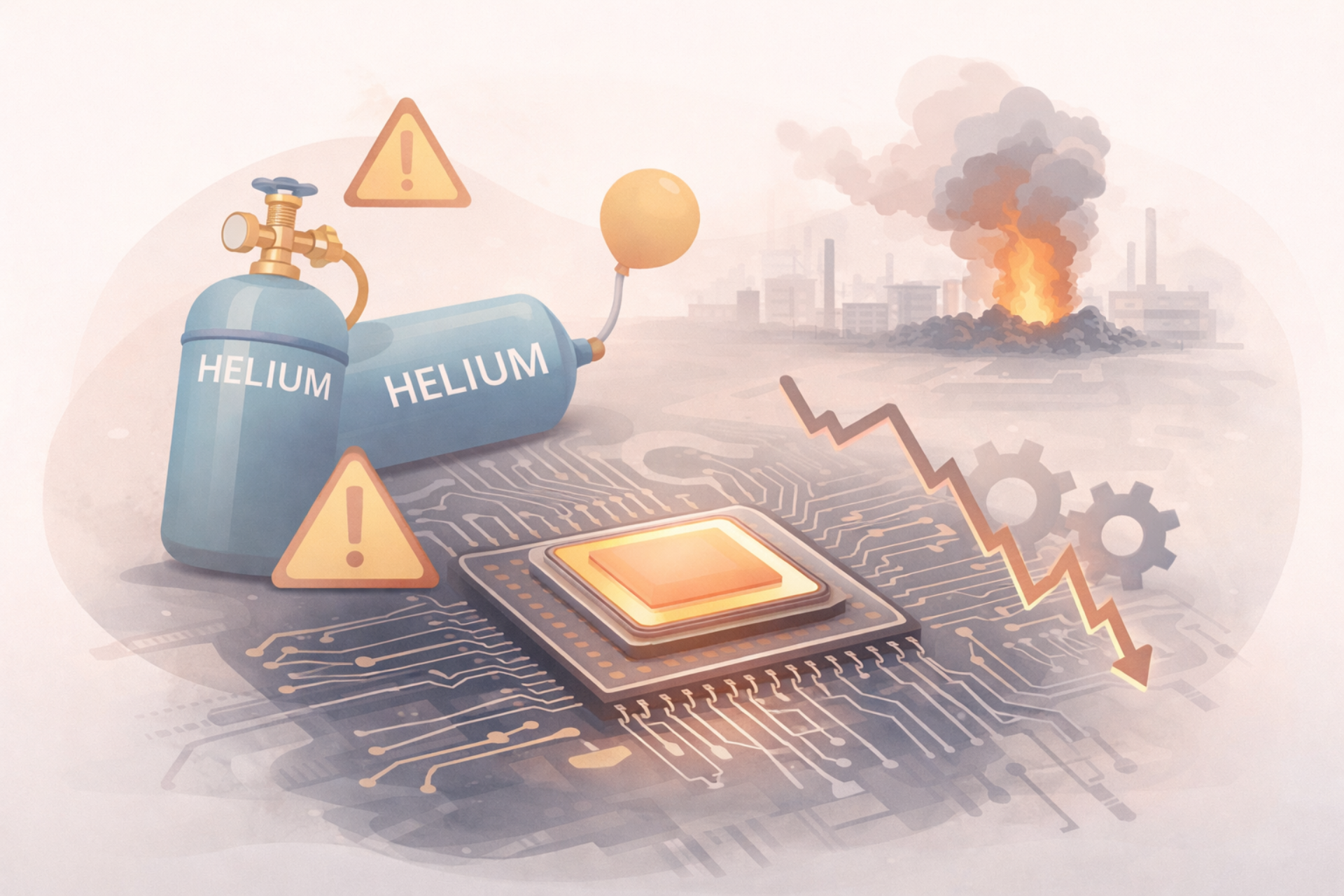
March 30, 2026 A major helium production facility in Qatar responsible for roughly one-third of global supply has been offline for nearly two weeks following damage during the US–Iran conflict. The disruption matters because helium is a critical, non-substitutable input in semiconductor manufacturing, raising the risk of slower chip production just as AI infrastructure demand is surging.
Early indications suggest repairs could take months, with some estimates extending significantly longer depending on damage to the Ras Laffan complex. The outage comes as global chip supply is already tight, and as hyperscalers continue to invest heavily in AI data centres.
Helium plays a specialised but essential role in advanced chip fabrication. It is used as a coolant in extreme ultraviolet (EUV) lithography and to maintain ultra-high vacuum conditions required for precision manufacturing. Due to its atomic properties, there is no direct substitute that can perform the same functions at scale.
The supply chain offers limited flexibility. Liquid helium dissipates over time during transport, typically losing viability after 30 to 35 days, making stockpiling difficult. This creates a just-in-time system with minimal buffer, meaning even shipments already in transit may not fully offset the disruption.
The regional impact is concentrated but globally significant. Qatar supplies a large share of helium used in East Asia, including South Korea, where key semiconductor components are produced. Manufacturers such as memory suppliers and fabrication partners feeding into AI hardware ecosystems are therefore directly exposed to supply constraints.
While companies have not broadly signalled immediate shutdown risks, the more likely outcome is reduced throughput rather than full stoppage. Chip fabrication facilities are expected to continue operating, but potentially at lower capacity or with delays — a scenario that could tighten availability and increase costs across the supply chain.
The timing amplifies the impact. Demand for advanced chips is accelerating due to AI workloads, particularly for data centres and high-performance computing. Any constraint on inputs like helium introduces friction into a system already operating near capacity.
Pricing pressure is already emerging. Spot prices for helium have reportedly increased, and supply contracts are tightening. At the same time, energy costs linked to liquefied natural gas, often co-produced with helium, may also rise, adding further cost pressure to chip manufacturing in Asia and Europe.
The disruption also highlights structural dependencies in the semiconductor supply chain. Helium production is geographically concentrated, and scaling new supply is complex, requiring specialised infrastructure and high purity standards. Alternative sources exist but are limited in capacity and slow to qualify for industrial use.