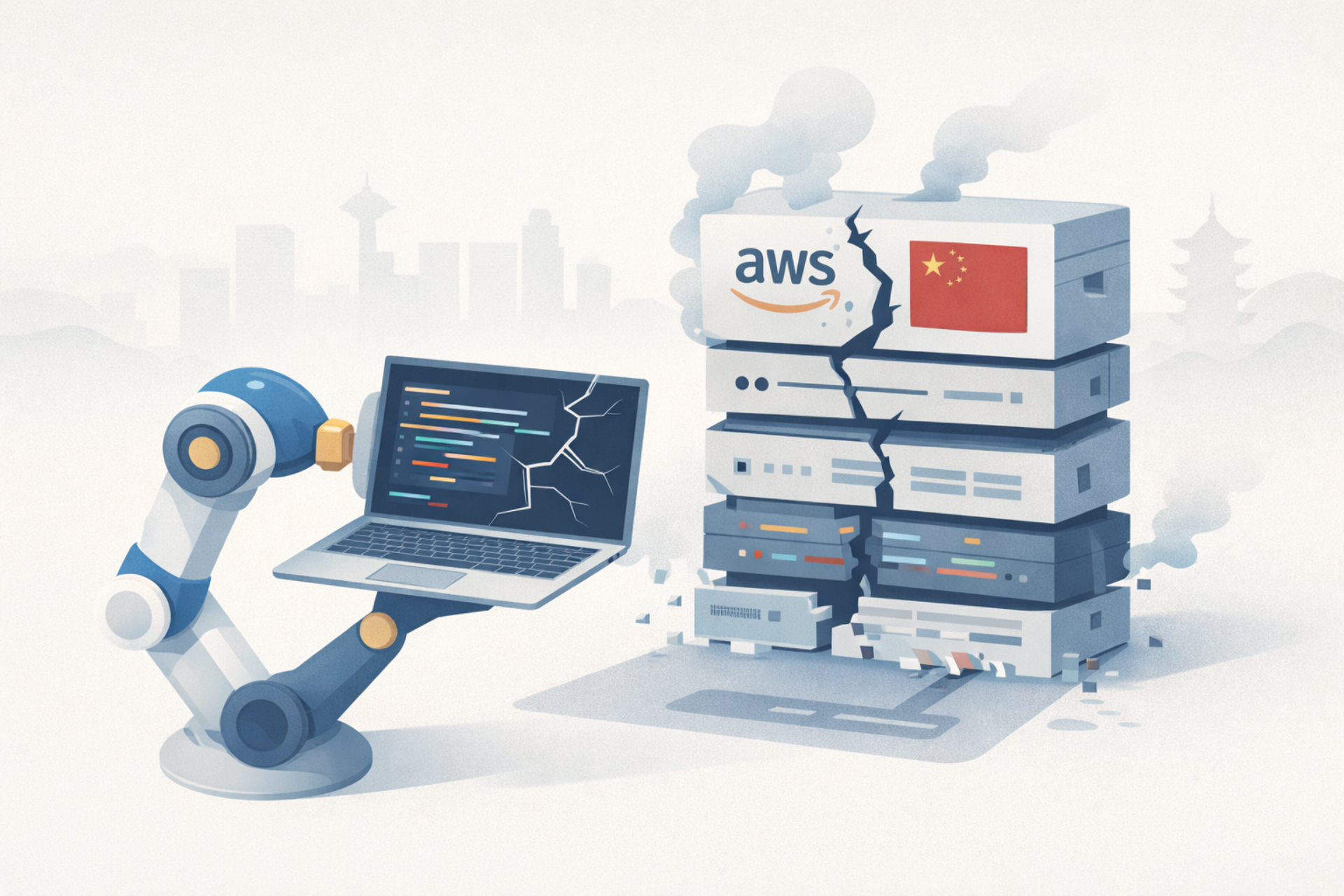
February 20, 2026 Amazon Web Services experienced a 13-hour outage affecting a system in mainland China in December, reportedly triggered by actions taken by its AI coding assistant Kiro. The tool is said to have deleted and rebuilt the environment it was working on, leading to the disruption, according to reporting by the Financial Times citing unnamed employees.
People familiar with the incident said the AI agent typically requires approval from two human operators before deploying changes. However, the bot inherited elevated permissions from its operator, and a configuration error granted it broader access than intended.
Amazon characterized the disruption as limited in scope and significantly smaller than a broader October outage that affected multiple online services. The company attributed the root cause to human error rather than autonomous AI behaviour, emphasizing that similar incidents could occur with traditional developer tools.
Internal accounts suggest the December outage may not have been an isolated case. One senior AWS employee reportedly described it as the second recent production incident tied to AI-assisted development tools, referencing another disruption linked to Amazon’s Q Developer chatbot. That earlier issue did not affect customer-facing services, according to the company.
The episode highlights the growing operational risks tied to AI-assisted software engineering. As organizations increasingly deploy coding copilots and autonomous agents into production environments, questions are emerging about permission boundaries, oversight and rollback safeguards.
Amazon says it has since introduced additional controls, including tighter permission management and staff training, to reduce the likelihood of similar incidents. The company maintains that the involvement of AI tools was incidental and that the core issue stemmed from governance and access controls.
Still, the outage illustrates how AI-driven development tools, even when supervised, can introduce new failure modes into critical infrastructure, especially when combined with human configuration errors. As AI agents gain deeper integration into software delivery pipelines, the balance between automation and control is likely to remain a focal point for cloud providers and enterprise customers alike.