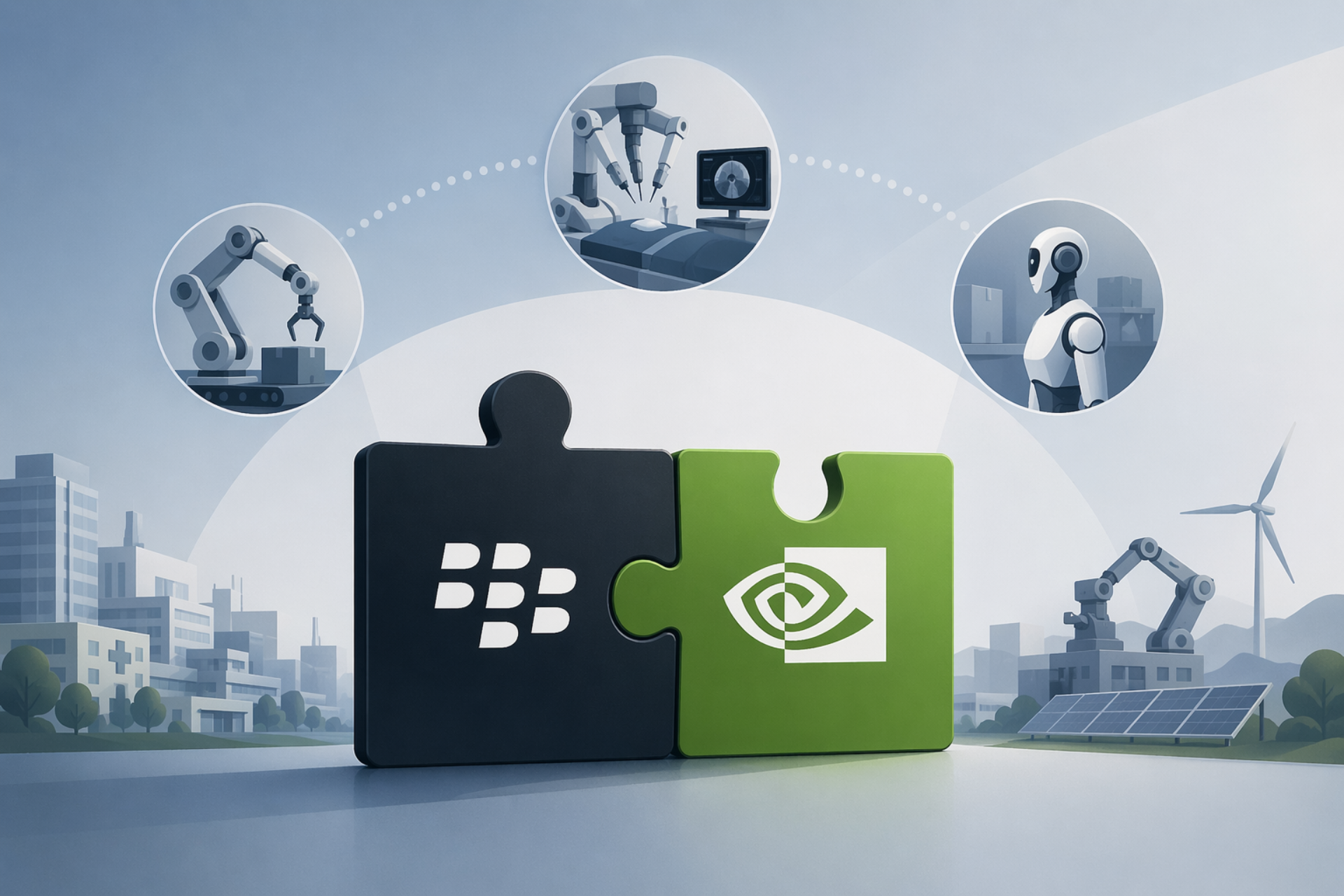
April 22, 2026 BlackBerry Ltd. shares rose 13 per cent after the company announced an expanded partnership with Nvidia to support AI development on Nvidia’s IGX Thor platform. The move positions BlackBerry deeper inside regulated, high-stakes AI environments such as robotics, medical systems and industrial automation.
The Waterloo, Ont.-based company said its QNX OS for Safety 8.0 will now integrate with Nvidia’s IGX Thor computing system, extending a partnership first formed in 2025 around autonomous driving. IGX Thor is designed for regulated environments, including autonomous and humanoid robotics, medical imaging and industrial automation, where certified software platforms are required.
BlackBerry’s QNX platform is a real-time operating system already deployed across vehicles, healthcare devices and industrial systems. The expanded collaboration shifts focus from automotive safety into broader “physical AI” applications, where AI systems operate directly in real-world environments. This includes use cases such as robotic surgery systems and automated manufacturing equipment.
Investor response has been immediate. Shares closed at $7.50, with additional gains after hours, extending a rally of roughly 75 per cent since early April. The company also disclosed a $950 million backlog in future royalty payments tied to QNX deployments, signalling sustained demand across mission-critical sectors.
The partnership also strengthens BlackBerry’s alignment with Nvidia’s AI hardware ecosystem, which continues to attract significant enterprise and investor interest. Nvidia’s GPUs underpin much of the current AI infrastructure stack, from data centres to edge computing systems, making integration with its platforms a strategic advantage.
However, questions remain around valuation and execution timelines. BlackBerry is trading at approximately 43 times projected earnings, a premium that reflects optimism around its AI positioning. At the same time, its Cylance cybersecurity division continues to show weakness, with net retention below 100 per cent, indicating contraction among existing customers.
There is also a timing mismatch. Physical AI deployments typically involve long development and certification cycles, meaning projects announced today may not generate meaningful revenue until 2028 or later. While the royalty backlog provides visibility into future income, it does not translate into immediate financial performance.
The partnership underscores BlackBerry’s transition from its legacy smartphone business to embedded software for regulated industries. It also reflects a broader shift in the AI market, where growth is moving beyond cloud-based models into physical systems that require specialised hardware and certified software layers.