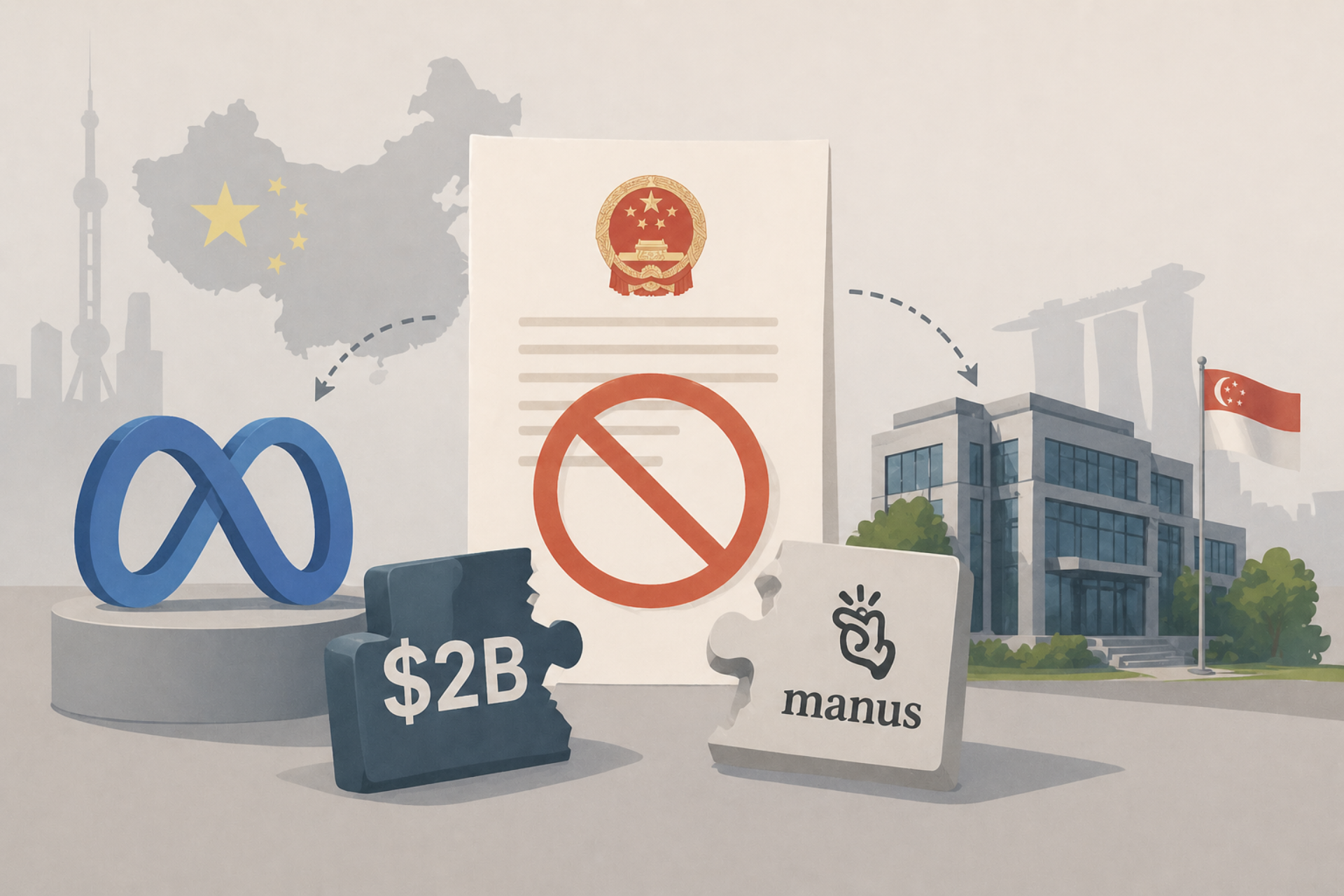
April 28, 2026 China’s top economic planner has ordered Meta to unwind its proposed $2 billion acquisition of AI startup Manus, halting a high-profile cross-border deal. The intervention signals tighter scrutiny over foreign investment in AI firms with Chinese origins, even when those companies relocate abroad.
The National Development and Reform Commission said the decision to prohibit the transaction was made in accordance with existing laws and regulations and instructed the parties to withdraw the deal. The move follows a separate review initiated earlier this year by China’s commerce authorities into compliance with rules governing export controls and overseas investment.
Manus, originally founded in China before relocating to Singapore, develops general-purpose AI agents capable of handling tasks such as market research, coding and data analysis. The company said it surpassed $100 million in annual recurring revenue within eight months of launching its first product, positioning itself among the fastest-growing AI startups. It previously raised $75 million in funding led by Benchmark.
Meta had framed the acquisition as a way to accelerate AI development across its consumer and enterprise offerings, including its Meta AI assistant. A company spokesperson said the transaction “complied fully with applicable law,” adding it expected “an appropriate resolution to the inquiry.”
The decision has drawn concern among founders and investors who have used relocation strategies – sometimes referred to as “Singapore-washing” – to position companies outside China while maintaining operational ties. The outcome suggests that geographic restructuring may not shield firms from regulatory oversight when sensitive technologies such as AI are involved.
Chinese officials did not provide detailed reasoning beyond legal compliance, but broader policy signals point to heightened attention on advanced technologies and cross-border ownership. APEC Senior Officials Meeting Chairman Chen Xu said it is “important that all parties act in a spirit of mutual benefit,” noting that proper handling of such issues could support broader regional discussions.