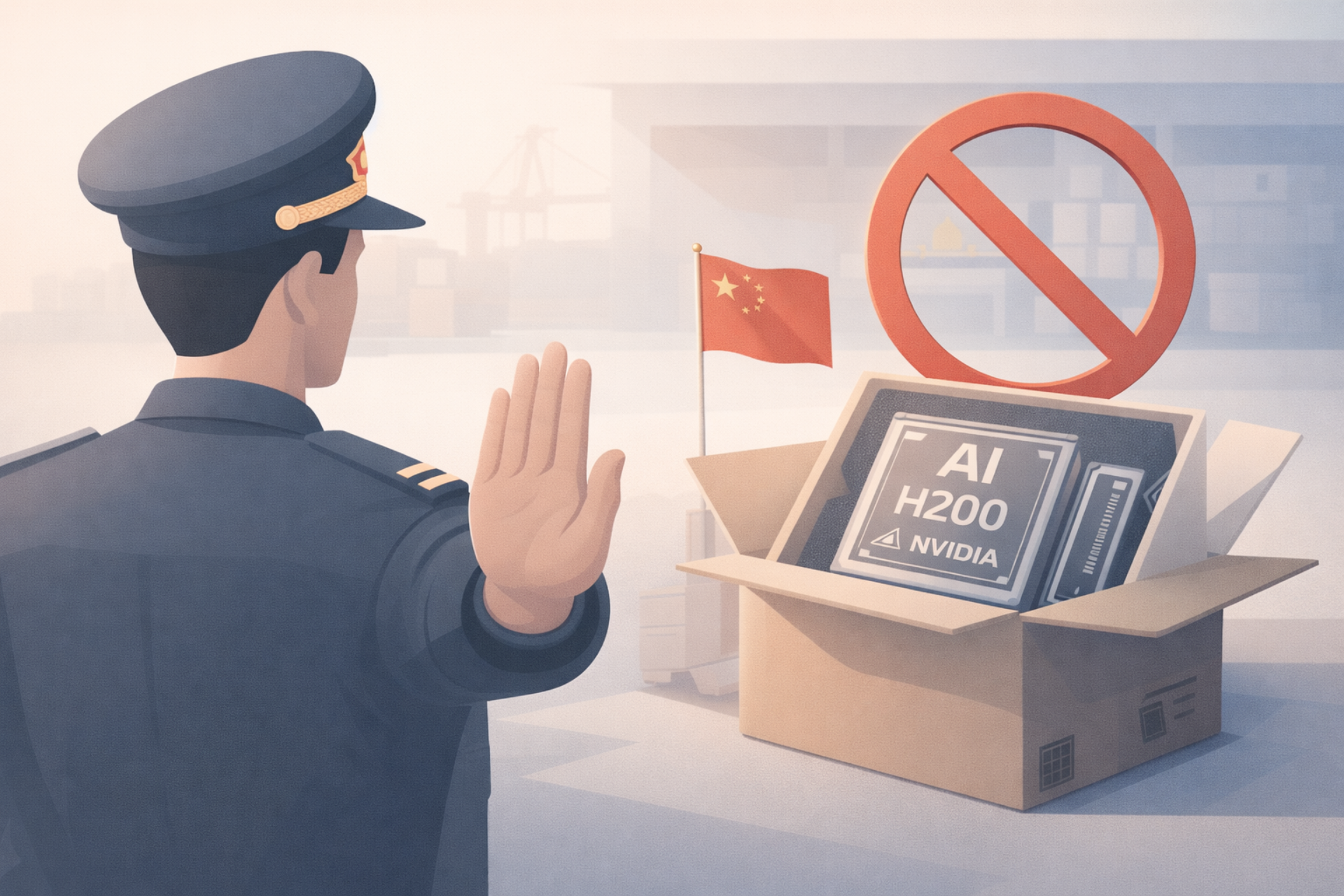
January 15, 2026 Chinese customs authorities have effectively barred Nvidia’s H200 artificial intelligence chips from entering the country, according to people familiar with the directive. The move comes just days after Washington approved exports of the chips under strict conditions, and as demand from Chinese firms continues to surge.
“The wording from the officials is so severe that it is basically a ban for now, though this might change in the future should things evolve,” one of the people briefed on the matter said.
According to multiple sources, Chinese customs officials this week instructed agents that the H200 chips, Nvidia’s second-most powerful AI accelerator, are not permitted to clear customs. Authorities have not provided a formal explanation, nor clarified whether the directive represents a permanent ban or a temporary hold. It also remains unclear whether the restriction applies to existing purchase orders or only to new shipments.
The development places Beijing at the center of a growing geopolitical tug-of-war over advanced AI hardware. The H200 was formally cleared for export to China by the Trump administration this week, albeit with conditions. This decision sparked pushback from U.S. lawmakers concerned about military and strategic uses of advanced AI. Now, China appears to be pulling in the opposite direction.
Analysts say the move may be less about technology policy and more about leverage. With U.S. President Donald Trump expected to visit Beijing in April for talks with President Xi Jinping, restrictions on H200 imports could be used as a bargaining chip in broader trade and technology negotiations.
There are signs the restriction may not be absolute. The Information reported that Chinese authorities have told some companies they may approve H200 purchases under limited circumstances, such as university-linked research and development projects. One source said exemptions for academic and R&D use are under discussion.
The stakes are high on both sides. The H200 delivers roughly six times the performance of the H20 chip, a weaker Nvidia processor that was previously caught in export control limbo. Last year, China quietly blocked H20 sales despite U.S. approval, prompting Nvidia CEO Jensen Huang to say the company’s AI chip market share in China had fallen to zero.
Chinese firms have since placed orders for more than two million H200 chips, each priced around $27,000, far more than Nvidia’s current inventory of roughly 700,000 units. While domestic alternatives such as Huawei’s Ascend 910C exist, the H200 remains significantly more efficient for training large-scale AI models.
From Washington’s perspective, allowing exports could generate billions in revenue and a 25 per cent fee for the U.S. government, while potentially slowing China’s push to develop homegrown alternatives. Beijing, however, appears unconvinced.