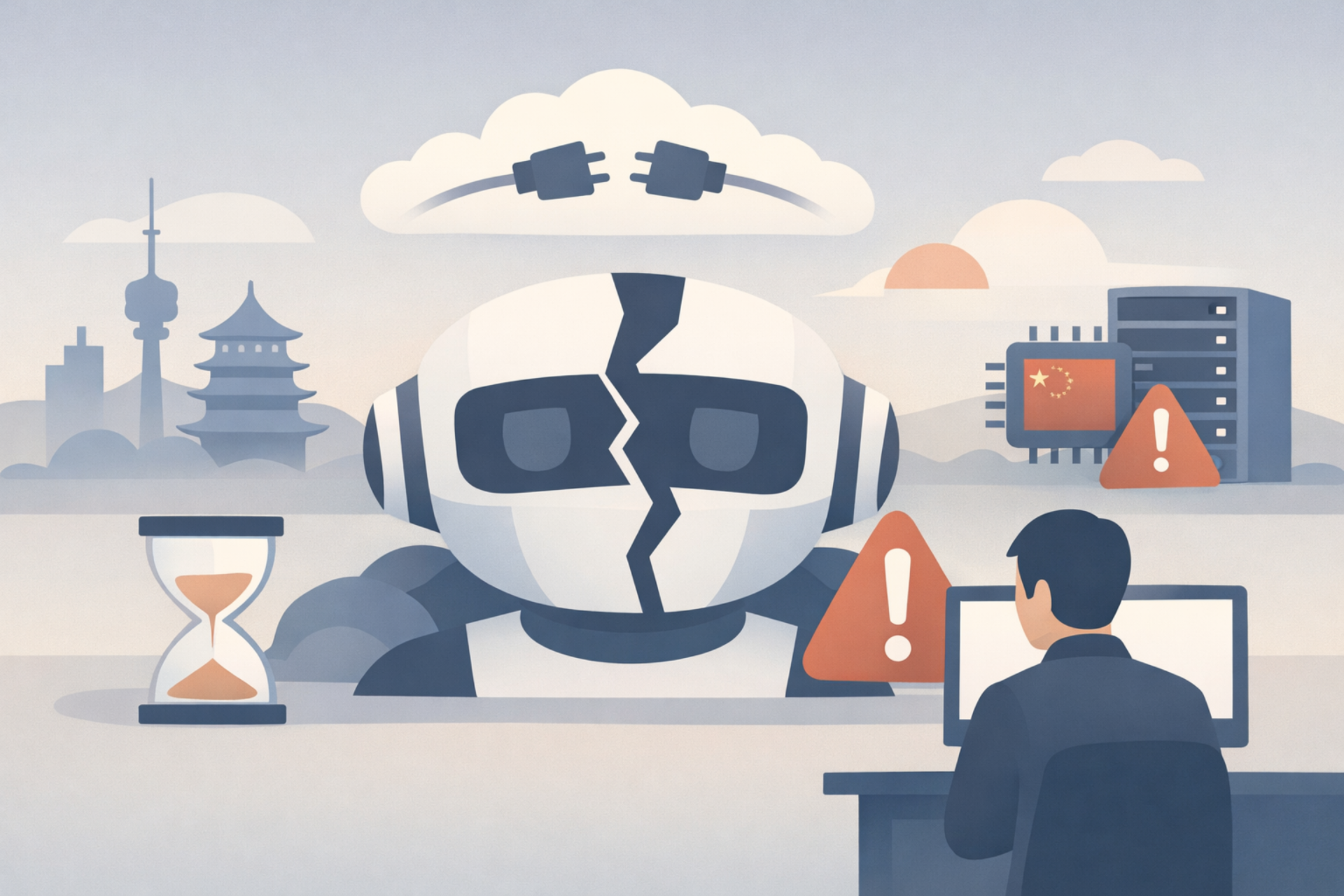
March 31, 2026 In what would be its longest public-facing outage to date, China’s DeepSeek chatbot went offline for more than seven hours on Monday. The disruption comes as the company prepares its next-generation model and positions itself as a serious challenger to US AI firms.
The company confirmed a “major outage” lasting 7 hours and 13 minutes, with services restored at 10:33am local time. No cause was provided, consistent with its standard incident reporting approach.
This is the first time DeepSeek’s main user-facing platform has experienced a disruption of this scale. Previous outages had primarily affected its API services, particularly during peak demand periods earlier in 2025, but had not exceeded two hours on the public interface.
The timing of this is notable, as DeepSeek is expected to release a new V4 model with multimodal capabilities, including text, image, and video generation. At the same time, the company has reportedly shifted its hardware alignment strategy, choosing to work with domestic suppliers like Huawei rather than sharing models with US chipmakers such as Nvidia.
That marks a departure from standard industry practice, where model developers typically collaborate closely with hardware providers to optimise performance. The approach aligns with efforts to reduce reliance on US technology infrastructure.
DeepSeek’s rise has already had measurable impact. Its R1 model, released in early 2025, demonstrated performance comparable to leading US systems while being free and open-source, triggering significant market reactions across major tech firms.
The latest outage introduces a different pressure point. As AI platforms scale globally, reliability becomes as critical as capability, particularly for developers and enterprises integrating these systems into production workflows.