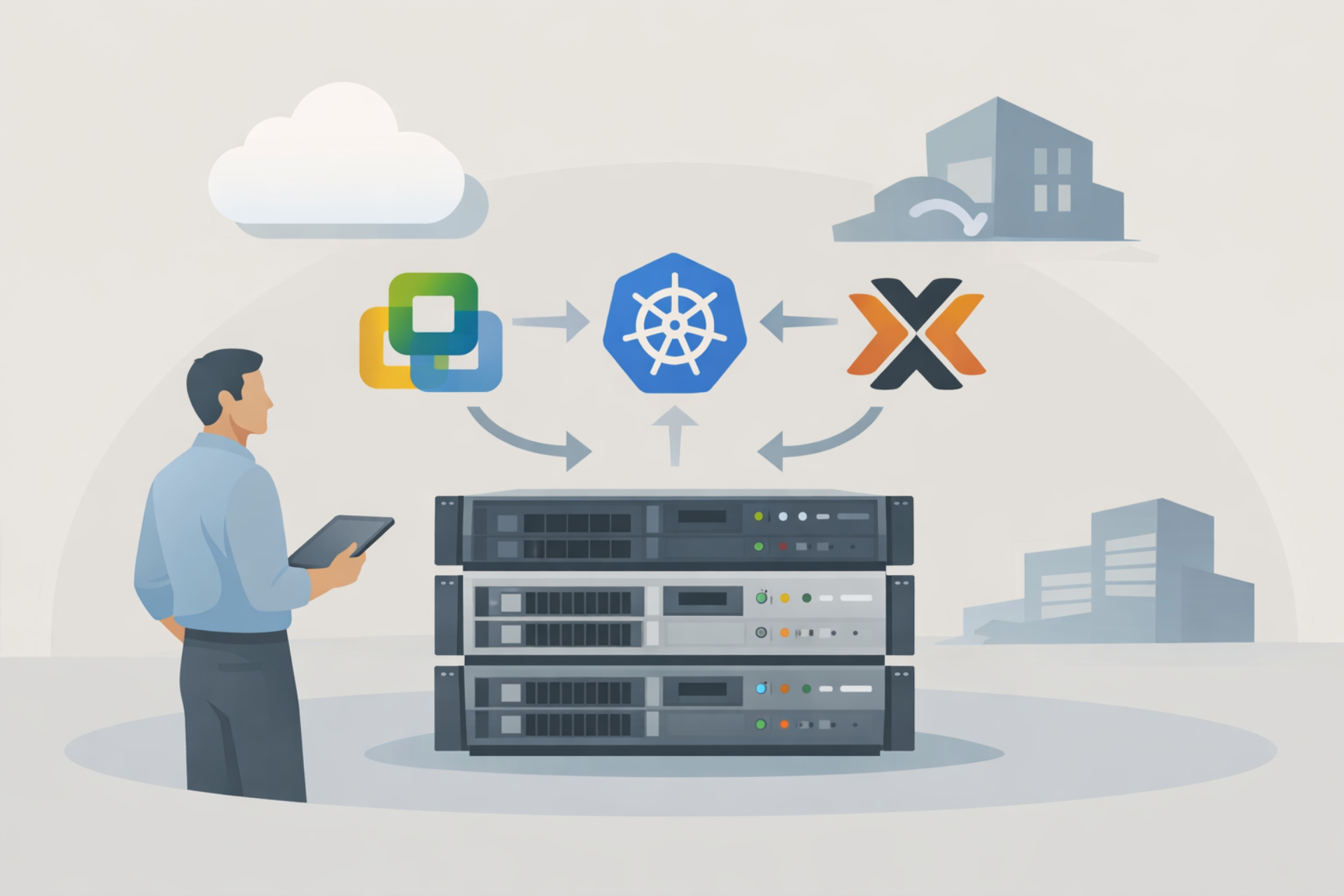
January 14, 2026 Lenovo is repositioning itself for a world where enterprise customers no longer want to be locked into a single virtualization platform. As organizations reassess their dependence on VMware and experiment with cloud repatriation, the hardware giant has introduced a new class of hyperconverged systems designed to support multiple hypervisors on the same infrastructure.
According to Kumar Mitra, executive director at Lenovo Infrastructure Solutions Group for Central Asia Pacific and Australia and New Zealand, customers are increasingly looking for optionality rather than allegiance to a single virtualization stack.
“A lot of customers are looking for a pathway to move off the VMware platform,” Mitra told The Register. “What we are seeing is customers are now open to doing more pilots, more proof of concepts.”
Traditionally, Lenovo has sold tightly tuned appliances built around specific software ecosystems. Its HX series targets Nutanix, VX is optimized for VMware, and MX is aligned with Microsoft Azure Local. But Mitra said customers increasingly want infrastructure that does not dictate their software choices.
“FX is a pretty emphatic proposition for proof-of-concept projects because it can handle multiple hyperconverged platforms,” he said. “We have unlocked the hardware and made it more open.”
The timing is notable. Since Broadcom’s acquisition of VMware, the virtualization giant has consolidated its offerings around VMware Cloud Foundation, a full-stack private cloud bundle. While Broadcom argues the platform delivers efficiency and long-term savings, many customers say it includes features they don’t need and carries higher costs.
Even so, Mitra acknowledged that leaving VMware is rarely straightforward. Independent analyst Michael Warrilow echoed that assessment, noting that most large VMware migration projects made only limited progress in 2025. He argues that enterprises should assume multi-hypervisor environments will become the norm, even if meaningful benefits take years to materialize.
Warrilow sees two realistic paths forward: invest heavily in preparing for a multi-hypervisor environment or accept Cloud Foundation for now while quietly reducing exposure. As a tactical step, he suggests starting with development environments, which can represent a significant share of licensing costs and provide a low-risk testing ground for future architectures.
Lenovo appears to be aiming the FX systems squarely at those transitional use cases. Beyond hypervisor flexibility, the appliances feature liquid cooling, signaling readiness for AI and high-density workloads, areas where enterprises are increasingly directing investment.
Warrilow argues that AI adoption itself may eventually reduce reliance on traditional virtualization models, particularly as workloads diversify across containers, virtual machines, and bare metal.