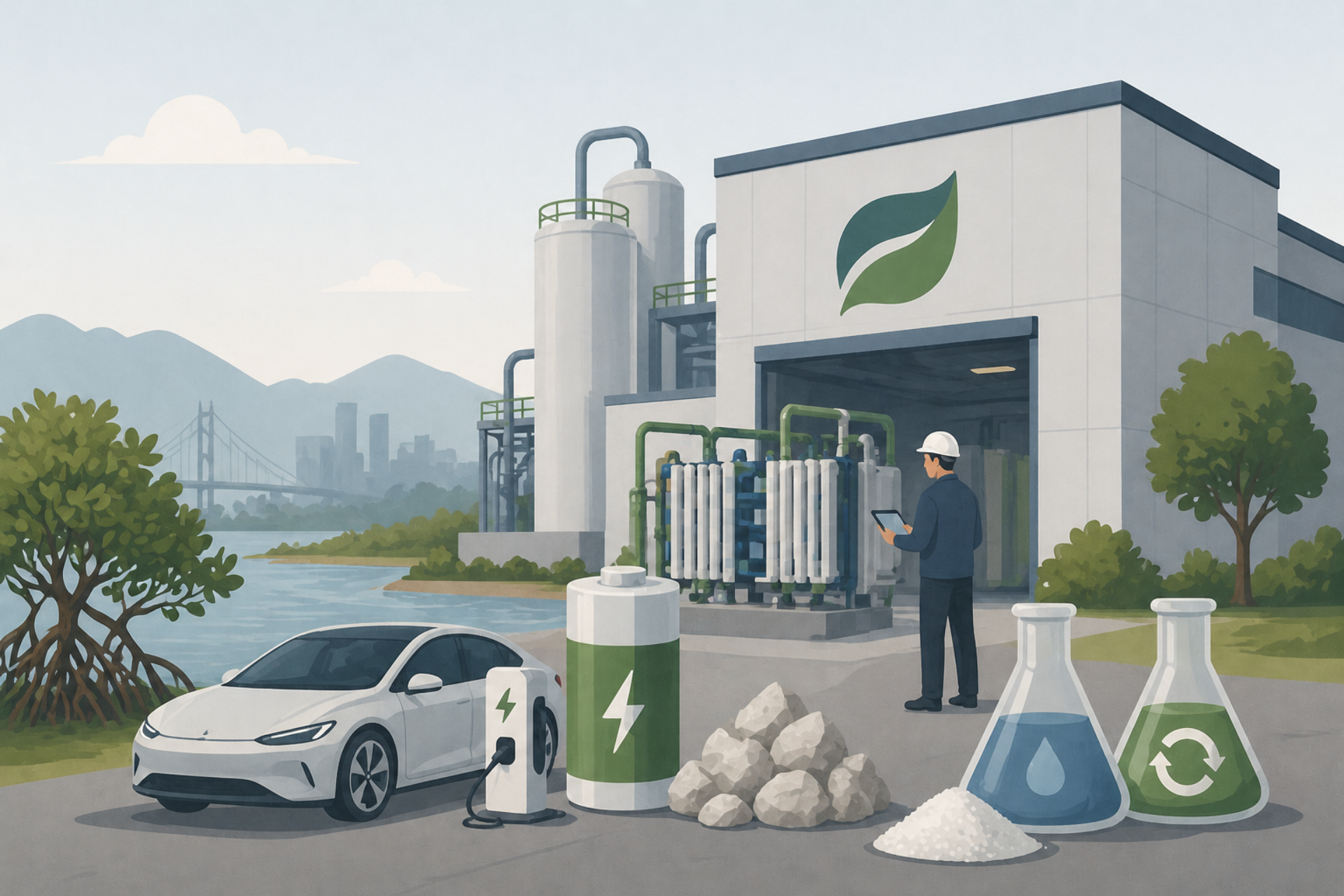
April 28, 2026 Mangrove Lithium has opened a new headquarters and commercial production facility in Delta, B.C., capable of producing 1,100 tonnes of battery-grade lithium per year using a new refining process. The site serves as a proof-of-concept for its Clear-Li technology, which aims to reduce waste and carbon emissions compared to conventional lithium processing.
The facility, launched April 16 near Vancouver, produces lithium hydroxide suitable for electric vehicle batteries and could supply material for roughly 25,000 EVs annually. While modest relative to overall EV production volumes, the output exceeds that of many pilot-scale operations and recycling facilities currently operating in North America.
Traditional lithium refining relies on energy-intensive chemical processes, typically involving roasting mined material with sulphuric acid to produce lithium sulphate, followed by conversion into lithium carbonate. This method generates significant waste, including sodium sulphate that is often unusable and discarded, and requires additional processing steps to produce lithium hydroxide for higher-capacity batteries.
Mangrove’s Clear-Li process replaces those steps with electrodialysis, an electrochemical method that separates ions through membranes. In this system, lithium sulphate feedstock is converted directly into battery-grade lithium hydroxide without impurities, while byproducts are transformed into commercially useful sulphuric acid rather than waste. The process can also convert sodium sulphate waste from other refineries back into usable chemicals, allowing integration with existing operations.
The company says this approach can reduce the carbon footprint of lithium refining by 59 to 73 per cent, primarily by eliminating the need to transport chemical reagents and manage waste byproducts. The overall emissions profile still depends on electricity sources used in the electrochemical process, but the reduction is most pronounced when refining lithium from hard rock sources.
Mangrove CEO Saad Dara said the company is positioning the technology as cost-competitive without relying on regulatory incentives. “We’re not relying on regulations to commercialize the technology,” he said, adding that producers may choose between investing in waste treatment or expanding production capacity while eliminating waste through the new system.
The Delta facility has secured a memorandum of understanding with Élévra to source spodumene from the North American Lithium mine in Quebec, forming part of a potential domestic supply chain. That route spans roughly 2,700 miles, connecting mining and refining stages within Canada.
The company also points to broader applications. The process can be used to refine materials from battery recycling streams, often referred to as “black mass,” which is expected to grow as EV adoption increases. It may also be deployed at future lithium production sites, particularly where new facilities are being developed without legacy infrastructure.
The launch comes as governments and manufacturers push to localise battery supply chains while reducing environmental impact. With limited large-scale lithium refining capacity currently operating in North America, technologies that reduce waste and improve efficiency are being positioned as part of the next phase of battery production.