March 12, 2026 Nvidia demonstrated a hands-free driver-assist system developed with Mercedes during a recent test drive through San Francisco. The company is now positioning itself as a provider of full autonomous driving systems for automakers, not just the chips that power them.
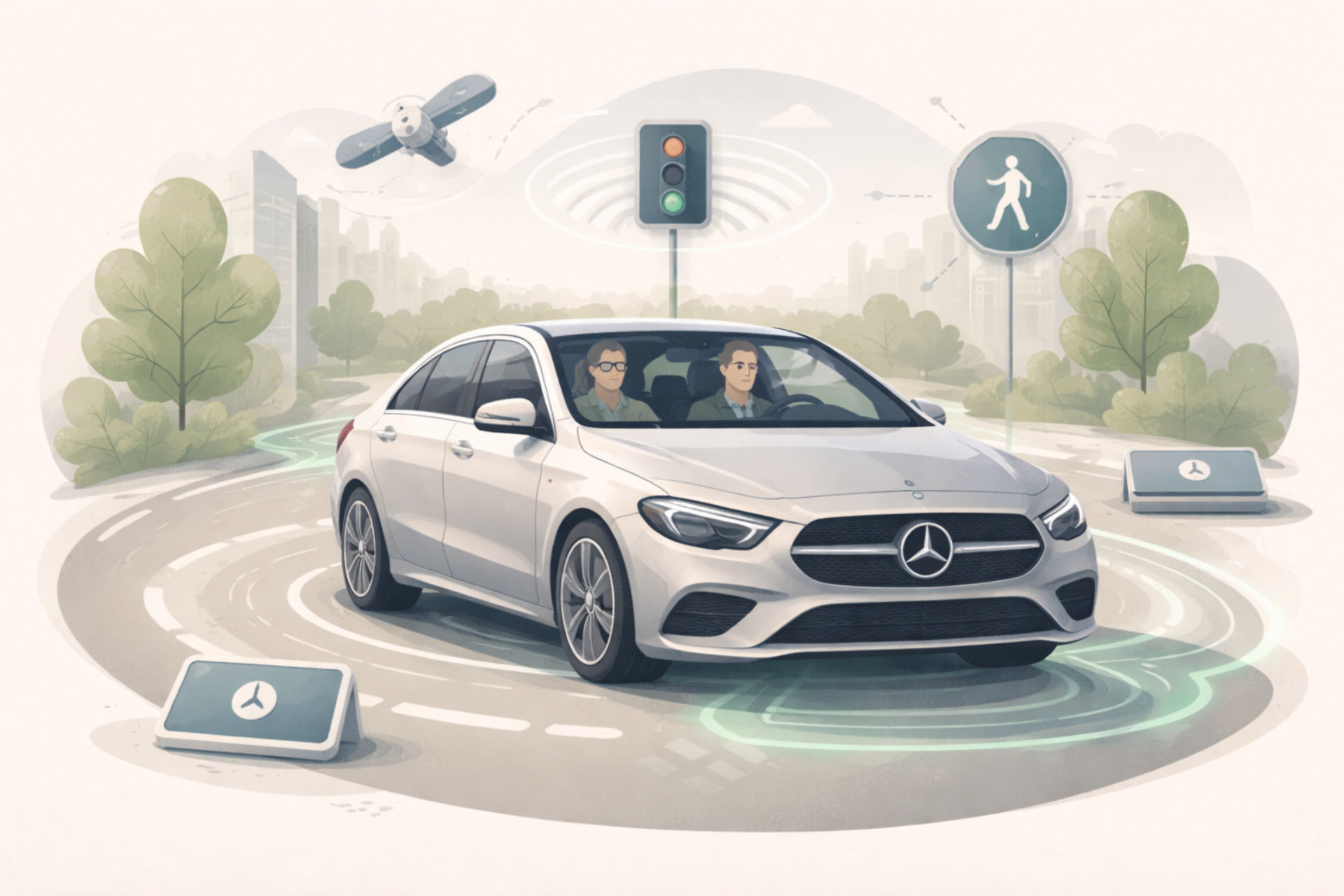
The demonstration featured Nvidia CEO Jensen Huang and automotive head Xinzhou Wu riding in a Mercedes CLA equipped with MB.Drive Assist Pro, a system partially developed by Nvidia. According to the company, the vehicle completed the 22-minute drive without disengaging the automated system.
For years, Nvidia has supplied the computing hardware used in autonomous vehicle development. Companies, including Tesla and other automakers, rely on Nvidia chips to power AI workloads inside vehicles.
More recently, the company has begun offering full software platforms for automated driving. Its partners include Mercedes, Jaguar Land Rover and Lucid, which are integrating Nvidia’s AI-based driving capabilities into future vehicle models.
At the Consumer Electronics Show earlier this year, Huang introduced a broader autonomous driving platform called Alpamayo. The system combines AI models, simulation tools and datasets intended to enable Level 4 autonomy, allowing vehicles to operate without human intervention under specific conditions.
Nvidia’s driving system combines two technical approaches. End-to-end AI models handle perception and driving behaviour, while a traditional rule-based “classical stack” provides safety controls designed to verify that the vehicle follows road rules.
Wu said the hybrid approach allows the system to respond naturally to complex road situations while maintaining predictable safety safeguards.
To develop its driving models, Nvidia relies heavily on simulation. Engineers recreate real-world driving scenes from sensor data and then modify those environments to test how the system reacts to rare events such as pedestrians entering the road unexpectedly.
The company is also developing a “Vision Language Action” model designed to combine visual perception, language reasoning and vehicle control into a single AI system.
Autonomous vehicle development remains a competitive field, with Tesla, Waymo and other companies pursuing different technical strategies. Nvidia’s approach supports multiple sensor configurations, including cameras, radar and lidar, allowing automakers to choose different levels of capability depending on cost and vehicle design.