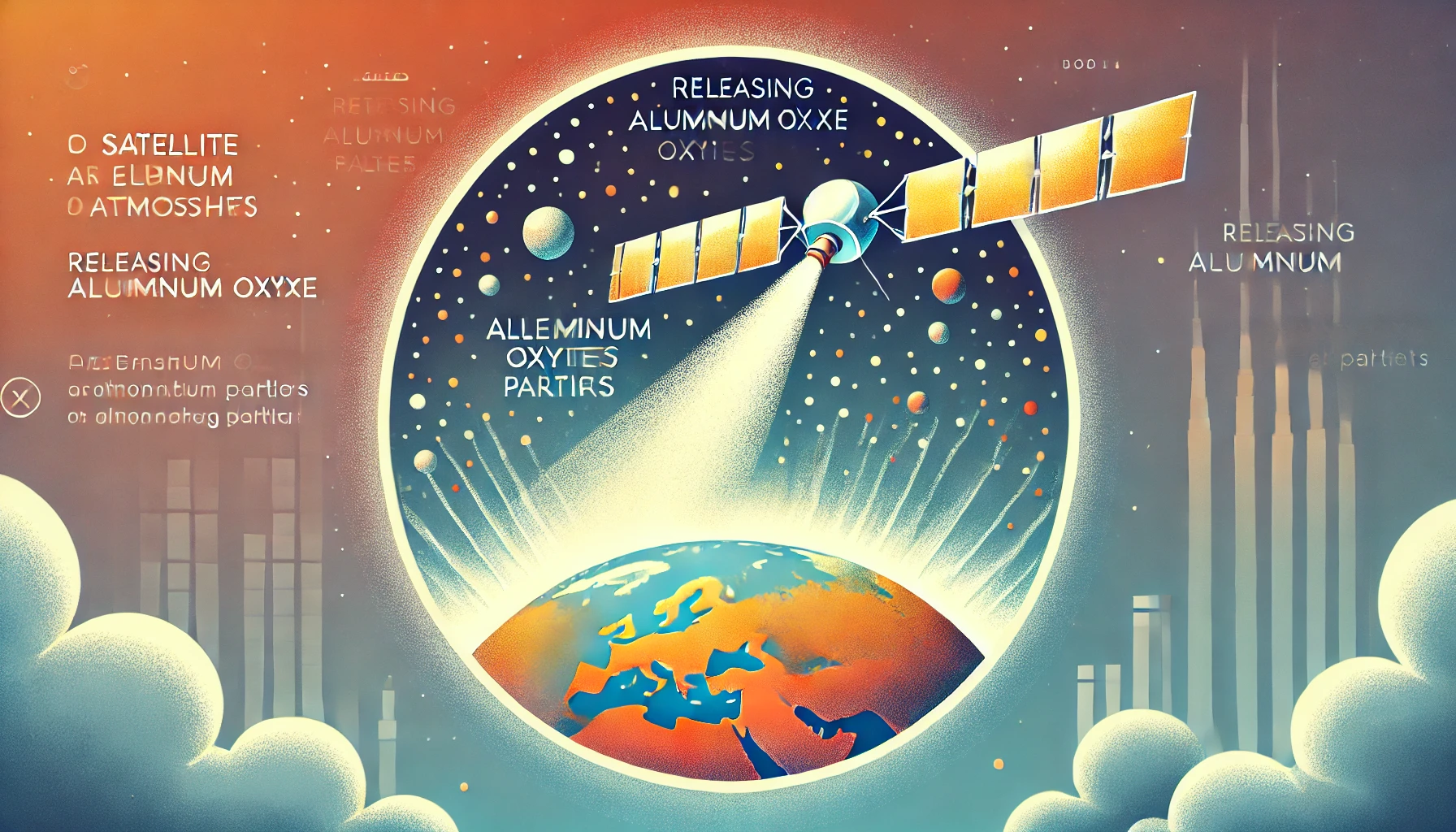
June 25, 2024 Recent research suggests that the increasing number of low Earth orbit satellites, like those operated by Starlink, could threaten Earth’s ozone layer as they re-enter the atmosphere. These satellites, used for purposes such as broadband coverage, typically have a lifespan of about five years. Upon re-entry, they burn up and release aluminum oxides, which are known to accelerate ozone depletion.
Researchers at the University of Southern California (USC) have found that the demise of a typical 250 kg satellite can generate around 30 kg of aluminum oxide nanoparticles. These particles may persist in the atmosphere for decades.
Large constellations of satellites, like Starlink’s estimated 6,078 satellites in orbit as of May 2024, could contribute over 360 metric tons of aluminum oxide compounds to the atmosphere annually. These compounds could lead to significant ozone depletion.
Aluminum, commonly used in satellites, reacts with oxygen upon re-entry to generate aluminum oxide. This substance can interfere with ozone chemistry and catalyze chlorine activation reactions, which boost ozone depletion.
The effects of aluminum on the atmosphere have been known from studies of emissions from solid rocket motors. However, little attention has been paid to the re-entry of satellites from low Earth orbit.
Re-entry by-products may take up to 30 years to settle from the mesosphere into the stratospheric ozone layer. Upon reaching an altitude of about 40 km, aluminum oxides catalyze chlorine activation, promoting ozone depletion.
The delay between the beginning of the injection process and the ozone depletion consequences could mean that the full impact may not become apparent for decades.
The researchers stress the need for further exploration of these concerns as satellite re-entry rates increase. More research is needed to fully understand the impact of aluminum oxides on the ozone layer and how they interact with other atmospheric chemicals.