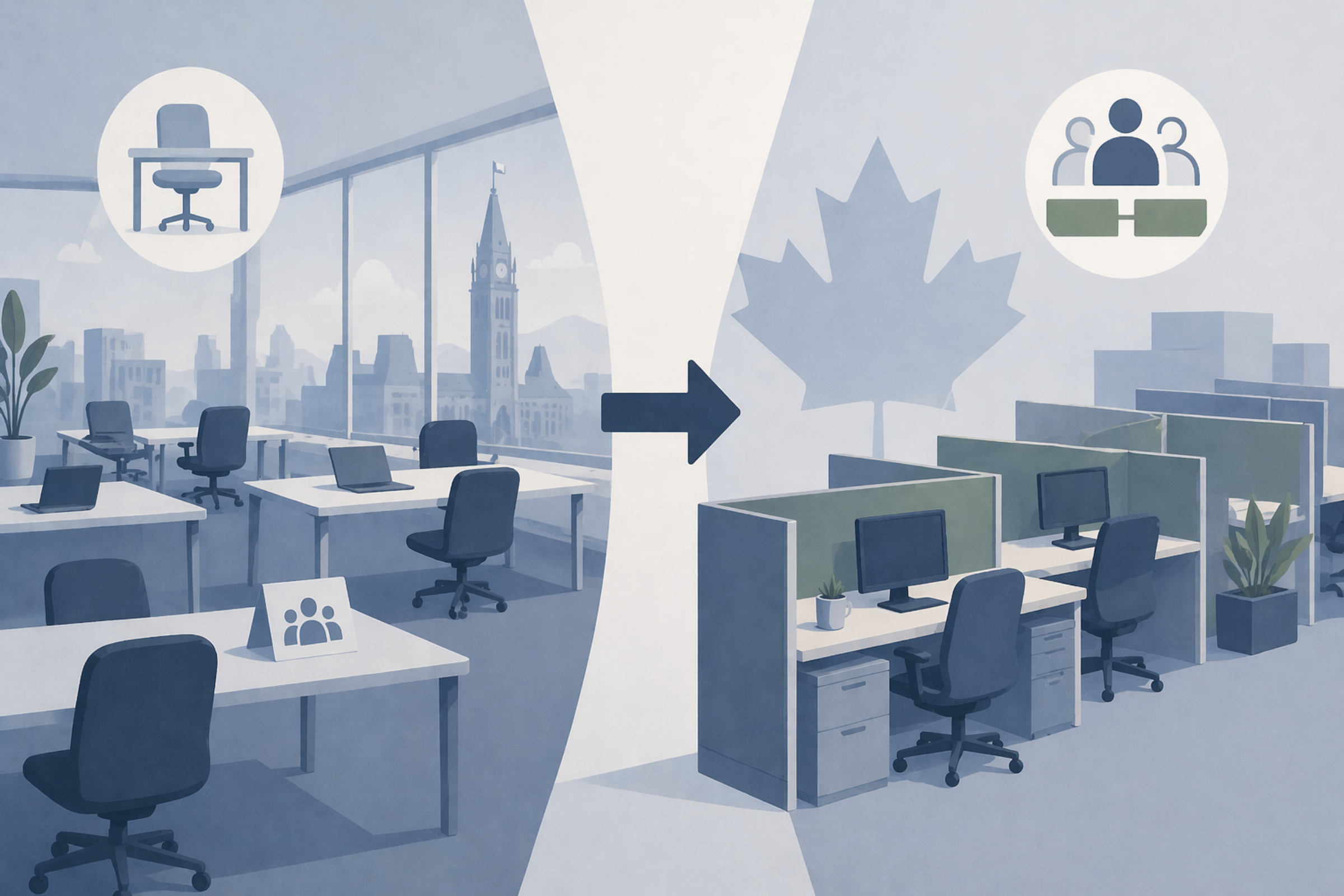
April 23, 2026 Shared Services Canada is abandoning desk “hoteling” for employees in the National Capital Region as it prepares for a four-day return-to-office mandate.
In an internal email dated April 20, assistant deputy minister Jacquie Manchevsky said the department will introduce a “neighbourhood model” that groups teams and directorates into dedicated areas, while eliminating many shared desk arrangements. “The neighbourhood model will give us the chance to work more closely together while supporting consistent and efficient ways of working,” the email stated.
The new model is scheduled to take effect on September 8, following a July 6 deadline requiring most federal public servants to return to the office four days per week, up from three. Executives will be required on-site full time starting May 4. As part of the transition, Shared Services Canada will discontinue the use of Archibus, the software used to book workstations under the hoteling system.
The change represents a clear reversal of a long-standing approach. Desk hoteling had been widely adopted across federal departments, even before the COVID-19 pandemic accelerated remote work. Government data from 2024 showed that at least 50 per cent of staff across nearly 40 departments did not have assigned desks, with Shared Services Canada among the highest at 92 per cent.
The return-to-office mandate appears to be reshaping those assumptions. Observers had anticipated that increased in-office requirements would reduce reliance on shared workspaces, and the department’s move confirms that shift. The new approach will also involve shutting down satellite co-working locations and consolidating teams within primary office buildings.
The transition has not been without internal friction. IT professionals within the public service have been among the most vocal critics of return-to-office policies, arguing their roles can be performed remotely without affecting productivity. Manchevsky acknowledged the impact of the change in her message, writing, “I recognize that workplace transitions like this can bring a mix of emotions, and I want to thank you for your patience and understanding as these changes take shape.”
The announcement comes alongside broader operational pressures. Public Services and Procurement Canada, which manages federal real estate, recently indicated the government may need to acquire additional office space to accommodate increased in-person attendance — a reversal of earlier plans to reduce its building footprint by half over a decade.
At the same time, workforce uncertainty remains. More than 1,000 employees at Shared Services Canada have recently been informed their roles could be affected as part of ongoing efforts to reduce public service staffing levels in the coming years.