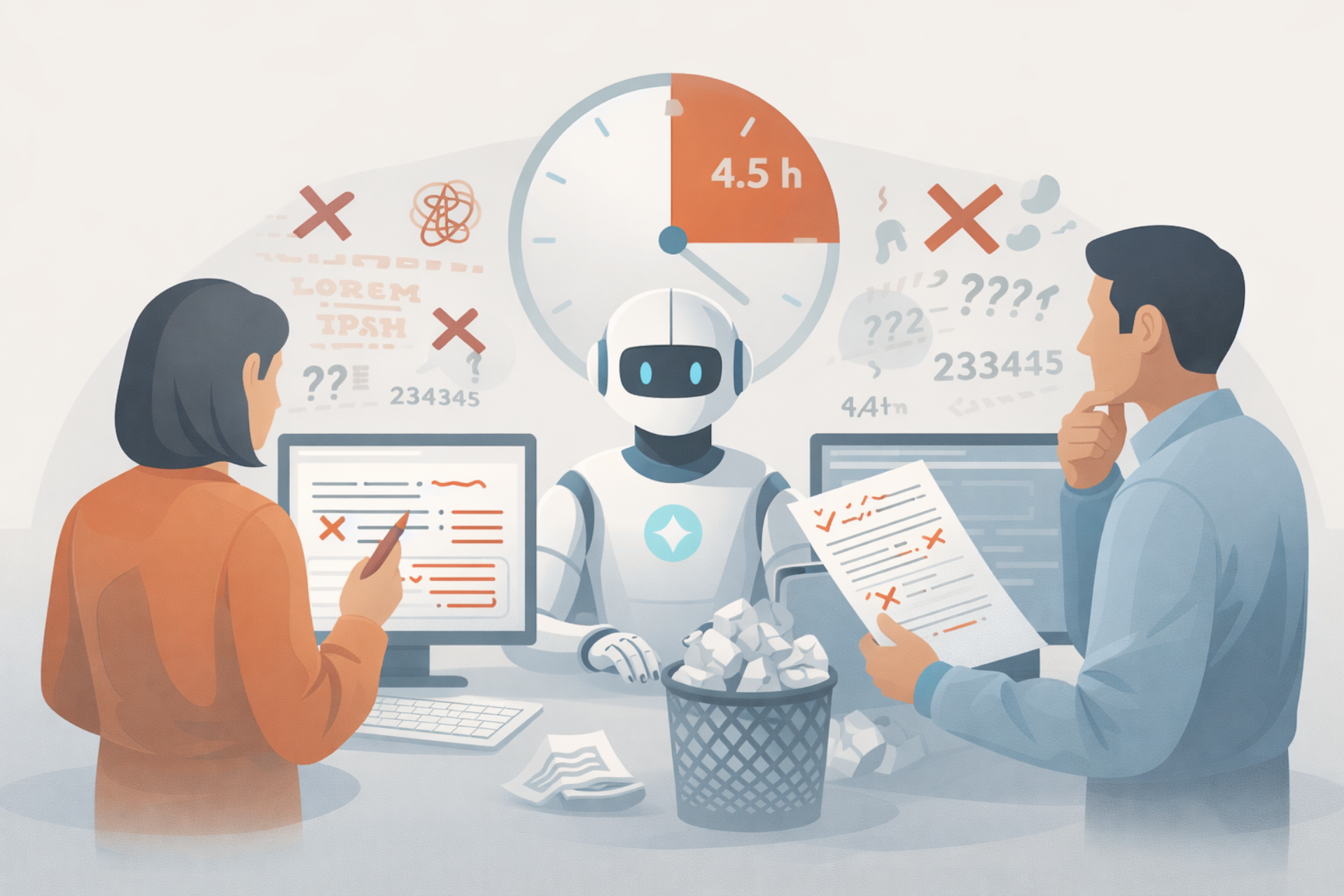
January 15, 2026 A new survey suggests much of the promised productivity is being quietly clawed back. While 92 per cent of workers say AI tools make them more productive, the average employee now spends more than half a workday each week fixing AI-generated mistakes. The result is what researchers are calling a growing layer of “AI workslop” inside modern workplaces.
The findings come from a new survey of more than 1,100 U.S. enterprise AI users released this week by Zapier. Per the report, 58 per cent of respondents said they spend at least three hours a week revising or redoing AI outputs, and 35 per cent spend five hours or more.
AI workslop, as defined in the survey, refers to AI-generated work that looks polished on the surface but lacks the accuracy, context or substance required to actually complete a task. These outputs often trigger cycles of fact-checking, rewriting, re-prompting or full rework. Despite that, enthusiasm remains high. Only one per cent of respondents said AI makes them less productive, and just two percent said they typically don’t need to revise AI outputs at all. On average, workers reported spending about 4.5 hours per week cleaning up AI-generated material.
Speaking of the risks, nearly three-quarters of respondents (74 per cent) said low-quality AI outputs have already caused tangible problems at work. Common consequences included internal work being rejected due to quality issues (28 per cent), privacy or security incidents (27 per cent), customer complaints (25 per cent), missed deadlines (24 per cent) and compliance or legal issues (24 per cent).
Those costs rise sharply for workers who spend the most time fixing AI outputs. Employees who reported five or more hours of weekly cleanup were more than twice as likely to report lost revenue, clients or deals compared with lighter users. They were also more likely to say AI mistakes had damaged their professional credibility.
Training emerged as a key dividing line. Workers without AI training were six times more likely to say AI reduced their productivity. Trained employees, by contrast, used AI more aggressively, spent more time refining outputs and were far more likely to say the trade-off was worthwhile.
Zapier’s report argues that the solution is not pulling back from AI but treating it as infrastructure rather than a novelty. Respondents with access to orchestration tools, shared company context and structured review processes reported the strongest productivity gains.
As AI becomes embedded deeper into enterprise workflows, the survey suggests the real challenge is no longer whether AI works but how much organizations are willing to absorb to make it work well.