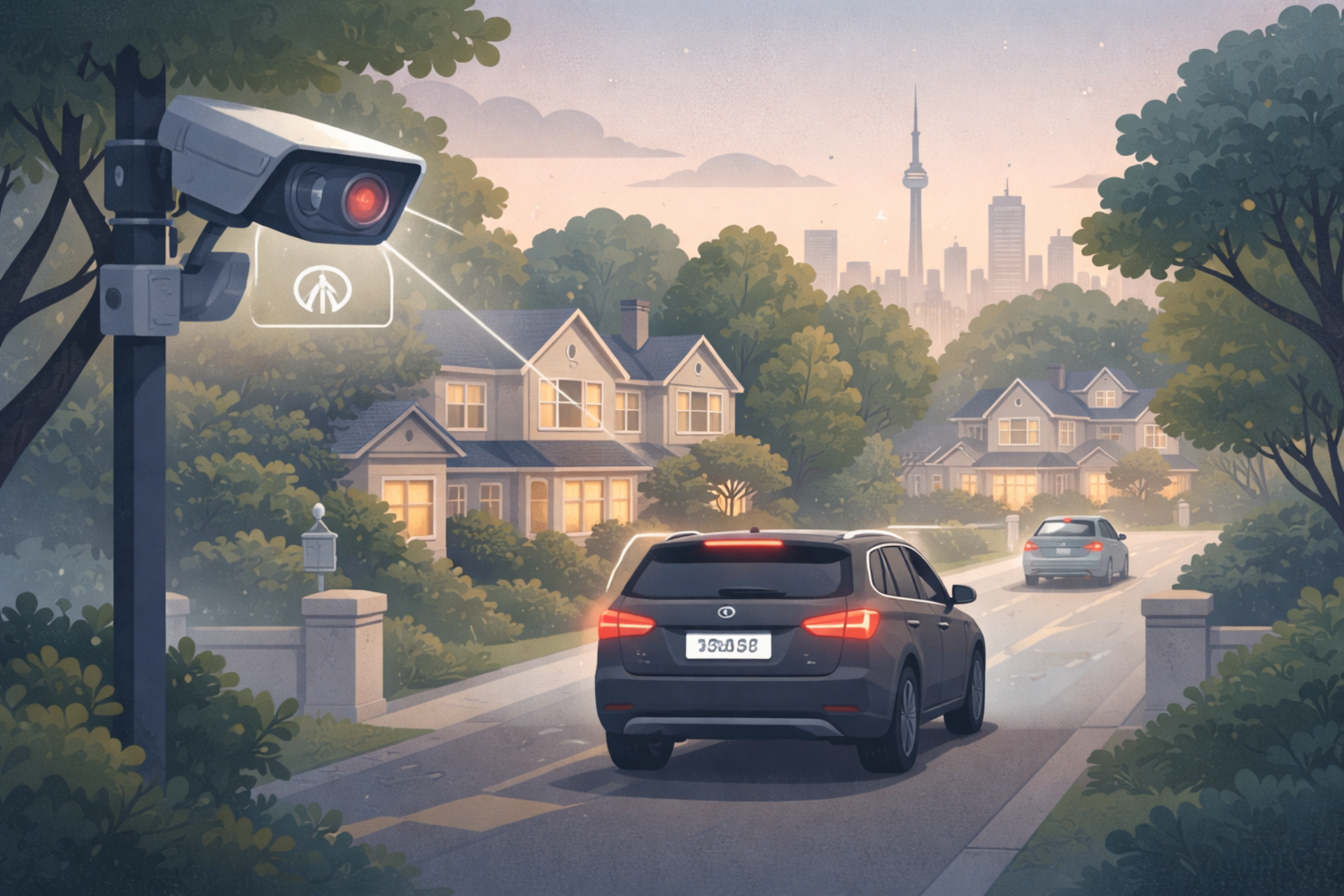
April 9, 2026 Residents in Toronto’s affluent Rosedale neighbourhood are considering an AI-powered surveillance system to create what would be Canada’s first “virtual gated community” in response to rising home invasions. Per The Guardian, the proposal would use licence plate–scanning cameras and AI to monitor vehicle activity.
The plan was presented in late March by local resident Craig Campbell, who runs a security company and holds Canadian licensing rights for the U.S.-based firm Flock Safety. About 100 residents would initially pay C$200 per month for the system, which would track vehicles entering the neighbourhood and classify them as known or suspicious.
Campbell said the proposal is driven by growing fear among residents following a series of home invasions. “My friends experienced a horrific home invasion here in the community – their children were held at knifepoint, and they will be traumatised for the rest of their life,” he said, adding that many residents are struggling to sleep amid ongoing incidents.
The system would rely on licence plate recognition rather than facial recognition, creating “whitelists” and “blacklists” of vehicles. Data would be retained for 30 days, and police access would require legal authorisation. It would also operate alongside existing unarmed private security patrols already funded by residents.
Support for the project appears mixed. Some residents in the neighbourhood’s WhatsApp group have already contributed to private security funding, with around 60 of 350 members participating. Others have pre-registered for the AI system, asking why anyone would oppose “this level of safety and security.”
At the same time, concerns about surveillance, bias and potential misuse of data have emerged. One resident described AI as “one of the most unethical tools of our time,” pointing to environmental impact, profiling risks and documented cases of wrongful arrests linked to similar systems.
Flock claims its network of more than 90,000 cameras has helped reduce crime by “up to 70%,” though researchers say that figure is difficult to independently verify. The company has also faced scrutiny in the United States, including incidents where licence plate misreads or lack of verification led to wrongful stops, arrests and other serious consequences.
Privacy and regulatory challenges are likely to be central if the system moves forward. Canadian laws, including the Personal Information Protection and Electronic Documents Act (PIPEDA), impose stricter requirements than U.S. regulations. Officials have indicated that such a network would likely be treated as a data collection system rather than simple home security, requiring clear consent, transparency and limits on data retention.
Toronto police acknowledged that residents may seek additional security measures but declined to comment on the legality of the proposal. A spokesperson noted that “any technology that captures images, video or licence plates raises important considerations around privacy, data storage” and advised residents to seek guidance on applicable laws.
Local guidelines also complicate deployment. While the city does not require permits for security cameras, it recommends minimising data capture outside private property and aligns with a suggested retention period of 72 hours, far shorter than the 30 days proposed in Rosedale. Even with opt-out mechanisms, experts note that drivers passing through the area would still be recorded, raising questions about meaningful consent.
For some residents, the issue goes beyond compliance. François Hébette, who moved to the neighbourhood from California, said while the system might reduce crime, it could fundamentally change the character of the area. “If you wanted to live in a gated community, you can move to one,” he said. “The idea of changing a neighbourhood into this ‘virtual’ one just doesn’t feel right.”