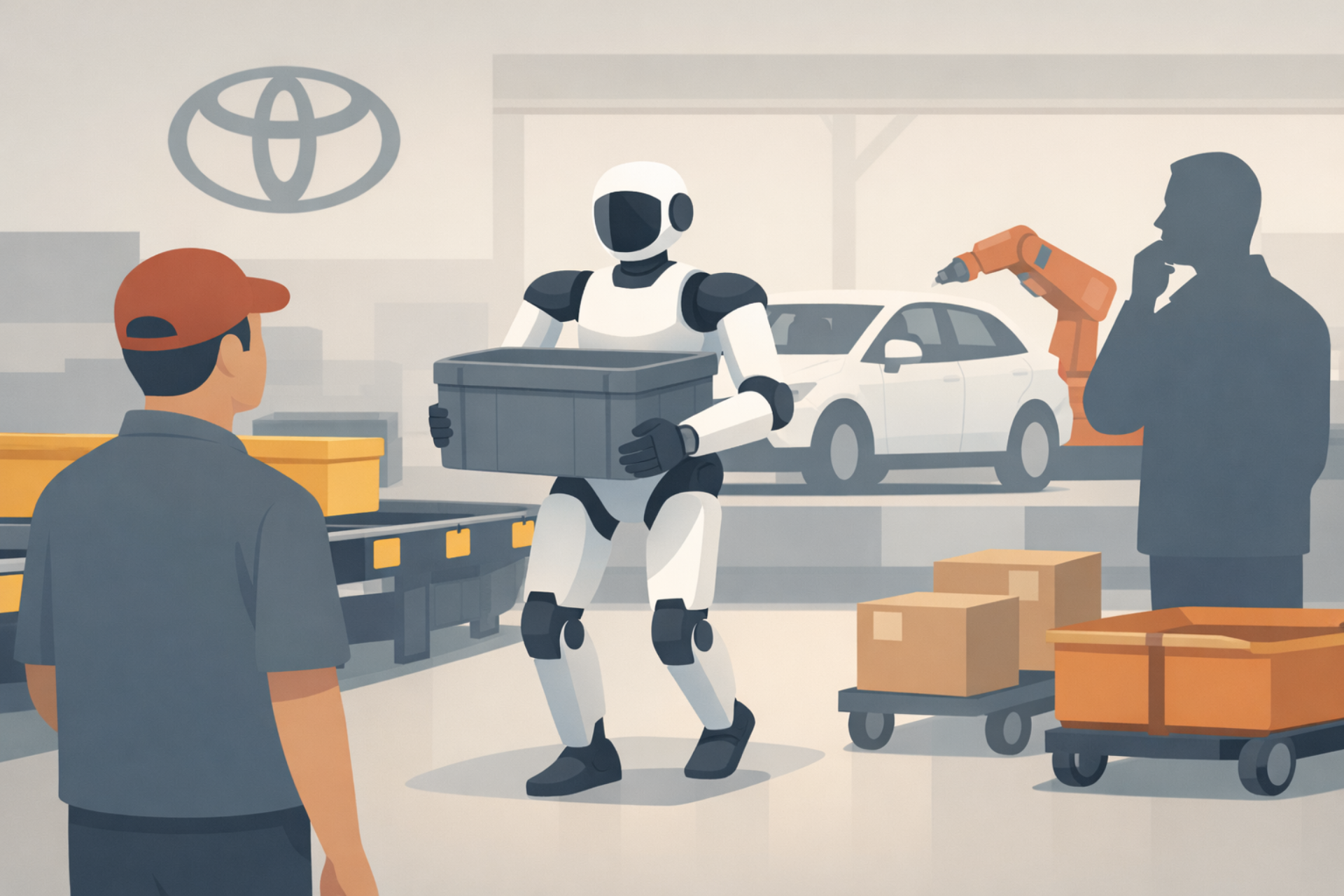
March 23, 2026 Toyota Motor has begun deploying humanoid robots in active production at its Woodstock, Ontario plant following a year-long pilot. The move places humanoid systems into daily manufacturing operations even as investor Mark Cuban questions whether the approach will remain viable over the next decade.
The deployment involves Agility Robotics’ Digit robots, initially rolling out seven units to handle repetitive and physically demanding tasks such as moving heavy totes between automated systems and assembly lines.
Toyota Motor Manufacturing Canada confirmed the shift from testing to production use, with President Tim Hollander stating the company is “excited to deploy Digit to improve the team member experience and further increase operational efficiency in our manufacturing facilities.” Agility Robotics, founded in 2015 as a spinout of Oregon State University, has focused on deploying humanoid systems in logistics and manufacturing settings. Its Digit platform is already used in warehouse environments, though scaling remains constrained by deployment costs.
“Cost of deployment can be more than the price of the robot by a lot,” Chief Technology Officer Pras Velagapudi said in a previous interview.
The rollout reflects an industry push toward humanoid robotics. Companies including Tesla and BMW are investing in similar systems, positioning human-like form factors as adaptable across varied tasks and environments.
At the same time, Mark Cuban has publicly challenged that direction. Speaking on the Technology Business Programming Network, he said, “Everybody’s making this push for humanoid robots. I think they might have a five-year lifespan, and then they’ll fail miserably. Maybe 10.” Cuban argued that the issue is not automation itself, but the assumption that machines should mimic human form.
He pointed to alternative approaches already in use, noting that Amazon operates more than one million robots across its warehouses, none of which are humanoid and all designed for task-specific efficiency.
Toyota’s deployment places humanoid robots into a live production setting at a time when the broader industry is exploring multiple design paths. While companies continue to invest in human-like systems, parallel models built around specialised, non-humanoid designs remain widely used in large-scale operations.