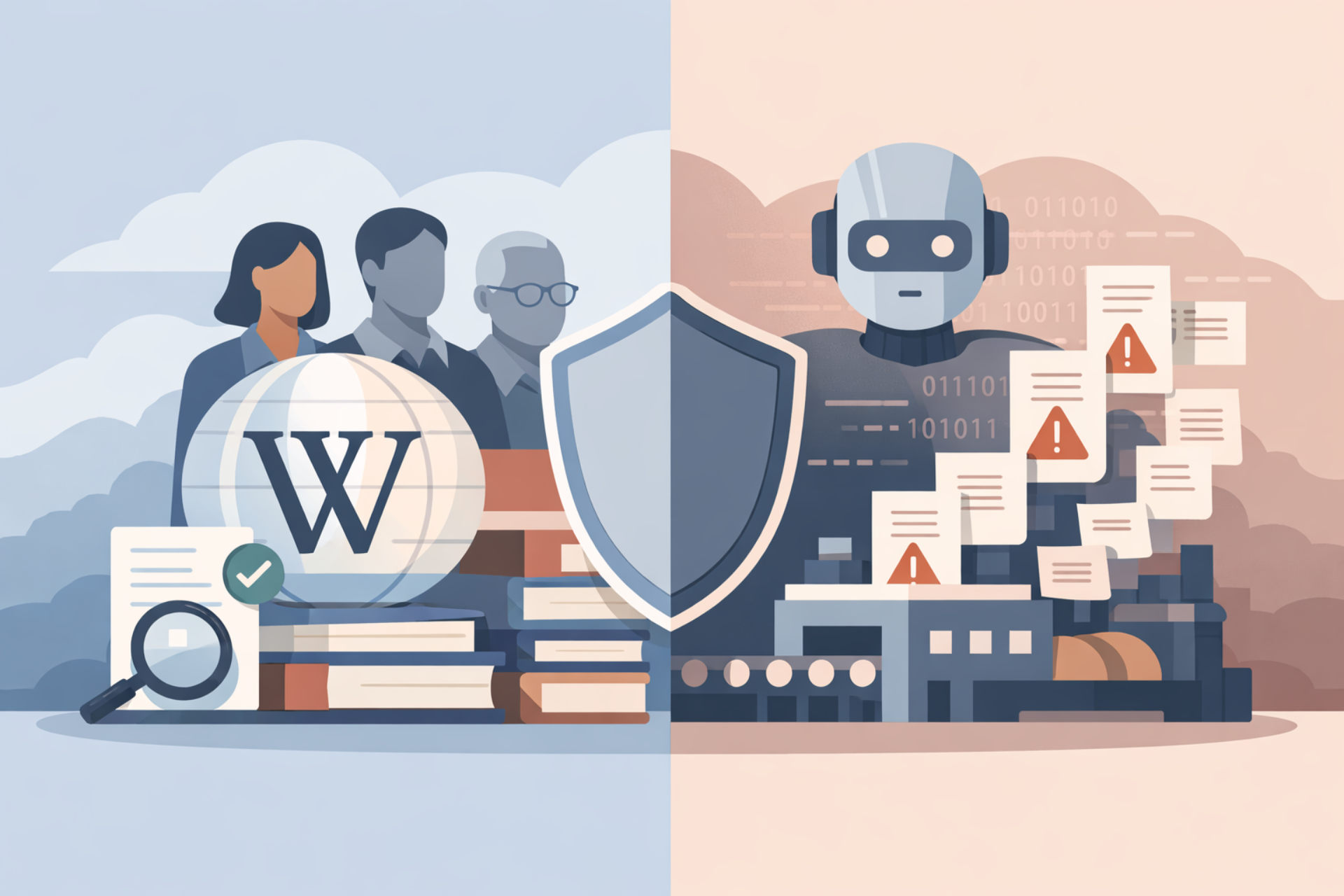
February 6, 2026 The Wikimedia Foundation announced in January that it is partnering with major AI companies, including Amazon, Meta, Microsoft, Mistral AI and Perplexity, to integrate Wikipedia and other Wikimedia projects into their systems. The stated aim is to feed AI models with “human-governed knowledge” — content written, reviewed and enforced by people rather than generated en masse by machines.
At a time when AI-generated misinformation, fabricated citations and synthetic “content farms” are spreading rapidly, Wikimedia and its volunteer editors see their role as a counterweight: a source of verified, transparent and accountable knowledge that can help anchor AI systems to reality.
Wikipedia’s scale makes it uniquely positioned for that role. Its encyclopedias span 350 languages, with Wiktionary and Wikibooks extending coverage even further. But its strength, editors argue, is not volume but process.
“Over many years, these volunteers have developed sophisticated rules and tools for identifying content that does not belong on Wikipedia,” said Marshall Miller, senior director of product at the Wikimedia Foundation. He described the community’s policies, review mechanisms and moderation tools as an “immune system” that is now being adapted to detect and remove AI-generated slop.
That immune system is increasingly under strain. Since 2024, Wikimedia volunteers have flagged more than 4,800 articles suspected of containing AI-generated content. A Princeton University study found that about five per cent of newly created English-language Wikipedia pages in a single month contained some AI-written text. Editors say much of it is easy to spot: generic phrasing, confident claims without evidence and citations that do not actually exist.
For regional-language Wikipedias, the challenge is sharper. Widely spoken languages such as Telugu, Marathi and Tamil are maintained by only a few hundred active editors, compared with hundreds of thousands in English. That makes them more vulnerable to AI slop slipping through, even as AI companies increasingly rely on Wikipedia to improve their performance in those same languages.
Pranayraj Vangari, a long-time contributor to Telugu Wikipedia, said strong human oversight is essential if AI is to narrow language gaps rather than widen them. Without it, he warned, AI could overwhelm smaller Wikipedias with poorly sourced or culturally inaccurate material.
Other editors see the AI partnerships as a pragmatic response to AI models already being trained on whatever data they can find.
Ravi Chandra Enaganti, who began writing Telugu articles in 2007 when the language had little online presence, said it is better for AI systems to learn from Wikipedia’s verified sources than from unmoderated corners of the web. In that sense, Wikipedia becomes a filter, steering AI away from misinformation rather than amplifying it.
Editors themselves are not rejecting AI outright. Many use tools such as ChatGPT or Gemini to brainstorm topics, improve structure or assist with translation. But they draw a clear line against using it for facts or final judgment.
There is a longer-term concern that Wikipedia could end up consuming its own reflections, drawing from AI-generated sources that were themselves trained on Wikipedia. That feedback loop, often described as “model collapse,” could degrade knowledge over time if not carefully managed. For now, Wikimedia’s strategy is to lean into human governance, strengthen moderation and make Wikipedia’s values explicit as AI systems scale.