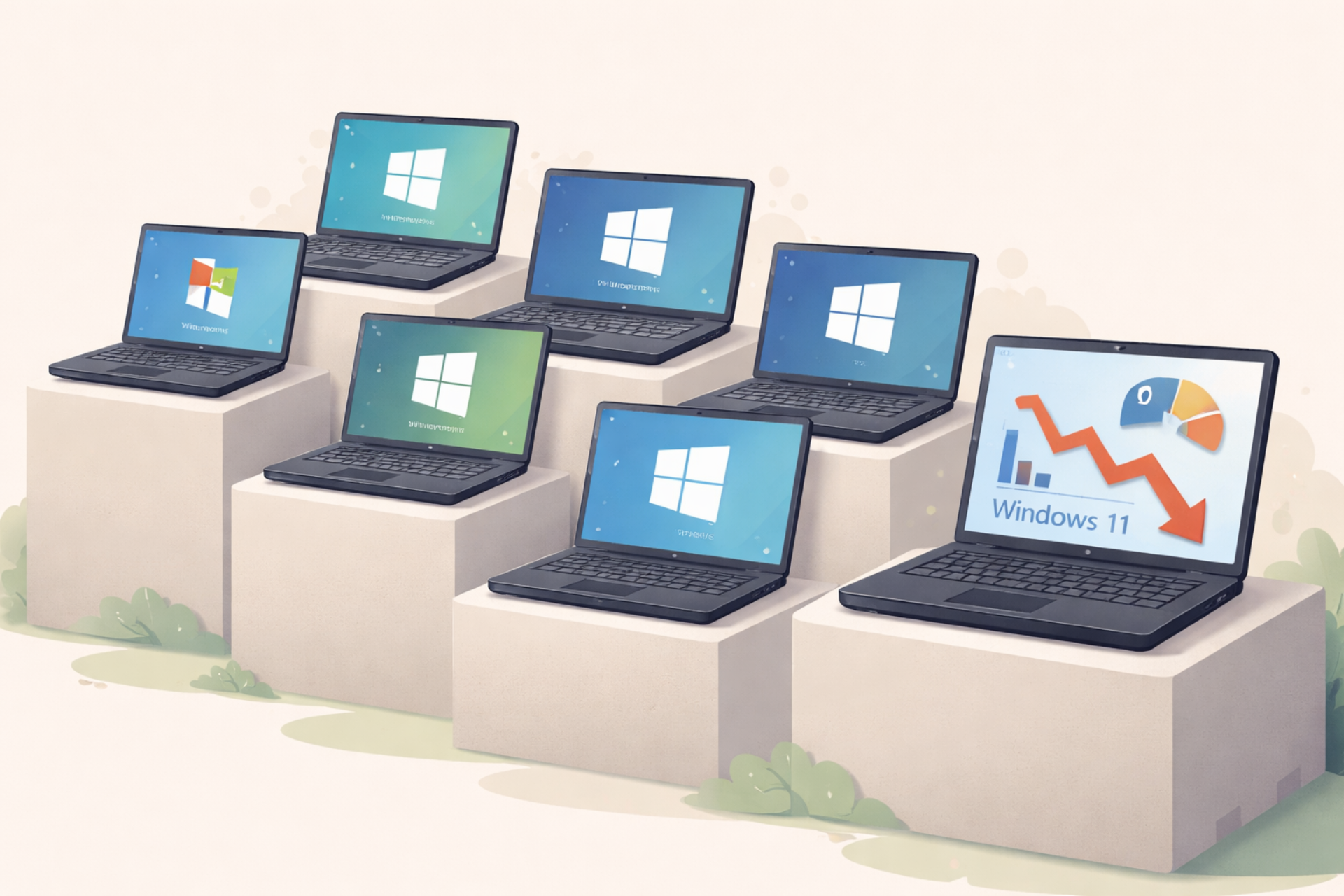
January 5, 2026 A community benchmark comparing six generations of Windows has placed Windows 11 dead last in nearly every test, reigniting criticism of Microsoft’s newest operating system. The results have circulated widely online as evidence that Windows 11 is bloated and inefficient. But the test setup itself explains much of the outcome – and limits what the findings actually prove.
The experiment, run by a YouTuber known as TrigrZolt, installed Windows XP, Vista, 7, 8.1, 10 and 11 on six Lenovo ThinkPad X220 laptops. Each system used a second-generation Intel Core i5-2520M CPU, 8GB of RAM and a 256GB mechanical hard drive. Windows 11 is not officially supported on this platform, a constraint that shaped nearly every result.
Across startup, storage usage, memory consumption, application launches, browsing stress tests and media workloads, Windows 11 consistently ranked at or near the bottom. It booted slowest, consumed the most RAM at idle, loaded the fewest browser tabs before hitting memory limits, and lagged in app opening times. In contrast, older operating systems, especially Windows XP and Windows 8.1, benefited from far lower baseline overhead and simpler background services.
In raw numbers, Windows 11 averaged roughly 3.3GB of RAM at idle, compared with about 0.8GB for Windows XP. In a browser stress test capped at 5GB of memory use, Windows 11 loaded just 49 tabs, while Windows 8.1 managed 252. Storage usage showed a similar pattern: Windows 11 occupied 37.3GB with the same app set, more than XP but still less than Vista and Windows 7.
Battery life, file transfers and benchmarks offered little relief. Windows 11 placed last or near last in most categories, though margins were often narrow. In some synthetic benchmarks and file copy tests, it avoided last place, but did not win any test outright.
Why the results don’t translate to modern PCs
The ThinkPad X220 predates Windows 11 by more than a decade and lacks an SSD, a component modern versions of Windows increasingly assume. Mechanical drives amplify the cost of background services, telemetry, security layers and UI frameworks that simply did not exist when XP or 7 were designed.
Windows 10, notably, degraded less under the same constraints, but even it was never intended to run optimally on such storage. On supported systems with modern CPUs and NVMe SSDs, many of Windows 11’s inefficiencies are masked or irrelevant.
TrigrZolt himself described the test as historical rather than practical and named Windows 8.1 the overall winner based on perceived responsiveness. A fairer comparison, he noted, would match each Windows release to flagship hardware from its own era.
The takeaway is not that Windows 11 is universally slow. It is that modern operating systems no longer scale down gracefully and that running a 2025 OS on 2011 hardware will inevitably produce ugly results.