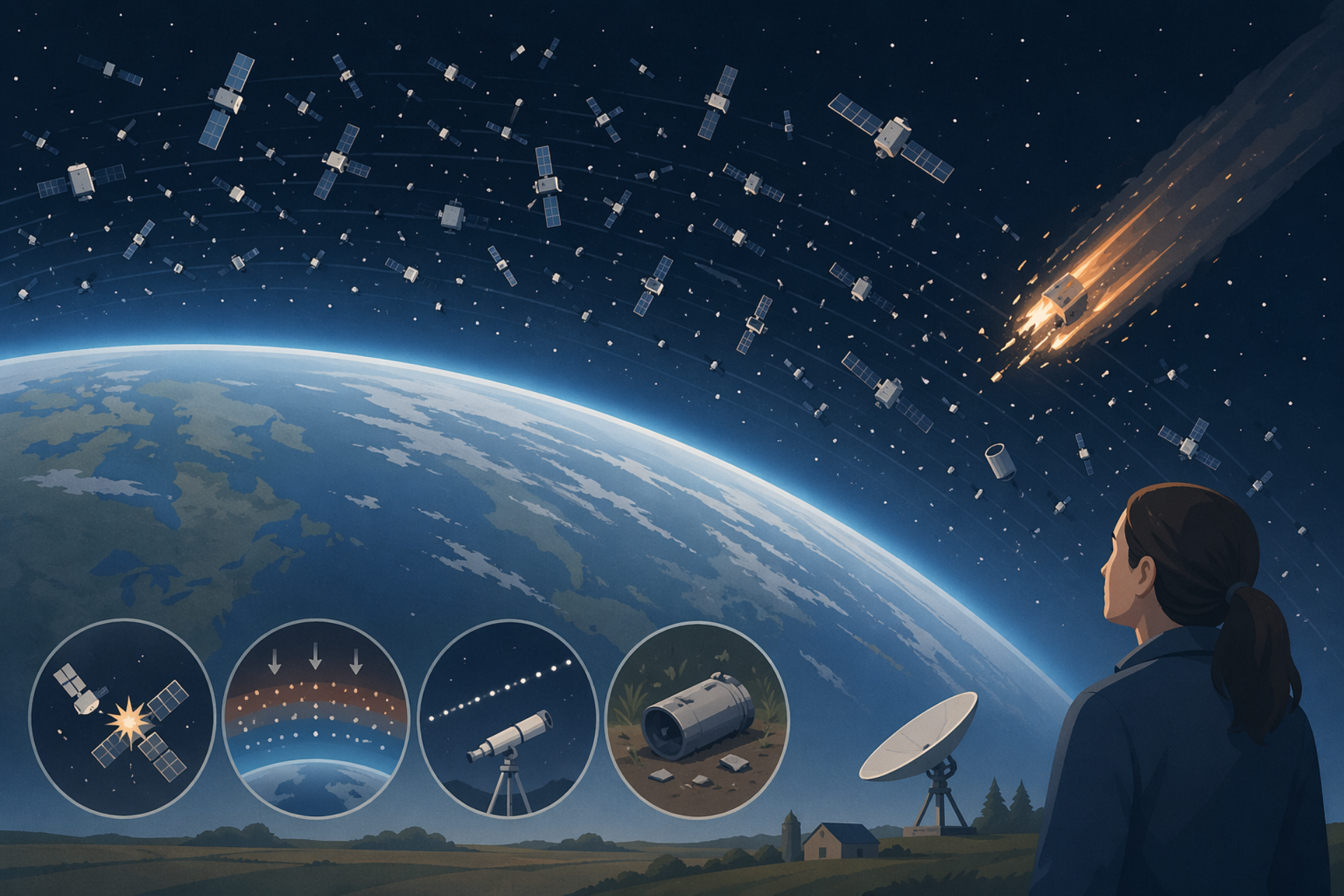
April 24, 2026 Thousands of satellites now orbit Earth at low altitude, with SpaceX accounting for more than two-thirds of them through its Starlink network. The rapid expansion is raising concerns among researchers about collision risks, environmental effects and the long-term sustainability of low Earth orbit.
The growth has accelerated since Starlink’s first launch in 2019, with satellites operating for roughly five years before re-entering the atmosphere, often at a rate of one or two per day. “There is a limit to how many we can safely have in orbit, and I think we’ve crossed that limit,” said Samantha Lawler, an astronomy professor at the University of Regina.
Low Earth orbit, generally defined as 2,000 kilometres or less above Earth, now hosts around 15,000 satellites, with proposals for tens of thousands more and, in some cases, far larger constellations. Lawler noted that earlier projections of 65,000 satellites once seemed unrealistic, but current trends suggest that number could be reached, with “no signs of slowing down.”
The operational lifecycle of these satellites introduces additional risks. When satellites burn up on re-entry, their materials such as aluminium, plastics and batteries are deposited into the upper atmosphere. During a six-month period when roughly 500 Starlink satellites re-entered, the added material exceeded the natural influx from meteorites by at least double.
“We don’t actually know” the full effects, Lawler said, noting preliminary research suggesting potential ozone depletion and temperature changes in the upper atmosphere.
Collision risk is another growing concern, as Lawler warned that the system is approaching a tipping point known as Kessler syndrome, where cascading collisions could render parts of orbit unusable. “We’re right on the edge of that already,” she said.
Even today, satellite operators must constantly perform avoidance manoeuvres to prevent collisions, underscoring how congested the environment has become.
The impact is also visible from the ground. Increasing satellite density is altering the night sky, with more visible objects and streaks affecting astronomical observations. Lawler noted that from her vantage point in Saskatchewan, “there’s a line where I can always see a Starlink satellite in motion,” highlighting the extent of change even for non-specialists.
Debris risks extend beyond orbit. While most satellites burn up completely, some fragments reach Earth. In Saskatchewan, both large spacecraft debris and smaller satellite fragments have been found on farmland in recent years. Lawler pointed out that Canada lacks a formal reporting system for such incidents, meaning discoveries are often handled informally. “The only way we find out if they aren’t burning up completely is if we find pieces on the ground,” she said.
Despite these risks, regulatory frameworks remain limited. Current international agreements, including the Outer Space Treaty and Liability Convention, were developed in an era dominated by government space programs and do not fully account for today’s private-sector-driven satellite expansion. Lawler said space is “not legally considered an environment,” meaning launches are largely exempt from environmental regulation.
At the same time, satellite networks like Starlink provide critical connectivity, particularly for rural and remote communities. The challenge, researchers say, is balancing those benefits with the constraints of a finite orbital environment.