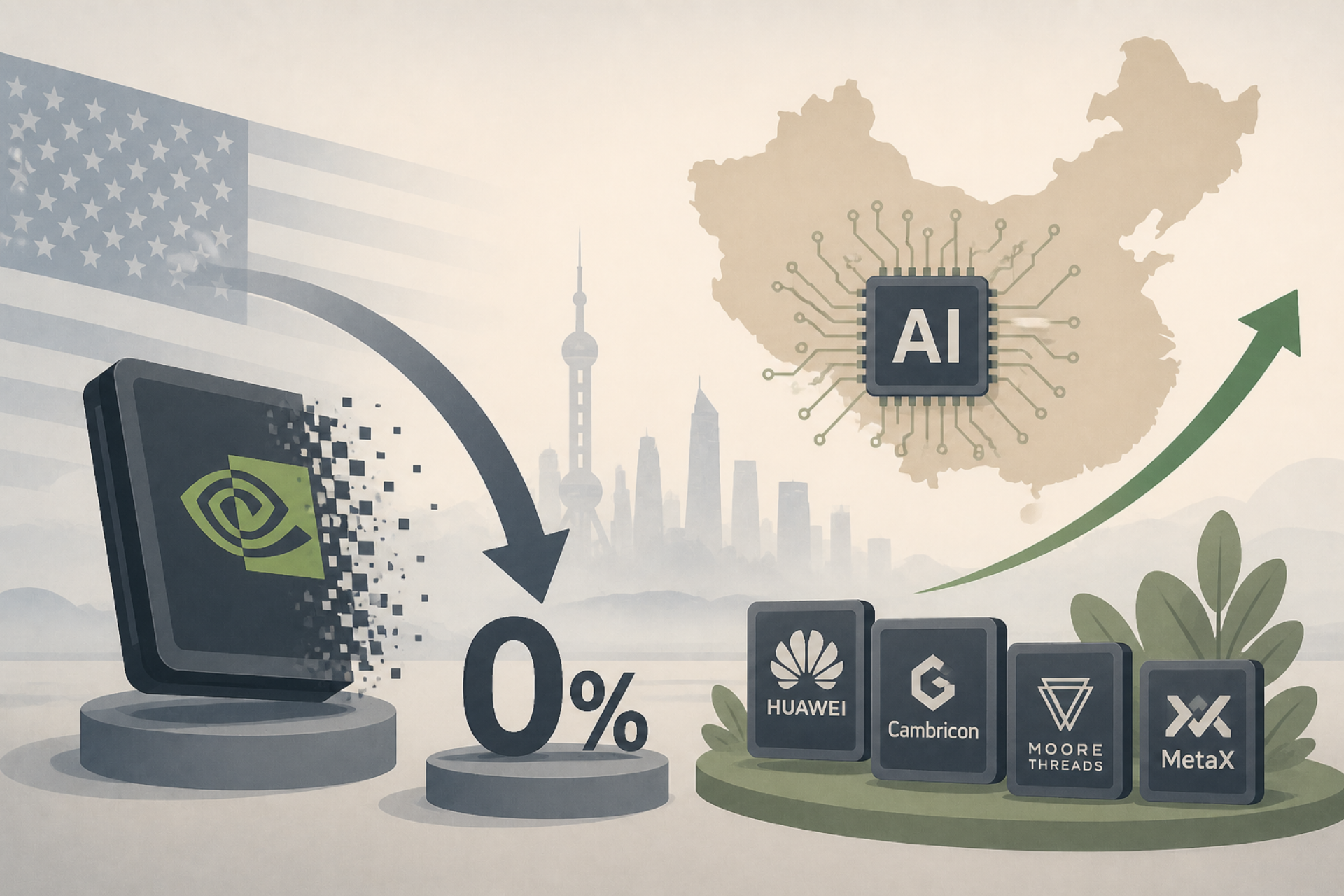
May 4, 2026 Nvidia CEO Jensen Huang says the company’s share of China’s AI accelerator market has fallen to zero. The decline follows U.S. export restrictions and rising domestic competition, marking a sharp reversal from Nvidia’s dominant position in the region just two years ago.
“In China, we have now dropped to zero,” Huang said in an interview with the Special Competitive Studies Project. He added that “conceding an entire market the size of China probably does not make a lot of strategic sense,” suggesting current policy may have unintended consequences for U.S. firms operating globally.
The shift has been building. Earlier estimates from research firm Bernstein projected Nvidia’s share of China’s AI GPU market could fall from 66 per cent in 2024 to around 8 per cent over time, driven by export controls and the rapid growth of local alternatives. Huang’s comments indicate that decline has already gone further, at least in terms of Nvidia’s direct sales into the market.
At the same time, Chinese companies are moving quickly to fill the gap. Firms including Huawei, Cambricon, Moore Threads and MetaX are advancing domestic AI hardware and software stacks, with some estimates suggesting local vendors could meet up to 80 per cent of demand.
Huang emphasised that hardware is only one layer of competition. He pointed to China’s broader advantages, including access to energy, engineering talent and a large pool of AI researchers.
“They have incredible talent… the number of AI researchers in China is quite extraordinary,” he said, describing it as a national strength that supports continued progress in AI development.
Despite losing hardware market share, Nvidia’s software ecosystem remains a key differentiator. The company’s CUDA platform continues to underpin much of the global AI development stack, and replicating that level of tooling and developer adoption remains a challenge for competitors.
Huang argued that restricting access to U.S. technology may accelerate China’s push toward self-sufficiency while reducing the global reach of American platforms. He suggested that maintaining a presence in large markets like China could help sustain influence over how AI systems are built and deployed worldwide.