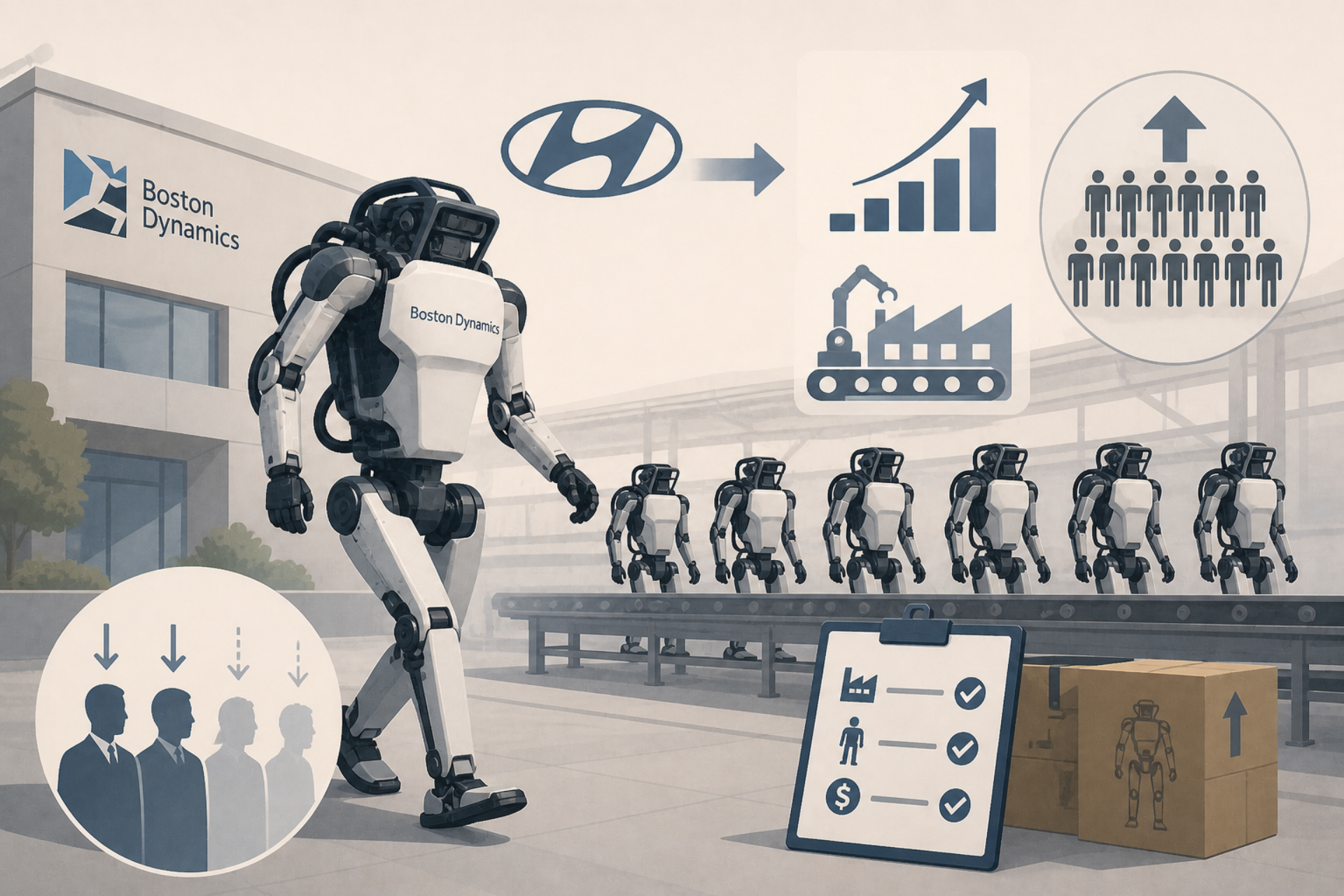
May 5, 2026 Boston Dynamics is under internal pressure as leadership changes coincide with a push to scale humanoid robot production. Hyundai, which acquired a majority stake in 2021, is reportedly demanding the company ramp manufacturing to tens of thousands of units in the coming years.
The shift follows a high-profile reveal at CES, where Boston Dynamics presented an updated Atlas robot and outlined plans for a new factory capable of producing up to 30,000 units annually. That ambition contrasts with current output levels, which are reportedly around four Atlas robots per month as the company works through manufacturing challenges.
The production push has been accompanied by leadership turnover. CEO Robert Playter retired earlier this year, followed by the departures of the chief operating officer and chief strategy officer. Reports citing former employees suggest additional exits among senior engineers and researchers, raising concerns about organisational stability during a critical scaling phase.
At the same time, competitive pressure is increasing. Companies including Tesla are advancing their own humanoid robotics efforts, contributing to urgency among Boston Dynamics’ leadership and board. The company is being pushed to move beyond research prototypes and deliver commercially viable systems for industrial use, particularly within Hyundai’s manufacturing operations.
Internally, the transition reflects a broader shift from research to productisation. Atlas project leadership has framed the move toward general-purpose humanoid robots as analogous to recent advances in AI software, where increased generality enables wider application. That framing underscores a change in expectations, from demonstrating capability to delivering scalable, deployable systems.
Boston Dynamics has said the organisational changes are intended to support mass manufacturing and rapid scaling. The company’s next phase will depend on whether it can translate its technical lead into consistent production at volume, while managing the operational and leadership challenges that come with it.