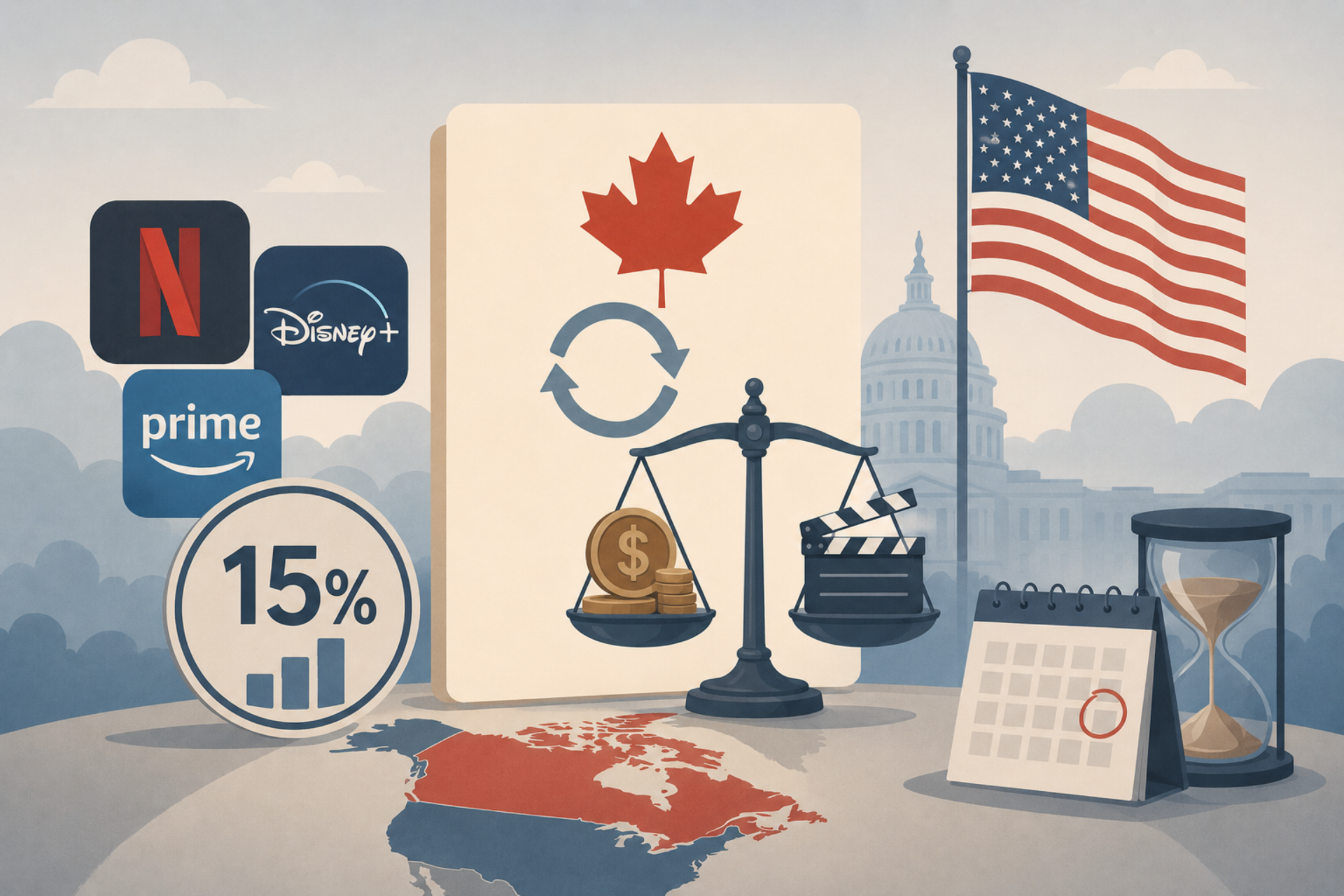
June 4, 2026 The federal government is directing the Canadian Radio-television and Telecommunications Commission (CRTC) to review its recent decision to triple the amount digital streaming companies must contribute toward Canadian content. The move comes amid mounting backlash from industry groups and growing pressure from the United States, which has repeatedly identified Canada’s Online Streaming Act as a trade concern.
Under previous CRTC rules, digital streaming platforms such as Netflix, Disney, and other major services were required to contribute five per cent of their Canadian revenues toward domestic content creation. However, those funds have yet to be collected because several streaming companies have challenged the requirements in court.
Late last month, the CRTC moved to increase that contribution rate dramatically, announcing that affected streaming services would be required to contribute 15 per cent of their Canadian revenues instead of five per cent. The decision immediately drew criticism from multiple directions.
In announcing the review order, the federal government pointed to concerns that the higher contribution requirements could ultimately increase costs for Canadian consumers.
“The CRTC’s new requirements would impose new costs on the companies providing these services, which could ultimately fall on Canadian consumers through higher prices,” Canadian Heritage said in a statement announcing the review.
“At a time when Canadians face cost-of-living pressure, now is not the time to make culture and entertainment more expensive.”
Affordability has become a central theme in the government’s response. Speaking to reporters on Parliament Hill, Canadian Identity and Culture Minister Marc Miller acknowledged the challenges facing Canada’s broadcasting and cultural sectors but stressed that affordability must remain part of the conversation.
“The reality is the sector’s been suffering,” Miller said.
He noted that ongoing litigation surrounding the Online Streaming Act has delayed the collection and distribution of funds intended to support the industry. At the same time, Miller emphasized that the government remains committed to supporting Canada’s cultural sector.
“The reality is we’re impatient to make sure that that sector stays vital and stays supported,” he said.
Miller pointed to a planned $600 million investment in the industry, arguing that workers and businesses cannot afford to wait for lengthy court battles to be resolved.
“That’s why we’re making that investment of $600 million into the industry that again needs it, and can’t wait for the litigations to be solved before people and jobs get lost,” he said.
The review also comes at a sensitive moment in Canada-U.S. trade relations. The United States has repeatedly raised concerns about Canada’s Online Streaming Act, viewing it as a measure that disproportionately affects American companies. In April, the office of U.S. Trade Representative Jamieson Greer included the legislation in its annual list of trade irritants. The report highlighted several Canadian policies viewed as problematic by Washington, including liquor regulations, supply management, procurement rules, and the Online Streaming Act.
While much of the attention has focused on Netflix, Disney, and other international platforms, Canadian broadcasters argue that they continue to face significantly heavier financial obligations. According to the Canadian Association of Broadcasters (CAB), private Canadian broadcasters are required to contribute 25 per cent of their revenues under the new framework.
Although the CRTC characterized the change as a reduction from contribution levels that were previously as high as 45 per cent, the CAB argued that domestic broadcasters still face a much larger burden than foreign streaming companies.
The federal government’s announcement does not clarify whether those broadcaster contribution requirements will also be included in the review. That leaves uncertainty over whether the review will focus solely on streaming platforms or examine the broader regulatory framework governing Canadian broadcasting and content funding.