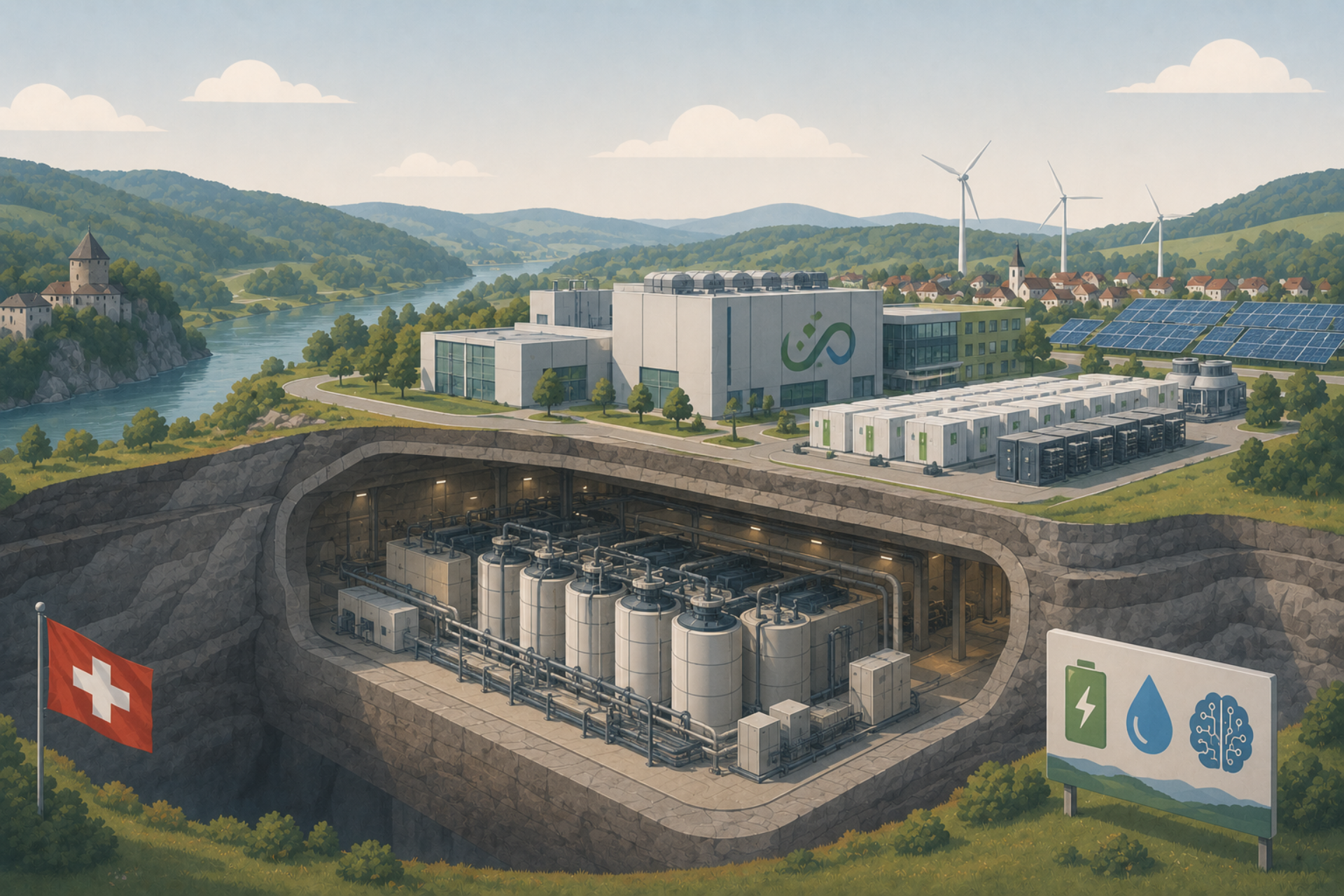
June 5, 2026 Switzerland is transforming a massive construction site in Laufenburg into one of Europe’s largest energy storage projects. The FlexBase development is planned to deliver more than 2.1 GWh of storage capacity and over 1.2 GW of power output, a scale the company says is comparable to the output of the Leibstadt nuclear power plant.
Located in the canton of Aargau near the historic Star of Laufenburg power hub, the project is being built at the Technology Center Laufenburg. Construction began in spring 2025 and combines a large redox flow battery system with a water-cooled AI data center, offices, and research facilities.
At the heart of the project is an underground excavation approximately 89 feet deep and longer than two soccer fields. The wider campus will cover more than 430,000 square feet, while the battery storage system itself is expected to occupy more than 215,000 square feet.
The project is designed to help address one of the biggest challenges facing renewable energy systems: balancing electricity supply and demand. Solar panels and wind turbines generate power when weather conditions allow, but electricity consumption does not always align with those periods.
FlexBase says the battery will store excess renewable energy and release it when demand increases, helping stabilize grid frequency and voltage. Swissgrid has already approved the first phase of the grid connection at 800 MW.
According to the company, the fully completed system is expected to exceed 2.1 GWh of storage capacity, enough to supply roughly 210,000 households with electricity for 24 hours.
Unlike traditional lithium-ion batteries, the project will use redox flow battery technology. These systems store energy in liquid electrolytes held in large tanks and pumped through electrochemical cells. During charging, electricity is converted into chemical energy, and the process is reversed when power is needed.
FlexBase says its system uses an aqueous electrolyte with a high water content that is non-flammable, non-explosive, and recyclable.
A major milestone was reached on May 21, 2026, when FlexBase announced a partnership with Invinity Energy Systems. Under the agreement, Invinity will provide a vanadium flow battery system with an initial scope of up to 1.5 GWh, with plans to expand to 2.1 GWh in later phases.
FlexBase CEO Marcel Aumer said Invinity’s technology was selected because of its safety characteristics, cycle stability, and operational flexibility.
Beyond energy storage, the project is intended to function as a broader technology hub. FlexBase plans to integrate battery storage, AI infrastructure, research facilities, and a heat recovery system.
The company says waste heat generated by the data center will be used to support a district heating network serving Laufenburg and surrounding communities. Over a 30-year period, FlexBase estimates the system could reduce carbon emissions by about 82,700 tons.
Swissinfo reported the privately financed project could cost between CHF 1 billion and CHF 5 billion ($1.2 billion to $6.2 billion) and create approximately 300 jobs. FlexBase has previously targeted full commissioning by 2028, while later reports suggest operations could begin in 2029.