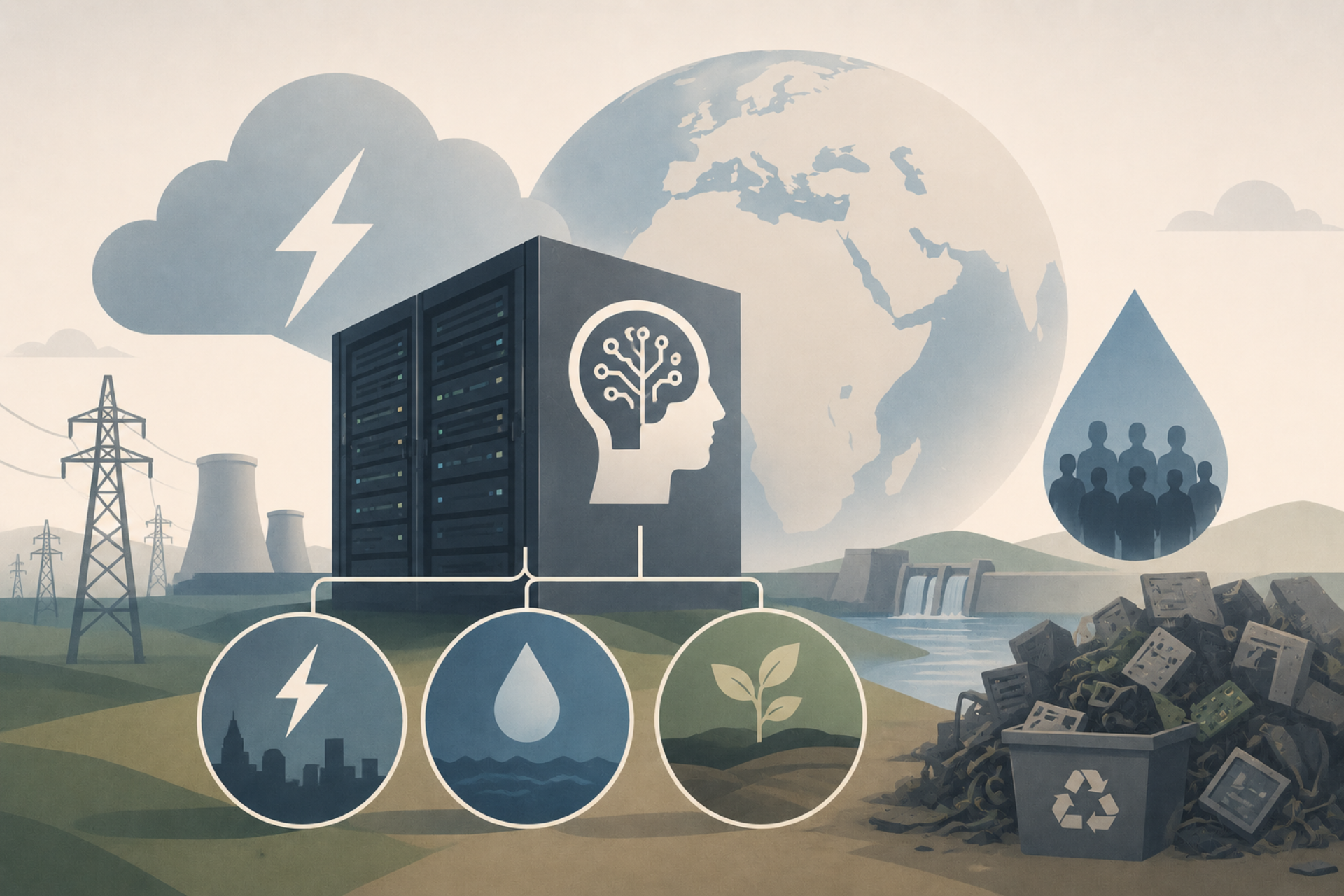
June 9, 2026 Artificial intelligence data centers are projected to consume 945 terawatt-hours of electricity annually by 2030, according to a new report from the United Nations University Institute for Water, Environment and Health (UNU-INWEH). The report says the associated water footprint would equal the basic annual domestic water needs of all 1.3 billion people living in Sub-Saharan Africa.
The study, titled Environmental Cost of AI’s Energy Use: Carbon, Water and Land Footprints, argues that the environmental impact of AI is often measured too narrowly through carbon emissions alone. Researchers examined the carbon, water and land footprints associated with the growing global demand for AI infrastructure. According to the report, global data centers consumed an estimated 448 terawatt-hours of electricity in 2025. If they were a country, they would have ranked as the world’s 11th-largest electricity consumer.
Researchers found that AI’s environmental costs extend beyond greenhouse gas emissions. Every unit of electricity used by AI systems also carries water demands for cooling and power generation, along with land requirements tied to infrastructure and supply chains. The report warns that reducing carbon emissions does not necessarily reduce other environmental impacts. In some cases, energy sources with lower carbon footprints can significantly increase water and land use.
The study also highlights a shift in where AI consumes energy. While public attention has focused on training large models, researchers estimate that inference, the ongoing process of running AI systems for user requests, accounts for 80 to 90 per cent of total AI energy use once models are deployed.
ChatGPT alone is estimated to process approximately 2.5 billion prompts each day, consuming roughly 383 gigawatt-hours of electricity annually. The report found that energy use varies dramatically depending on the task. A typical AI-generated image can require around 1,450 times more energy than a basic text-classification task, while a short AI-generated video can consume as much electricity as 200,000 spam classifications.
Researchers also highlighted growing concerns around resource concentration. Only 32 countries currently host AI-specialized data centers, with more than 90 per cent of global AI cloud compute capacity concentrated in the United States and China.
Beyond electricity use, the report projects AI infrastructure could generate up to 2.5 million tonnes of electronic waste annually by 2030. The authors called for broader environmental reporting standards, greater transparency, sustainable infrastructure planning and increased international cooperation to ensure AI development remains both environmentally sustainable and equitable.