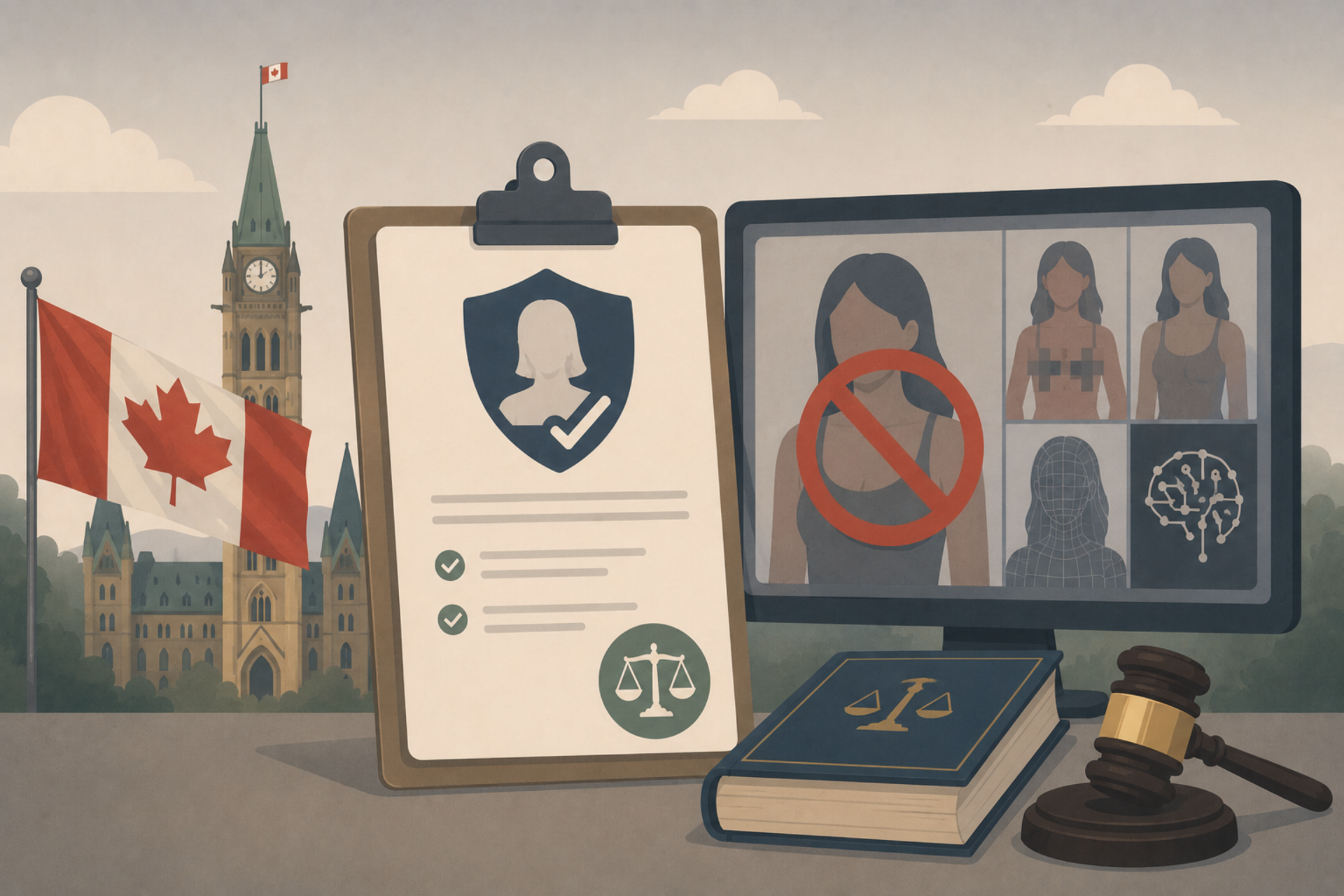
June 5, 2026 Canada’s proposed legislation targeting non-consensual deepfakes has been amended to include “nearly nude” images. The change comes after experts warned that the original version of the bill may not have covered many AI-generated images, including some that circulated earlier this year through Elon Musk’s Grok chatbot on X.
The amendment to Bill C-16 was approved by members of the House of Commons justice committee during its clause-by-clause review of the legislation. The original bill would have criminalized the non-consensual distribution of images showing a person nude, exposing sexual organs, or engaged in explicit sexual activity.
However, concerns were raised that some AI-generated content depicting individuals in revealing but not fully nude situations, such as altered images showing transparent or see-through clothing, might fall outside the bill’s scope.
Conservative MP Andrew Lawton introduced an amendment expanding the definition to include images in which a person is “nearly nude.” Committee members voted in favor of the change. “We are seeing with the advancement of technology these very sophisticated and in some cases quite traumatizing assaults taking place,” Lawton told the committee. “It simply just ensures that a small technicality is not excluding something that I think this law intends to capture.”
Liberal MP Patricia Lattanzio, parliamentary secretary to Justice Minister Sean Fraser, supported the amendment, saying it clarifies the offence and aligns with evolving case law while responding to victims’ needs.
The amendment was not unanimously supported. Bloc Québécois MP Rhéal Fortin objected, arguing that the term “nearly nude” lacks a sufficiently precise legal definition.
Bill explicitly references artificial intelligence
Committee members also approved another amendment that specifically references artificial intelligence software within the bill’s definition of an “intimate image.” Lawton said the addition is intended to ensure the legislation remains effective against modern AI technologies used to create synthetic content.
“We’re trying to ensure that we don’t end up having to come back to the drawing board because this fails to capture the technologies that we’re dealing with here,” he said.
An alternative proposal from NDP MP Leah Gazan was not adopted. Her amendment sought to include images depicting women and children in sexualized or humiliating situations that do not necessarily involve nudity, including images showing transparent clothing, blood, or bruises.
Gazan argued that such images are often created to humiliate victims and should be covered by the legislation.
Tougher penalties and faster removal requirements
The committee also approved amendments that would increase maximum penalties when deepfake material depicts sexual assault. Another amendment would require the removal of offending images within 48 hours.
Lawton said the deadline is intended to place greater responsibility on technology companies. However, a departmental expert told MPs it remains unclear whether the provision would ultimately speed up or slow down the takedown process. The committee completed its review of Bill C-16 last week. The legislation must still pass through the Senate before becoming law.
Deepfakes represent only one portion of the broader bill, which also includes provisions criminalizing coercive control and restoring mandatory minimum prison sentences that were previously struck down by courts. Bill C-16 is one of three crime-focused criminal justice bills currently being advanced by the Liberal government.