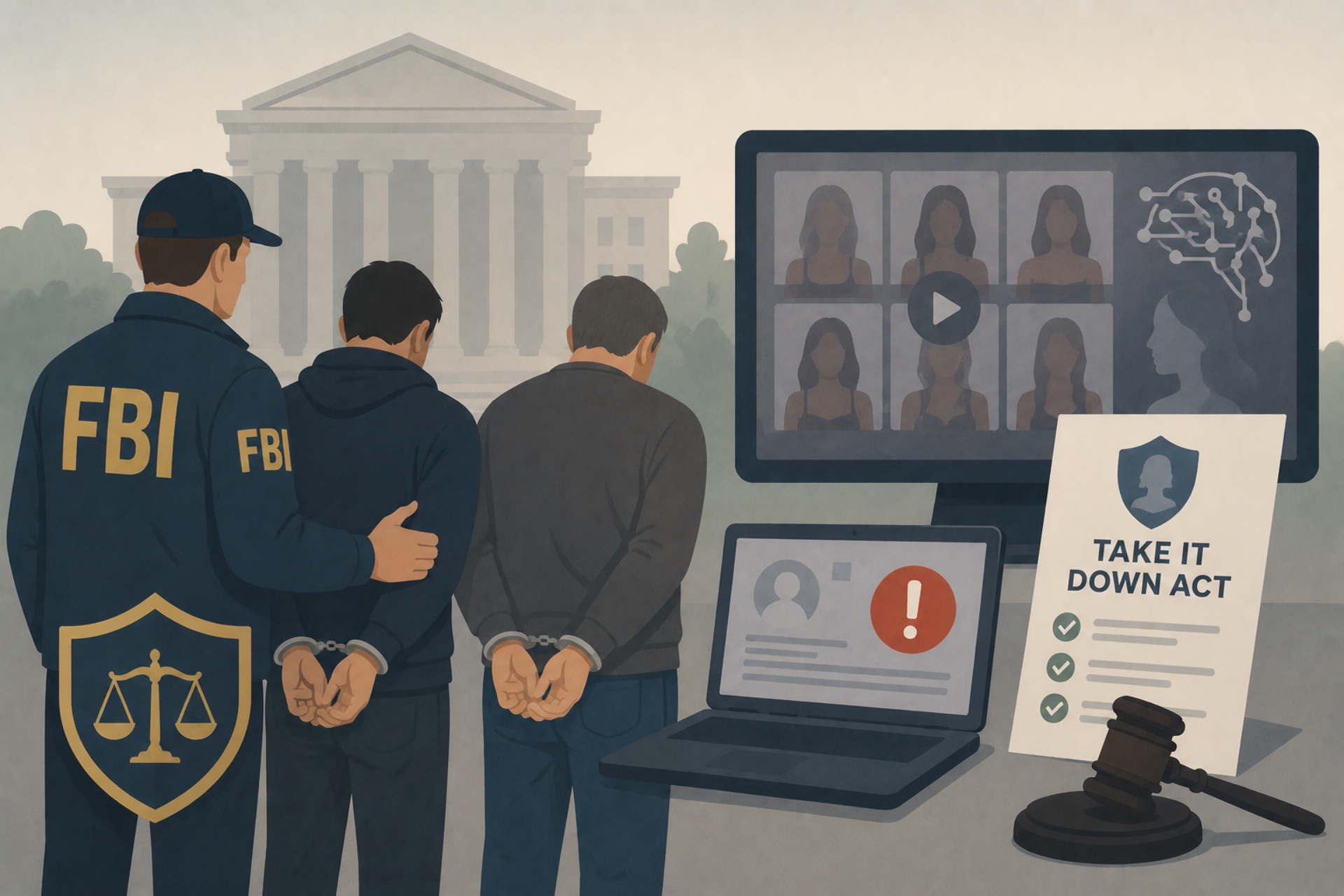
June 5, 2026 Federal investigators have made some of the earliest arrests under the Take It Down Act (TIDA), charging two men accused of creating and distributing nonconsensual AI-generated sexualized images of women online. The cases suggest law enforcement was able to identify suspects using account records, IP addresses, social media activity and publicly available information.
One suspect, 20-year-old Arturo Hernandez, is accused of posting 113 albums containing AI-generated sexualized images and videos of about 50 women. According to court filings, the content was viewed nearly one million times and included political figures, actresses, musicians, former classmates and social media contacts.
Investigators linked Hernandez to the activity through multiple sources, including geo-location data, PayPal records, IP addresses, Apple account records and Instagram activity. Authorities also found that Hernandez had saved on Instagram an image that was later used to create AI-generated content viewed more than 36,000 times.
The second suspect, 51-year-old Cornelius “Neil” Shannon, is accused of publishing approximately 360 AI-generated albums viewed more than two million times. The content allegedly featured around 90 women, primarily public figures such as politicians, actresses and musicians.
According to investigators, Shannon allegedly made identification easier by using his own photograph as the profile picture for the account. FBI agents compared the image to Department of Motor Vehicle records and surveillance photos. If convicted, both men face up to two years in prison under the Take It Down Act.
Federal officials signaled that enforcement efforts are likely to continue.
“This predatory conduct represents a disturbing abuse of technology that inflicts emotional harm on victims, violating their privacy, dignity, and security,” said James C. Barnacle Jr., assistant director in charge of the FBI’s New York field office. “The use of this emerging technology to victimize individuals is not innovative—it is criminal and will be pursued with the full force of the law.”
At the same time, regulators are also targeting companies that provide AI tools used to create such content. Last week, the Federal Trade Commission sent warning letters to 12 companies offering so-called “nudify” services, which use AI to generate nonconsensual intimate images. The FTC warned that these companies may be violating TIDA and must implement a process allowing victims to request content removal within 48 hours.
The agency said noncompliance could result in civil penalties of up to $53,088 per violation. The FTC has also contacted major online platforms, including Amazon, Alphabet, Apple, Bumble, Discord, Meta, Microsoft, Pinterest, Reddit, Snapchat, TikTok and X, reminding them of their obligations under the law.
X recently announced that victims can report content through a dedicated Take It Down Act reporting process, stating that reports are reviewed within the law’s required 48-hour timeline. The Take It Down Act requires online platforms to provide mechanisms for victims to report and remove nonconsensual intimate images, including AI-generated deepfakes.