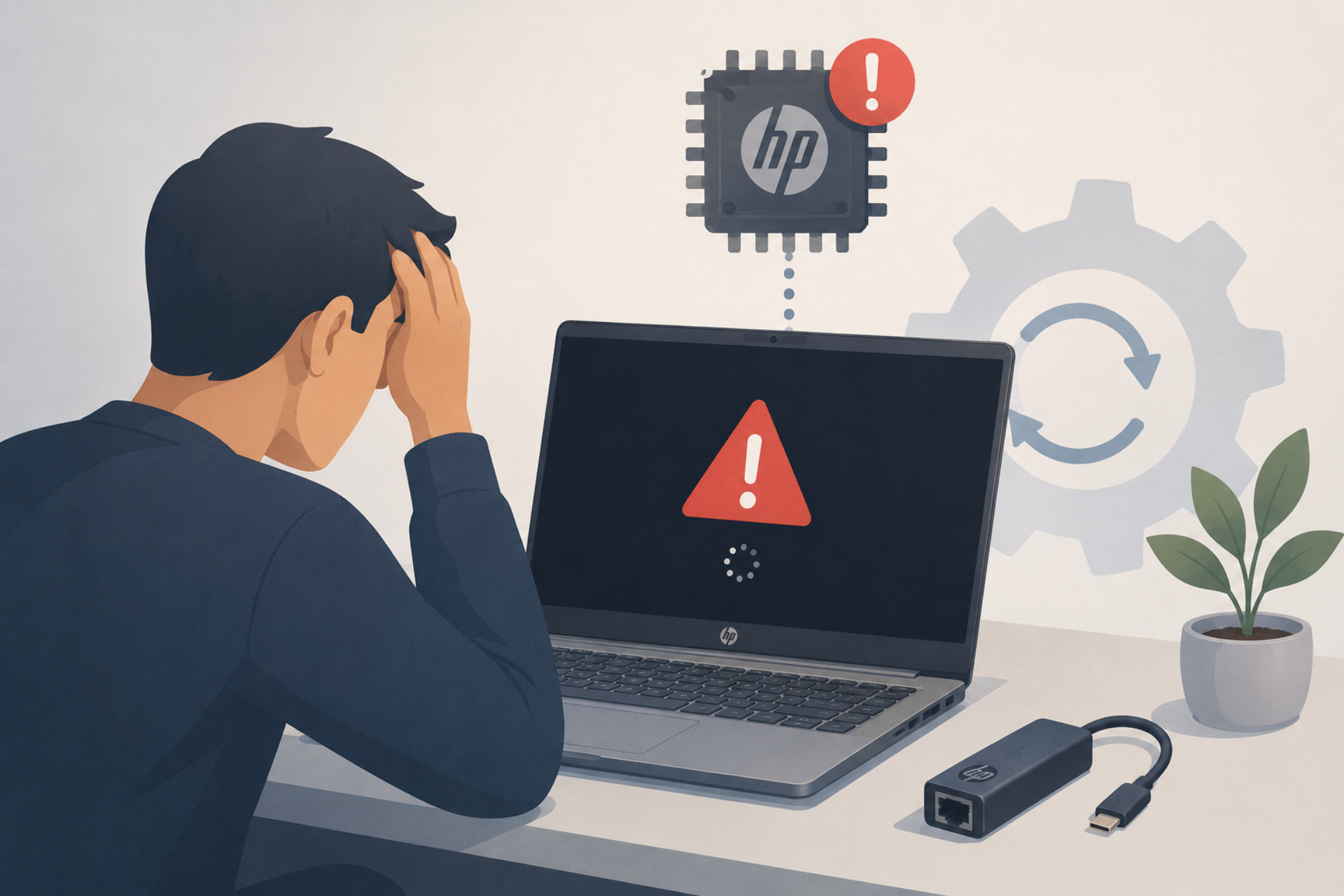
May 25, 2026 Customers of HP are reporting serious issues after installing recent BIOS updates on some of the company’s premium laptops. Many of the affected updates were flagged as “critical” and automatically delivered through Windows Update, leaving users little control over whether the firmware was installed.
Over the past few months, complaints have surfaced across forums describing devices that fail to boot, freeze during startup, or suffer from persistent system instability. Some users have also reported spikes in fan noise and repeated Blue Screen of Death (BSOD) errors following the updates.
One widely cited example involved a user of the ZBook Ultra G1a, a high-end mobile workstation, who said their system froze completely during the boot process after installing a BIOS update. Specific BIOS versions linked to issues include 01.04.03 and 01.04.05 for the ZBook Ultra G1a, and 01.03.11 and 01.05.00 for the EliteBook X G1a.
The root of the problem appears tied to how these updates are distributed and applied. Because the BIOS updates were categorized as critical, they were automatically pushed to devices via Windows Update. Once installed, however, reverting to a stable version has proven difficult for many users.
While some have managed to roll back to earlier firmware using HP’s network BIOS downgrade feature, this workaround requires additional hardware, specifically an HP USB-C to Ethernet dongle, and is not a straightforward process for most users.
The situation is not without precedent. In 2024, HP faced similar issues when a BIOS update left some devices permanently unusable, forcing customers to deal with costly repairs or replacements. The recurrence of such problems has raised concerns about the reliability of firmware updates, particularly when they are automatically deployed.
The timing is notable. Microsoft has been working to improve the reliability of its ecosystem, including applying greater scrutiny to third-party drivers and firmware distributed through Windows Update. BIOS updates, which operate at a low level of system functionality, carry higher risk when they fail compared to standard software patches.
HP has acknowledged the situation, stating that it is aware of the reported BIOS issues and is investigating them. The company has advised affected users to contact its support teams for assistance.
At the same time, HP recently strengthened its involvement in the broader firmware ecosystem. On May 20, the company joined the Linux Vendor Firmware Service (LVFS) project as a premier sponsor, alongside other manufacturers. LVFS is an open-source initiative designed to streamline and improve firmware updates across devices.