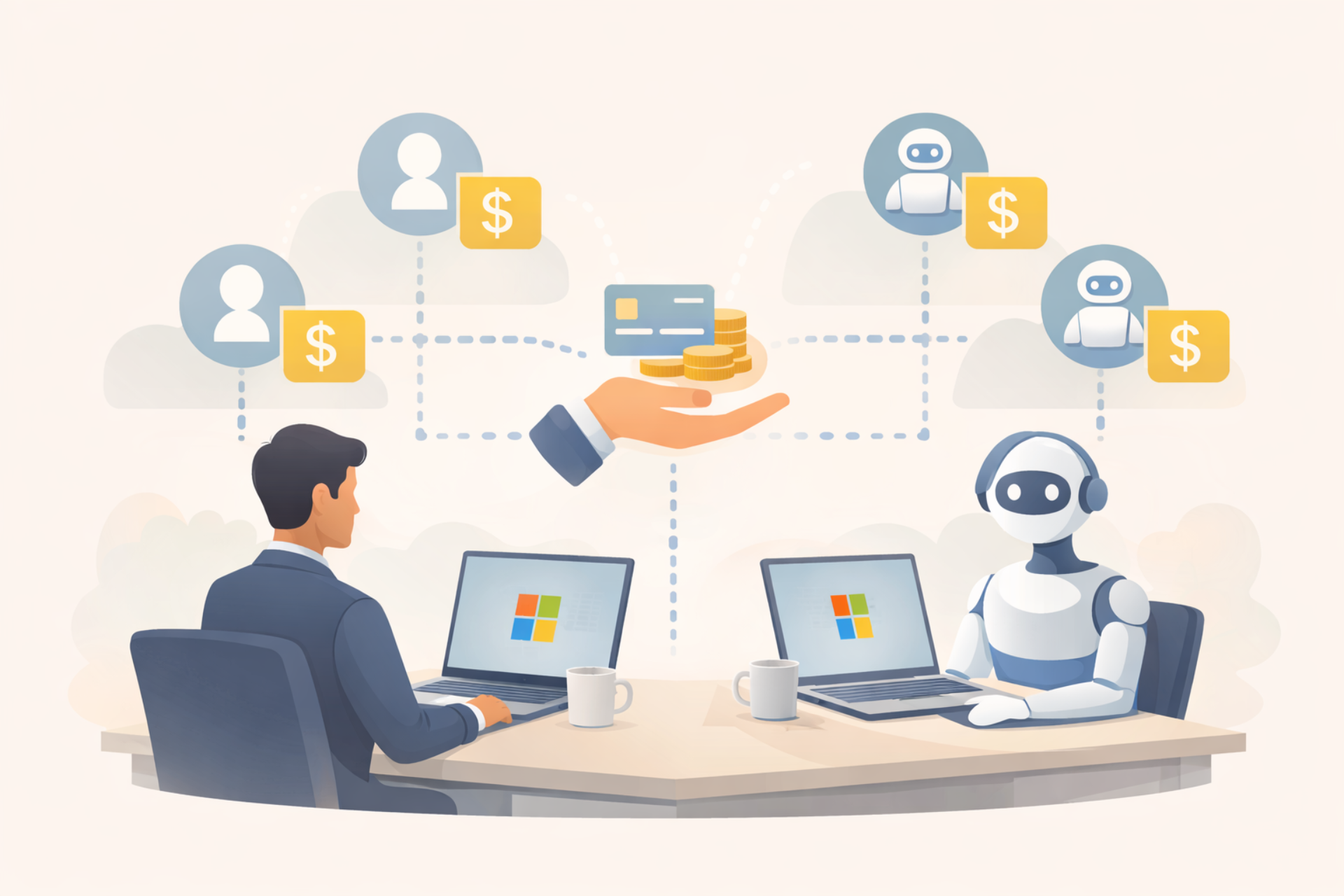
April 14, 2026 A senior Microsoft executive has suggested that AI agents may soon be treated as full software users, complete with logins, inboxes and paid licences. If adopted, the shift could reshape how enterprise software is priced, with companies potentially paying for fleets of AI agents rather than just human employees.
The idea was outlined by Rajesh Jha, who argued that AI agents should be viewed as “seat opportunities,” meaning each agent could require its own subscription in the same way a human user does. In this model, software demand would not shrink with automation but expand alongside it.
The proposal lands at a moment of growing uncertainty for the software-as-a-service industry. Investors have been questioning whether AI will erode traditional seat-based pricing models, where companies pay per employee using a system. If fewer people are needed to run operations, the assumption has been that software revenue would decline.
Jha’s argument flips that logic. Instead of reducing seats, AI could multiply them. A company that currently pays for 20 licences might reduce its workforce but deploy dozens of AI agents, each performing tasks across workflows. Even with fewer employees, the total number of “users,” now including agents, could increase.
Not everyone in the industry agrees with that outlook. Nenad Milicevic, a partner at AlixPartners, expects the opposite effect. He argues that AI agents will reduce the number of humans interacting with software systems, which would in turn reduce the number of licences required. In that scenario, companies may push back against pricing models that charge for agent access, especially if those agents are simply extensions of existing users.
That disagreement highlights a deeper issue for software vendors. If agents are treated as independent actors, charging per agent may be justified. But if they are seen as tools controlled by a single user, additional fees could be viewed as duplicative. Vendors that enforce strict pricing on machine-based access may risk losing customers to competitors offering more flexible models.
The debate also has implications for platform strategy. Milicevic suggests that open platforms could gain an advantage if they allow AI agents to operate without additional licensing friction, while more restrictive ecosystems may face pressure to adapt.
At its core, the question is simple but unresolved: does an AI agent count as a user, or just an extension of one? How companies answer that question will shape not just pricing models, but the structure of enterprise software itself as AI agents become embedded across workflows.