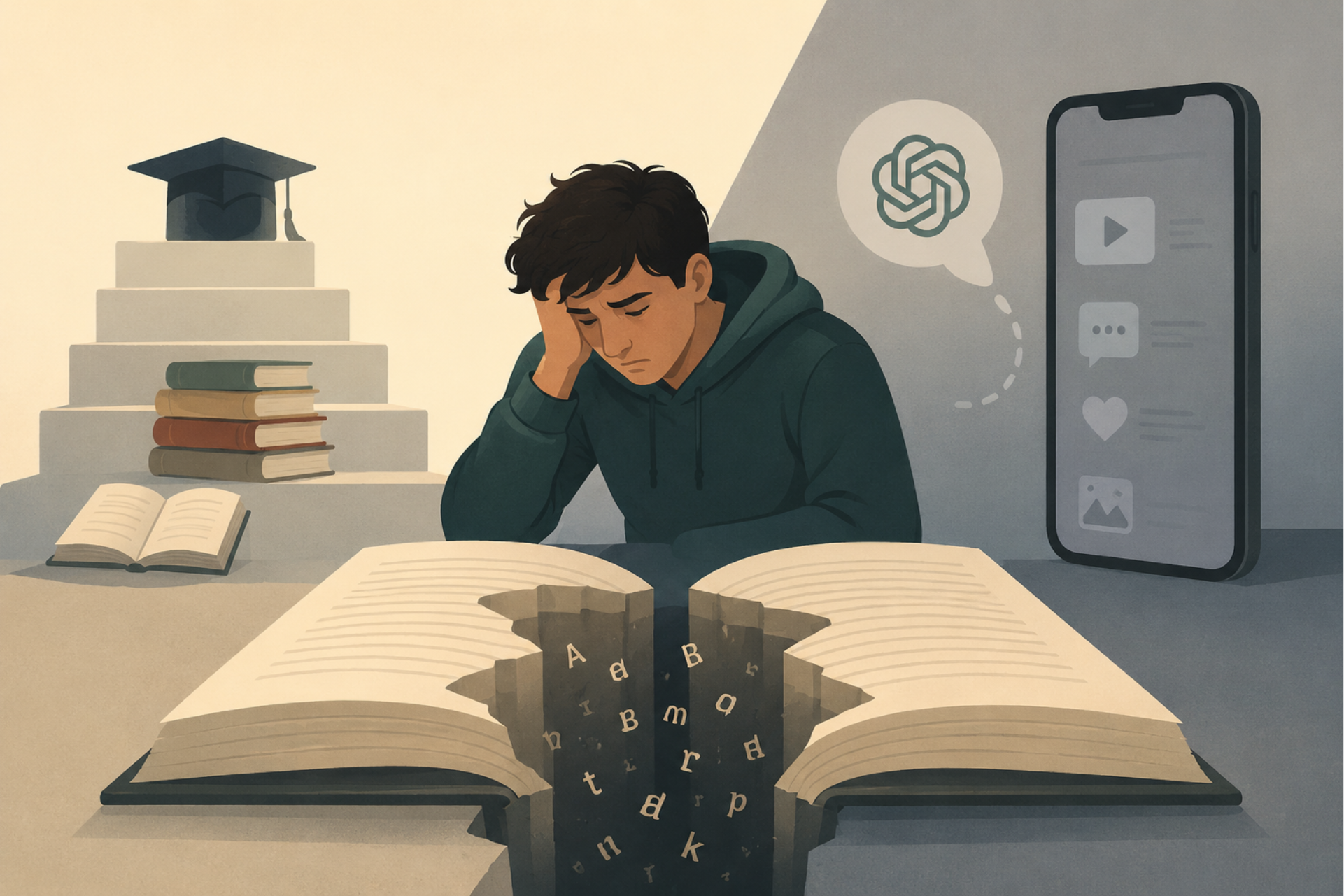
June 15, 2026 A university literature and writing instructor says many students are now struggling to complete even modest reading assignments. National reading assessments show 12th-grade reading scores have fallen to their lowest level since testing began in 1992, with nearly one-third of students performing below the basic reading level.
In an essay published by The Chronicle of Higher Education, instructor Tyler Jagt described assigning a 20-page academic article to his students and finding that not a single student completed it successfully. According to Jagt, one student admitted they repeatedly lost track of what the article was about and could not finish reading it. He argued that what he is seeing in the classroom reflects a broader decline in reading and writing abilities rather than isolated student struggles.
Jagt pointed to data from the 2024 National Assessment of Educational Progress, which found significant declines in reading performance among high school students. He also cited a report from the Annie E. Casey Foundation showing that 70 percent of fourth graders are not reading at a proficient level.
The instructor said the rise of generative AI has complicated the problem. Many students use AI tools to summarize difficult readings, while others rely on them to generate essays or solve coursework. At the same time, universities have increasingly provided students with access to AI tools, accelerating their adoption in education.
Research on AI’s educational benefits remains mixed. Jagt noted that one major study claiming ChatGPT improved learning outcomes was retracted last month. Other studies have linked AI use to reduced critical thinking and memory-related concerns.
He highlighted an MIT study that found users who relied on ChatGPT during writing tasks showed lower activity in brain regions associated with creativity. The study also found that 83 percent of AI users could not quote a single line from essays they had just written.
Jagt also pointed to smartphones as another contributing factor. He cited a 2017 study showing that simply having a smartphone nearby, even when turned off, reduced cognitive capacity and impaired performance.
According to Jagt, the reading crisis is ultimately a structural problem that educational institutions have largely left individual instructors to manage. He said he has been forced to split reading assignments into smaller sections and spend class time teaching note-taking and reading-comprehension skills that would traditionally have been learned much earlier.
“When I assign analysis, I am not trying to extract a polished product; I am trying to put the student’s mind through resistance in order to make it stronger,” Jagt wrote. He argued that relying on chatbots to avoid difficult intellectual work prevents students from developing the skills needed for deeper learning.