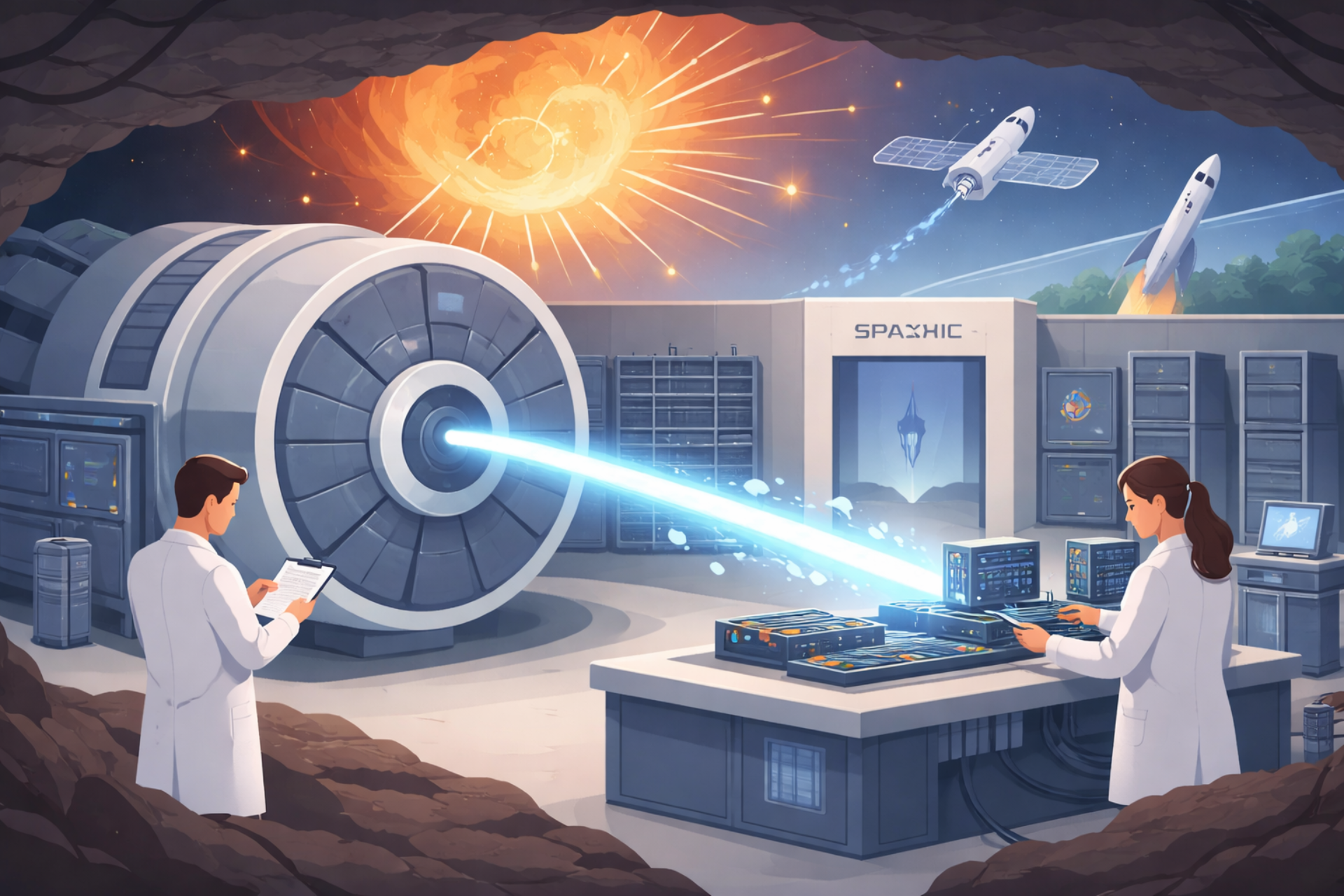
February 12, 2026 The Sun’s radiation has become an existential risk for spacecraft, and SpaceX is taking the fight underground, literally. The Elon Musk-led company is building a powerful cyclotron particle accelerator in Florida to simulate space radiation and test the resilience of its spacecraft hardware, including its Starlink satellites.
Unlike auroras that dazzle Earth’s skies, charged solar particles pose a serious threat to electronics in orbit. These particles can overload circuits, corrupt onboard systems and shorten satellite lifespans. SpaceX’s new facility, designed to blast electronics with high-energy protons, will replicate these extreme conditions here on Earth, helping engineers understand and harden their hardware before it reaches orbit.
The Florida-based cyclotron will accelerate individual protons to 230 mega-electronvolts (MeV), allowing them to collide with chips and printed circuit boards under tightly controlled conditions. The goal is to identify how radiation affects electronic components across SpaceX’s fleet – from Starlink to Falcon, Dragon, Starship and future lunar vehicles.
According to job listings and public comments from SpaceX VP of Starlink Michael Nicolls, the company is hiring engineers to join its “Radiation Effects team,” tasked with screening and characterizing electronics for performance under cosmic duress. In other words, SpaceX is bringing single-event testing in-house, slashing dependency on external labs and streamlining development across its satellite and spacecraft programs.
Solar storms have already taken a toll on the Starlink constellation. In past years, geomagnetic events triggered by heightened solar activity have led to satellite degradation and premature de-orbiting. With more than 5,000 satellites currently in orbit and thousands more planned, such risks threaten both operational continuity and revenue.
But the stakes climb even higher beyond Earth orbit. In deep space, radiation is far more intense, as no atmospheric shield exists there. Future missions to the Moon, Mars and beyond must account for hardware degradation and, eventually, human safety. A single glitch in flight computers or life-support systems due to radiation could endanger entire missions.
SpaceX’s decision to build its own accelerator is part of a growing trend of vertically integrating capabilities critical to space resilience. While some of the world’s most powerful accelerators, such as the 590 MeV Ring Cyclotron in Switzerland, are research-focused, SpaceX’s facility appears squarely aimed at iterative testing and hardware qualification for space deployment.
Beyond the glamour of rocket launches, this move highlights the unseen challenges of space travel. Every system onboard a satellite or crewed capsule is vulnerable to high-energy particles. Even slight disruptions can cascade into mission failure. By creating its own radiation lab, SpaceX is reinforcing its engineering pipeline and reducing development lag for new designs and missions.