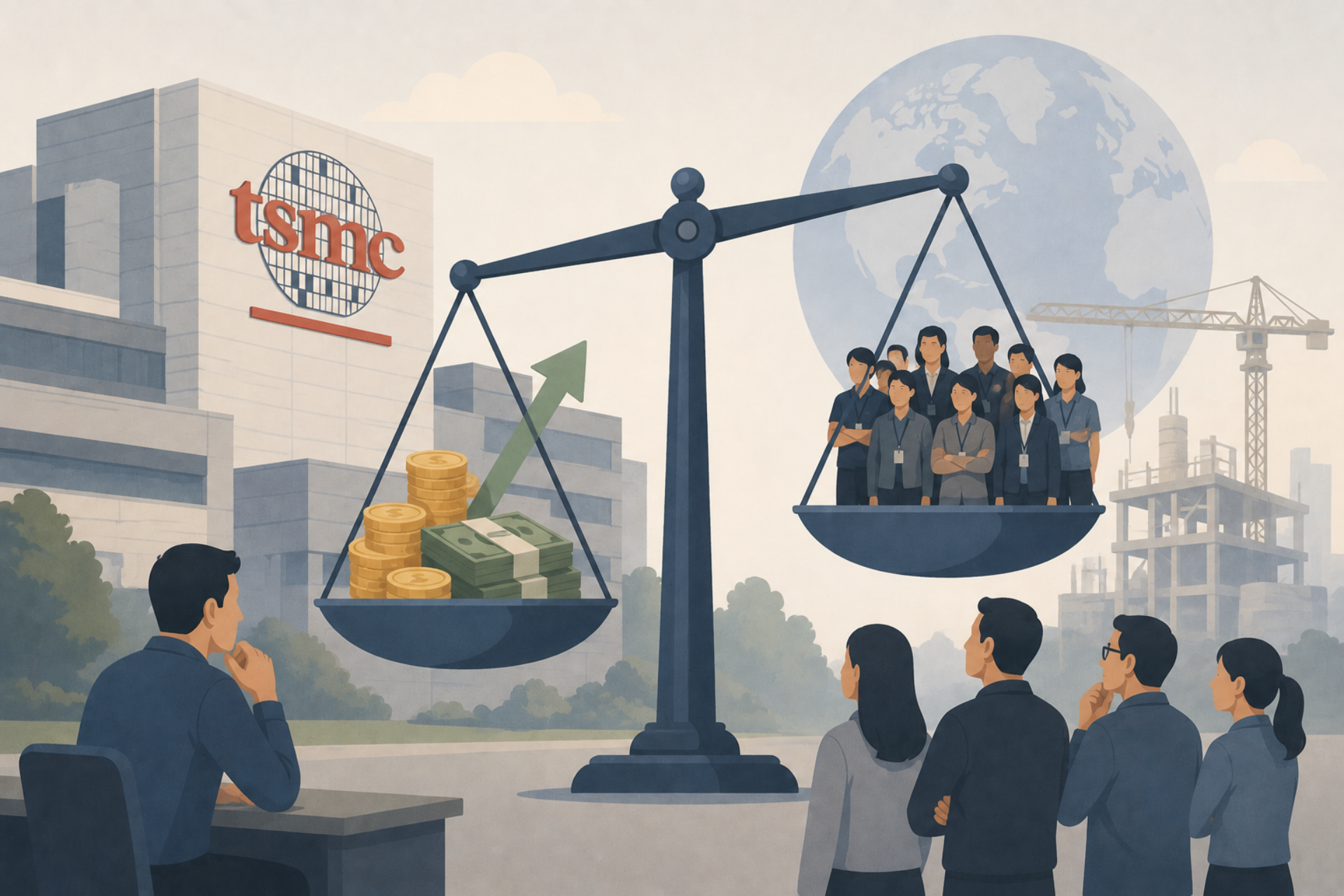
May 26, 2026 Employees at TSMC are increasingly voicing frustration over potential cuts to their annual bonuses. The discontent follows speculation that 2025 bonuses, expected to be paid in July, could be reduced by as much as 15% as the company ramps up spending on overseas expansion.
The tension comes at a moment when the semiconductor industry is riding a powerful wave of growth, fueled by the ongoing chip supercycle. But that same boom is now exposing a deeper conflict inside companies: how to balance aggressive investment with rewarding the workforce driving that success.
At TSMC, bonuses are tied directly to performance. The company allocates at least 1 per cent of its operating profit to annual bonuses, with final decisions made by its board and compensation committee. Earlier this year, the board approved a bonus pool of 206.15 billion Taiwan dollars (about $6.5 billion), representing roughly 10.6 per cent of operating profit for 2025.
Based on estimates, that pool could translate to an average payout of around 2.64 million Taiwan dollars per employee across a workforce of about 78,000. Payments are typically distributed in five installments, with employees already receiving quarterly bonuses equivalent to about 5 per cent of operating profit last year. The remaining balance is expected in July.
But despite those headline figures, uncertainty over how bonuses are calculated and distributed has become a major source of frustration. Unlike Samsung Electronics or SK hynix, TSMC does not disclose individual bonus amounts. Instead, payouts vary depending on department-level performance and internal evaluations, which employees say lack transparency.
That opacity is now colliding with rumors that the company may tighten performance criteria, effectively reducing payouts to help fund its global expansion strategy. TSMC has not publicly responded to the speculation.
The backlash is particularly sharp because it comes alongside strong financial results. The company reported first-quarter revenue of 1.13 trillion Taiwan dollars and net profit of 572.48 billion Taiwan dollars, representing increases of 35.1% per cent and 58.3 per cent year-over-year, respectively.
For many employees, the contrast between record profits and potential bonus reductions is difficult to reconcile. Complaints have spread across internal forums and social media groups, with some workers questioning whether the company is prioritizing shareholders over staff.
“The company changing promised bonuses whenever it wants is exactly the same kind of internal management it has always practiced,” one employee wrote. Another added that workers are under constant pressure and feel the proposed cuts are unfair given the company’s performance.
The situation is also unfolding against a broader backdrop of labor unrest in the semiconductor industry. At Samsung Electronics, union tensions recently escalated to the brink of a full-scale strike before a last-minute agreement was reached. Some TSMC employees are now openly referencing those events as a possible blueprint for collective action.
Posts in employee communities have begun pointing to Samsung’s wage negotiations, with comments suggesting that similar action could be on the horizon if concerns are not addressed.