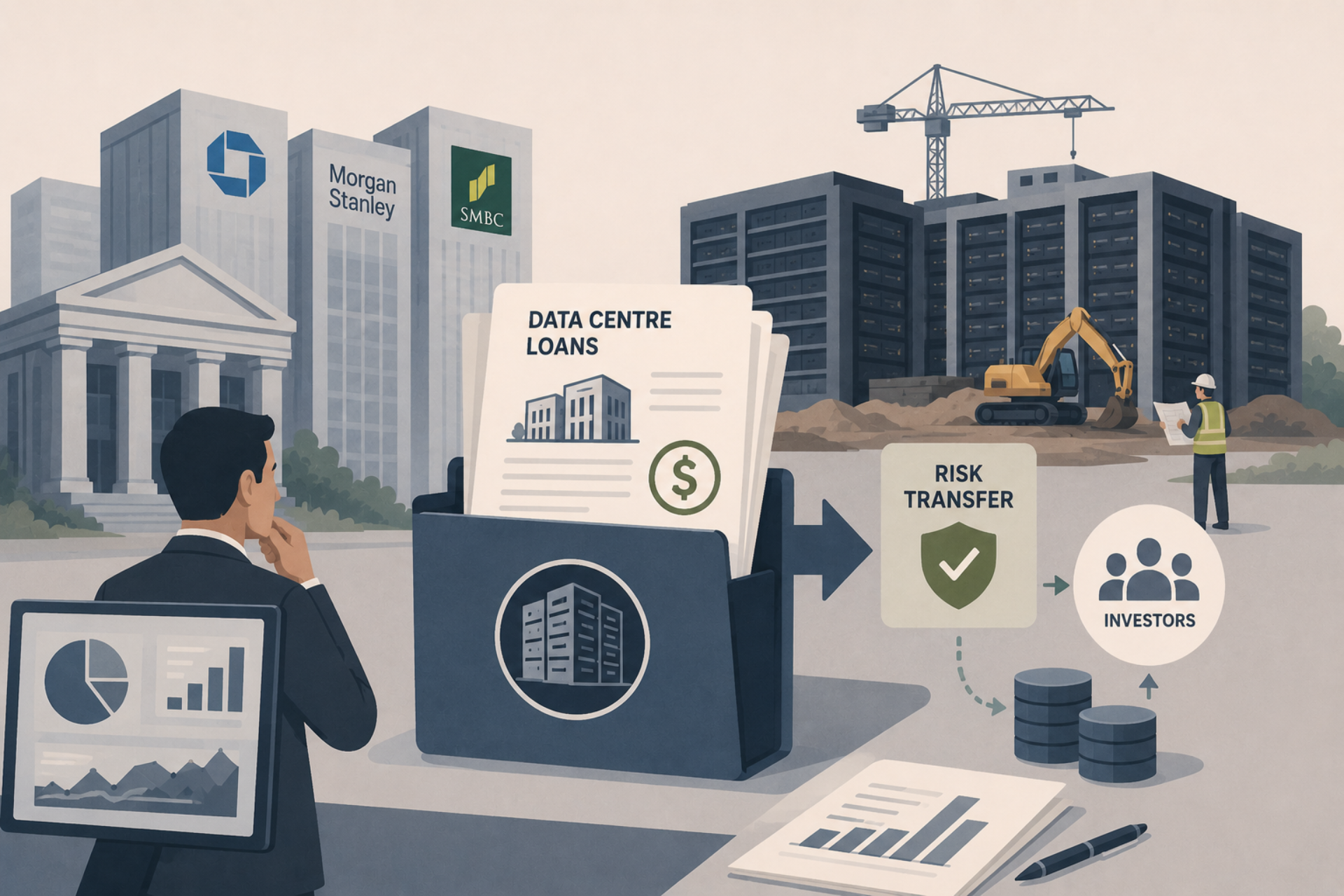
May 6, 2026 Major banks are searching for ways to reduce their exposure to the enormous loans financing AI data centres as demand for artificial intelligence infrastructure pushes traditional lending models to their limits. Institutions including JPMorgan Chase, Morgan Stanley and SMBC are reportedly exploring private debt sales and risk-transfer structures to distribute portions of data centre financing to other investors.
The move reflects the unprecedented scale of borrowing tied to the AI buildout now underway across the United States. Companies such as Oracle and CoreWeave have borrowed hundreds of billions of dollars to fund data centre construction for AI workloads, creating concentrated exposures that are testing bank balance sheets and internal risk limits.
“The sizes we’re talking about . . . they’re out of scale to anything we’ve thought about, ever. Banks very quickly start choking,” said Matthew Moniot, co-head of credit risk sharing at Man Group.
According to people familiar with the matter, lenders including JPMorgan and MUFG have already spent more than six months attempting to distribute roughly $38 billion in construction debt connected to a data centre project in Texas and Wisconsin leased to Oracle. Some banks reportedly attempted to sell portions of those loans at a discount to non-bank investors in order to reduce their exposure.
The pressure is forcing banks to experiment with financial structures more commonly associated with European banking markets. Several institutions have reportedly approached investors about variations of so-called significant risk transfers, or SRTs. These deals allow banks to move portions of loan risk off their books while still maintaining part of the exposure themselves.
Traditionally, SRTs involve diversified portfolios of loans, but AI infrastructure financing presents a different challenge. Many of the projects are highly concentrated around a small number of borrowers and involve significant construction risk. That concentration makes investors more cautious and raises the returns they expect in exchange for taking on the risk.
“Unlike a traditional SRT, there are limited operators, it’s extremely concentrated and there’s significant construction risk,” said Frank Benhamou, portfolio manager at Cheyne Capital. “You expect to be paid a bit more for it.”
Banks are also facing another growing problem: public opposition to large-scale data centre developments. Communities across parts of the U.S. have raised concerns about energy consumption, water use and land development tied to AI infrastructure projects. In April, lawmakers in the state of Maine passed a statewide ban on new data centres, adding another layer of uncertainty for lenders evaluating long-term projects.
“If I was a chief risk officer at a bank, and I had bankers asking for multibillion-dollar lines to individual projects, I’d be asking them about how they sell it down,” Moniot said.
The financing market is already evolving in response. Data centre operators are increasingly turning beyond traditional syndicated bank loans and tapping private credit markets, asset-backed securities, commercial mortgage-backed securities and privately placed bonds to fund expansion.
“There’s a nervousness . . . [Banks] are having to find more counterparties in order to achieve for what’s in the market and in the pipeline,” said Carlos Mendez, co-founder of Crayhill Capital.