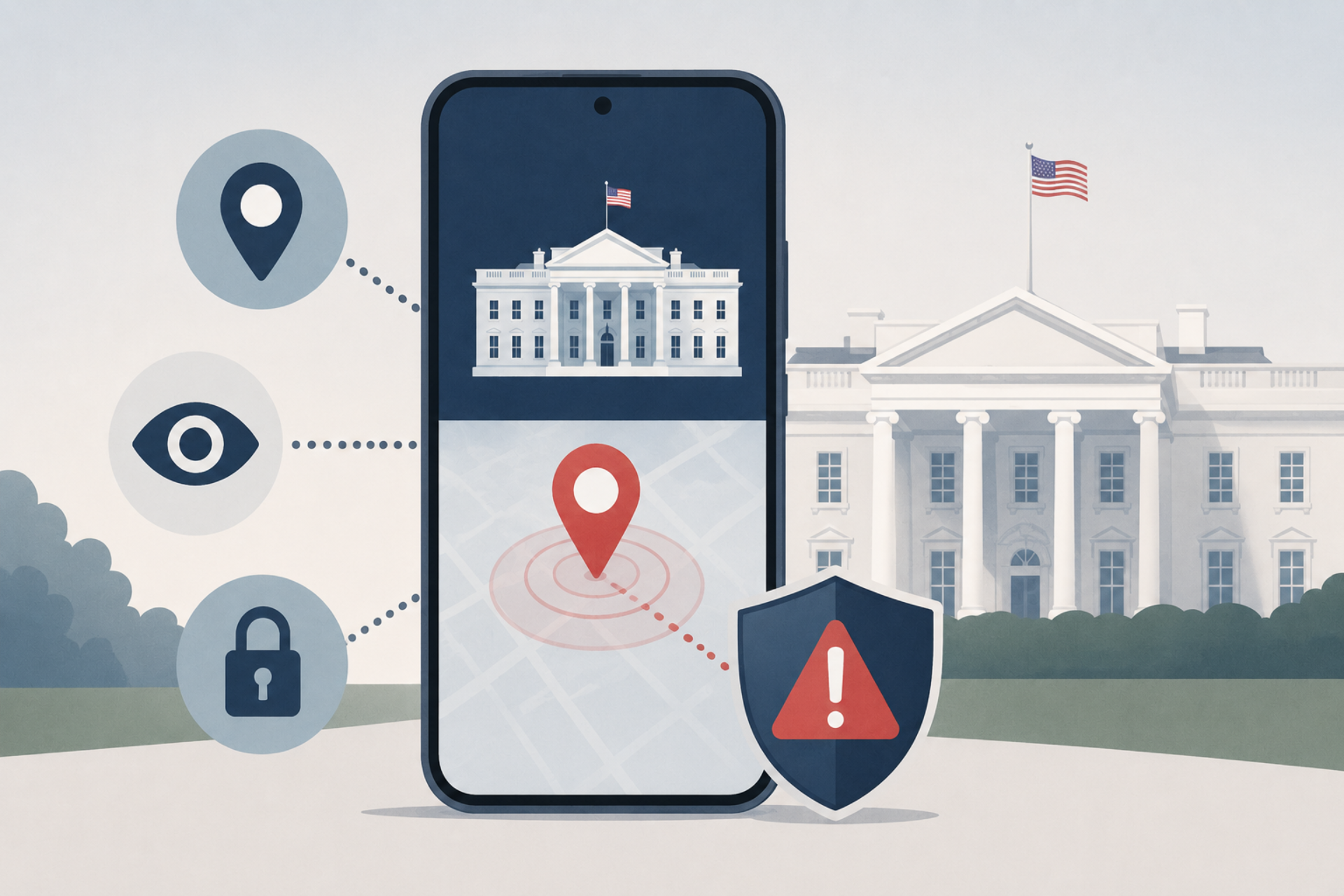
May 6, 2026 The official White House mobile app for iOS and Android is facing scrutiny after a security researcher analyzed its Android package and reported extensive location tracking capabilities and multiple security weaknesses. The app, launched by The White House as a way to provide users with “unparalleled access to the Trump Administration,” reportedly includes code capable of collecting GPS data every few minutes and sending it to third-party infrastructure.
The findings emerged after researchers decompiled the Android APK and inspected the app’s underlying architecture and permissions. According to the analysis, the app is built using React Native and Expo SDK 54, while the backend relies on [WordPress](https://wordpress.org?utm_source=chatgpt.com) through a custom REST API. While those technologies are common in mobile and web development, researchers say the implementation raised concerns about both privacy and security practices.
One of the most discussed findings involves location tracking. The analysis claims the app contains a full GPS tracking pipeline capable of polling user location approximately every 4.5 minutes while the app is active and every 9.5 minutes in the background. The system reportedly collects latitude, longitude, timestamp and accuracy data and syncs it through infrastructure connected to OneSignal.
Researchers noted that the location requests are not explicitly declared inside the AndroidManifest file, but are instead handled dynamically through the OneSignal SDK at runtime. Some developers familiar with the framework pointed out that the tracking functions would still require user permission and server-side activation before becoming operational. Still, privacy advocates argued the presence of the code itself raises questions about how aggressively the app was designed to collect user data.
The review also identified broader application security concerns. According to the report, the app loads JavaScript for embedded YouTube content from a personal GitHub Pages site rather than from infrastructure controlled directly by the White House or a managed enterprise service. Researchers warned that if the associated GitHub account were ever compromised, malicious code could potentially be injected into the app’s WebView environment.
Another issue highlighted in the analysis is the lack of SSL certificate pinning, a security technique used by many mobile apps to reduce the risk of man-in-the-middle attacks on compromised or untrusted networks. Without certificate pinning, researchers say traffic interception may become easier on hostile public Wi-Fi networks or corporate proxy systems.
The app’s in-app browser functionality also drew criticism. According to the findings, the application injects custom JavaScript and CSS into webpages opened inside the app. Researchers claim the injected code removes cookie consent prompts, GDPR notices, login walls and certain paywall mechanisms.
The APK reportedly also contained development artifacts left inside the production build, including references to localhost Metro bundler URLs commonly used during React Native development. While leftover debug components are not uncommon in rushed software releases, they are generally viewed as poor security hygiene in production applications tied to government infrastructure.
The controversy reflects growing scrutiny around government-developed apps and how they handle user privacy, particularly when they involve political engagement, personalized communication or behavioural analytics. Security researchers increasingly examine public-sector apps the same way they audit commercial consumer platforms, especially when those apps request persistent permissions or embed third-party tracking frameworks.
The findings also arrive at a time when mobile privacy practices are under broader public pressure. Both Apple and Google have introduced stricter app permission systems in recent years, requiring developers to more clearly disclose how user data is collected and used. Even so, researchers often discover functionality that is technically permissible under platform rules but still raises concerns about transparency or necessity.
At the centre of the criticism is not simply the use of analytics or location infrastructure, which are common across many modern apps, but the combination of persistent tracking capabilities, third-party dependencies and reported security oversights inside an official government application.
No evidence has been presented showing that the app was actively exploited or that user data was compromised. However, the analysis has intensified debate over what level of security and privacy standards should apply to government-affiliated consumer apps, particularly those encouraging direct engagement with political institutions.