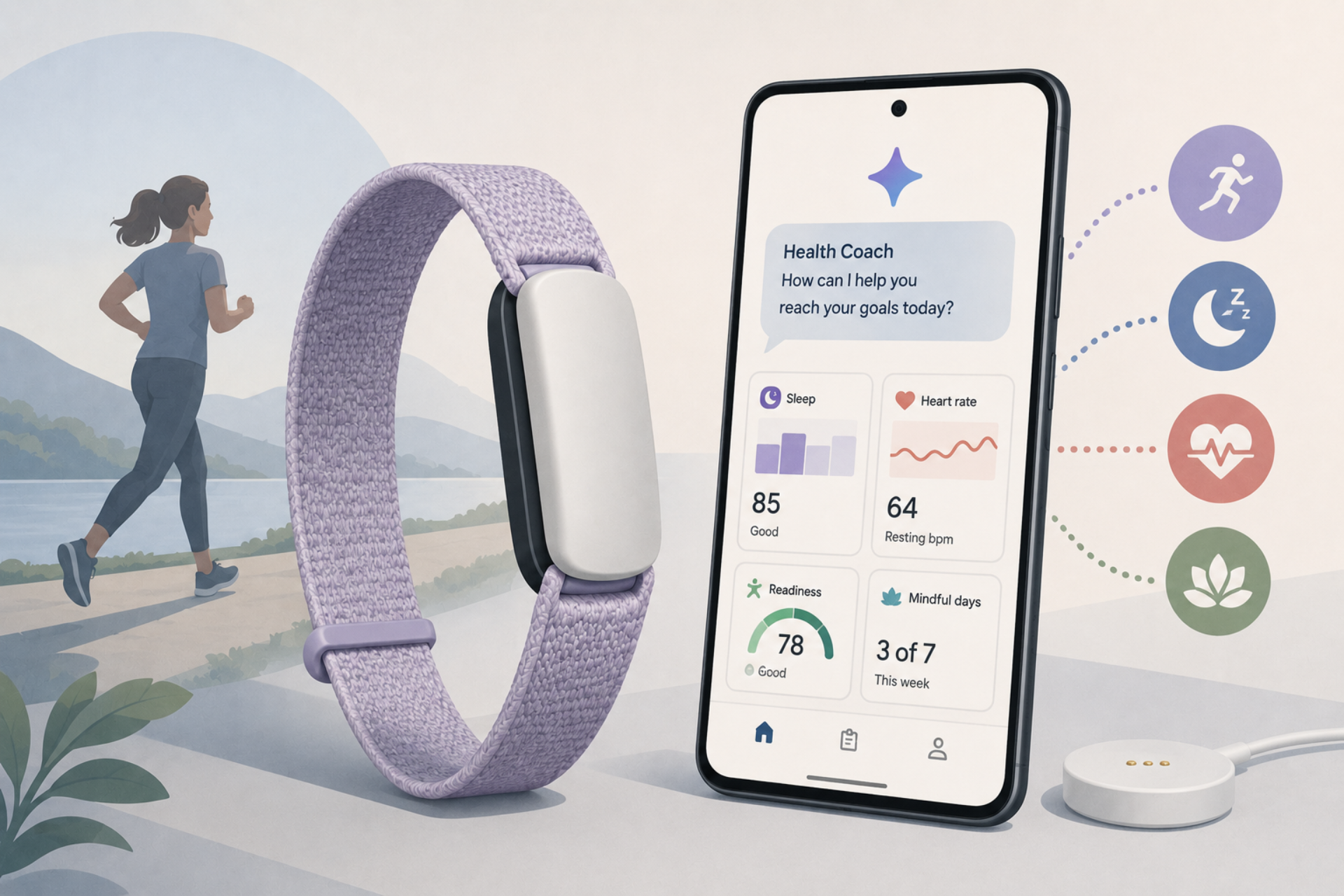
May 9, 2026 Google Fitbit has introduced the Fitbit Air, a new $99.99 screenless fitness tracker designed around AI-powered health coaching and continuous wellness monitoring. The wearable’s core feature is a revamped Google Health Coach powered by Gemini AI, which combines fitness tracking data with user-provided information such as injuries, nutrition and weather conditions to deliver more personalized guidance.
The Fitbit Air enters a growing category of screenless health trackers that includes products from Whoop and Polar. Last year, Polar launched its subscription-free Loop tracker, while Google previously teased the Fitbit Air through promotional appearances involving Stephen Curry.
The Fitbit Air tracks steps, workouts, sleep and heart rate without including a display. Data collected from the device syncs to the Google Health app, which is available on both iOS and Android.
Google said the Health Coach experience has been redesigned to feel more personal through Gemini integration. According to company representatives during a virtual briefing, the AI system can use tracked health data alongside contextual information shared by users through natural language prompts.
The company said the more information users provide, the more tailored the coaching becomes.
Google also highlighted several hardware-focused features. The Fitbit Air includes automatic activity detection and a compact design that the company says is approximately 25 percent smaller than the Fitbit Luxe.
The wearable uses a detachable “pebble” module containing the sensors, allowing users to swap different wristbands. Google is also releasing a Stephen Curry Special Edition featuring a pink colourway and a redesigned interior print intended to improve airflow.
Battery life is rated at up to seven days on a single charge using the included magnetic charger. Google said a five-minute fast charge provides enough power for one day of use, while a full charge takes about 90 minutes.
The company also announced updates to its health tracking systems. Google said the Fitbit Air’s 24/7 heart-rate monitoring improves sleep tracking accuracy by up to 15 percent. The wearable can now detect naps lasting at least 20 minutes, and Google has redesigned the sleep score interface to make the information easier to understand.
Google also introduced what it describes as “advanced algorithms” designed to wake users during more optimal sleep periods.
One feature Google emphasized is seamless synchronization between the Fitbit Air and the Google Pixel Watch 4. Users can switch between devices — for example, wearing the Pixel Watch during the day and the Fitbit Air while sleeping — while the Google Health app combines the information automatically.
The company said users can also filter health data by device inside the app.
Google confirmed that users can upload additional health information, including PDF documents, into the Google Health Coach platform so the AI system can incorporate that data into its recommendations.
Preorders for the Fitbit Air opened May 7, with retail availability beginning May 26. The device includes three months of Google Health Premium, after which the subscription service costs $9.99 per month. Additional bands are priced at $34.99.