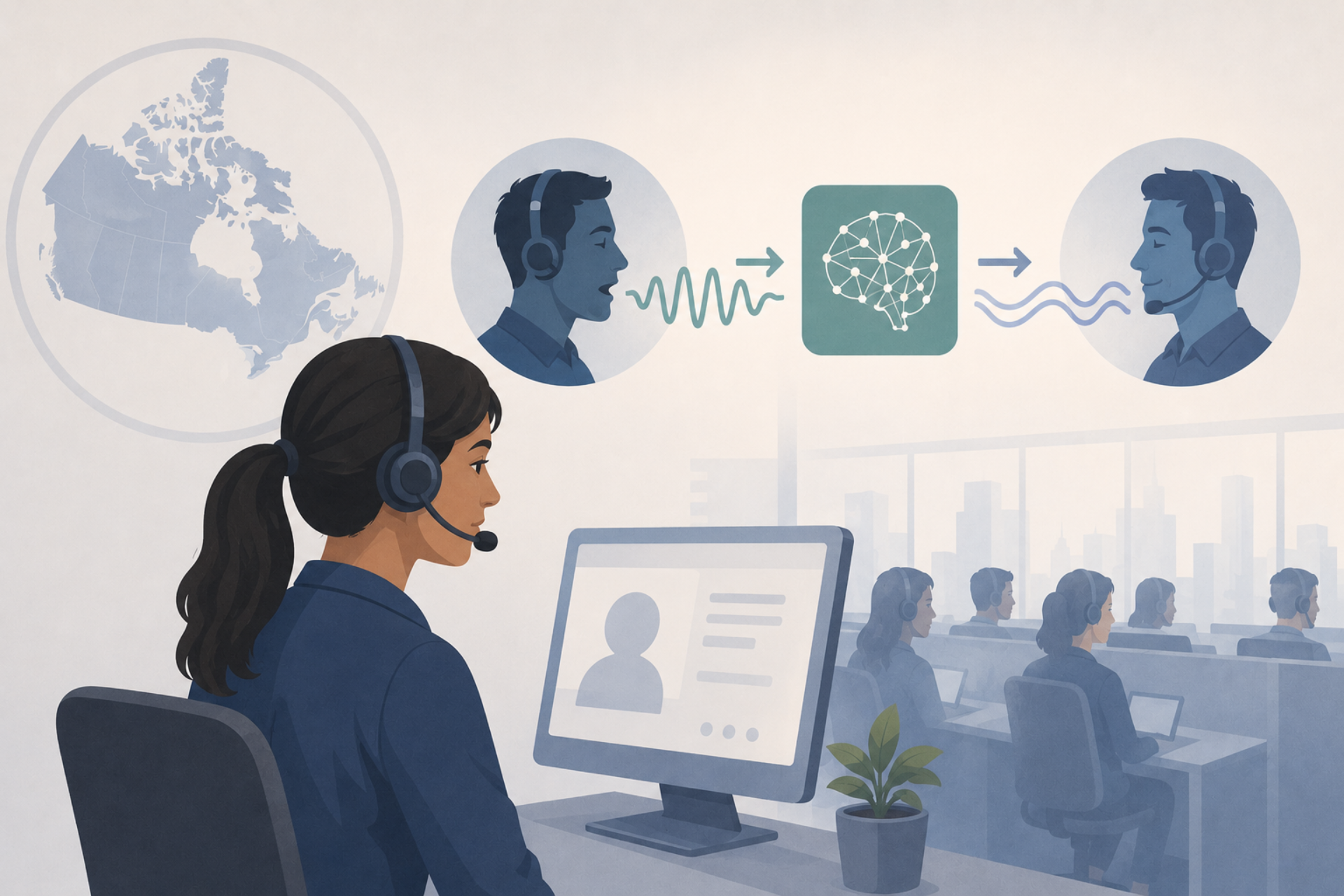
May 7, 2026 Artificial intelligence tools that alter the accents of call centre workers in real time are drawing scrutiny in Canada as labour groups warn the technology could mislead customers and accelerate the outsourcing of Canadian jobs. Union representatives say at least one major Canadian telecommunications company has already used AI-powered speech technology designed to “soften accents” for offshore customer service agents.
The issue surfaced publicly during an April 30 parliamentary committee hearing, where Roch Leblanc said the Canadian Telecommunications Workers Alliance had identified the technology being used within Canada’s telecom sector.
“We’re aware of at least one of the three big telco companies using it to mask the accents of offshore agents, altering how customers perceive who they’re talking to,” Leblanc told the committee.
While Leblanc did not identify the company directly, Telus Digital had previously published material on its website describing a partnership with an “AI-powered speech enhancement” provider. The company said the technology uses “cutting-edge speech-to-speech models” that modify speech acoustics in real time while preserving a worker’s original voice.
According to the company’s description, the software is intended to “improve clarity and reduce accent-related friction.”
Rogers Communications and Bell Canada both denied using AI in this way when questioned by Global News. Telus did not respond to requests for comment.
The technology itself has become increasingly sophisticated. Demonstrations posted online show AI systems modifying pronunciation, cadence and speech patterns almost instantly during live conversations. Rather than generating a synthetic voice, many of the tools preserve the original speaker’s tone and emotional delivery while changing how words sound to the listener.
The systems are primarily marketed toward companies operating large customer support networks in countries such as India and the Philippines, which remain major hubs for outsourced North American call centre operations.
Supporters argue the technology can reduce communication barriers and improve customer experience. Maura Grossman said clearer communication can matter in customer support environments where callers are already frustrated or trying to solve urgent problems.
“It is very hard sometimes when you’re on the line with someone and you can’t understand them and you want something done,” Grossman said.
But critics say the issue extends far beyond audio quality.
Renee Sieber warned that seemingly minor AI enhancements can reshape labour markets in ways consumers may not immediately recognize.
“Here’s an application that a company may say is benign, but actually could be stealing Canadian jobs,” Sieber said.
Labour groups argue the technology could make it easier for companies to shift even more customer service work overseas while making those transitions less visible to customers. By masking accents in real time, companies may reduce one of the few signals consumers have that support operations have been outsourced.
Leblanc said transparency is becoming a central concern.
“Canadians should know when AI is being used,” he said.
The debate also touches on broader questions around language, bias and cultural acceptance. Critics argue that altering accents could reinforce the idea that certain speech patterns are more acceptable or professional than others.
Grossman questioned whether companies would be equally interested in modifying accents associated with countries like Australia or the United Kingdom.
“You have to ask yourself, would we be doing this if it was for an accent from Australia or the U.K.?” she said.
The technology is already spreading internationally. Teleperformance SE, the world’s largest call centre operator, has reportedly begun deploying similar AI systems designed to neutralize or reduce Indian accents in customer service calls.
Canada’s federal government has not yet released its long-promised national AI strategy, though officials have previously said transparency requirements will form part of future regulation. It remains unclear whether that framework would require companies to disclose when voices are being altered by AI during customer interactions.