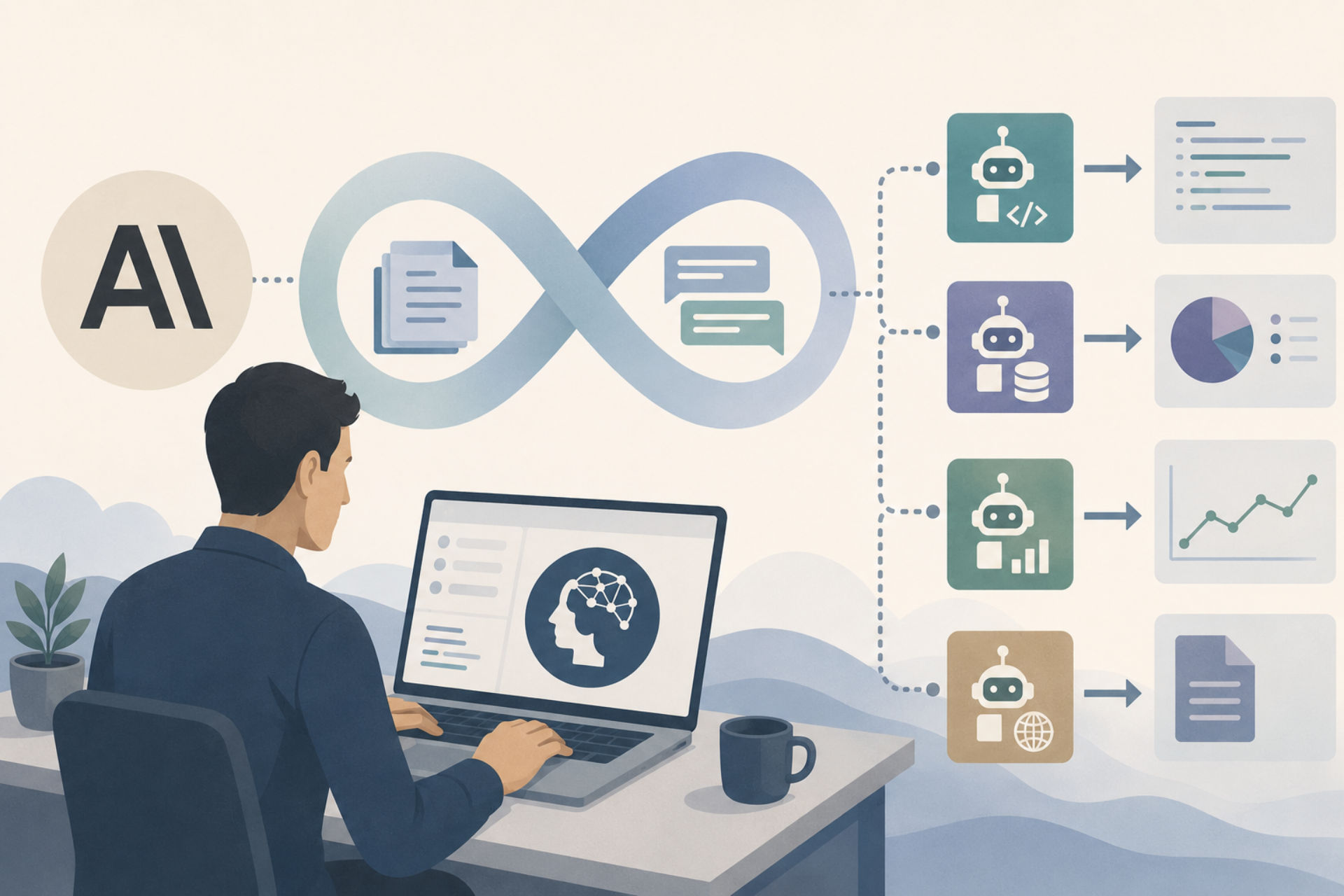
May 9, 2026 Anthropic has introduced a major set of upgrades to its Claude AI platform, including what it describes as infinite context windows designed to let the model retain and process information across long-running workflows and sessions. The update signals a broader shift in enterprise AI development, where companies are moving beyond chatbots and toward systems capable of managing persistent memory, coordinating multiple agents and handling complex software engineering tasks with minimal human intervention.
The changes position Claude more directly as an operating layer for AI-driven development work rather than simply a conversational assistant. According to details shared through World of AI and Anthropic’s own roadmap discussions, the company is prioritizing long-term memory, scalability and autonomy as competition intensifies among major AI labs.
One of the most significant additions is Claude’s expanded context handling. Traditional AI models operate within fixed context windows, meaning they eventually lose track of older information during extended interactions. Anthropic says Claude can now retain substantially more information over time, allowing developers to maintain continuity across large projects, historical datasets and long-running engineering workflows.
For software teams, that could reduce one of the biggest frustrations with current AI tools: constantly reintroducing project context, codebases or previous decisions during ongoing work.
Anthropic is also introducing more advanced multi-agent coordination. Instead of relying on a single AI model to handle every task sequentially, Claude can now delegate work to specialized agents operating simultaneously. Those agents can work across interconnected workflows, helping break larger problems into smaller coordinated tasks.
The company says the feature is intended to improve efficiency for large-scale engineering and research projects that require parallel execution.
Claude’s new “Dreaming” feature pushes the platform even further into adaptive behaviour. Anthropic says the system can review prior interactions, evaluate outcomes and refine future responses based on previous performance. Combined with a new iterative self-correction capability, Claude is designed to identify mistakes during workflows and dynamically adjust outputs in real time.
In practical terms, Anthropic is trying to make Claude less dependent on constant user supervision.
The company is also expanding Claude’s ability to integrate with external tools and services through webhook support. Developers can now connect Claude directly into broader automation systems, enterprise software stacks and external workflows.
The infrastructure supporting those upgrades is expanding rapidly as well.
Anthropic says all paid plans now include doubled API rate limits to support heavier enterprise workloads. The company also disclosed a major increase in compute capacity through partnerships and infrastructure investments, including access to 220,000 Nvidia GPUs and roughly 300 megawatts of energy capacity through collaboration with SpaceX.
The scale of those numbers reflects the increasingly industrial nature of frontier AI development. Training and operating large AI systems now depends as much on energy access, hardware supply chains and cloud infrastructure as model design itself.
Anthropic is also leaning heavily on partnerships with major cloud providers, including Google Cloud, Amazon Web Services and Microsoft Azure, to support Claude’s expansion.
The updates arrive as AI labs race to position their models not just as assistants, but as autonomous systems capable of replacing larger portions of software development and operational work.
Anthropic has openly framed Claude’s long-term direction as evolving into a largely autonomous software engineering platform capable of handling complex tasks over extended periods with minimal oversight. Upcoming model families, including future Haiku, Sonnet and Cloud 5 systems, are expected to continue pushing in that direction.
That strategy increasingly mirrors broader trends across the AI sector. Companies are no longer competing only on benchmark performance or chatbot quality. Instead, the focus is shifting toward persistent memory, orchestration, infrastructure scale and workflow integration — essentially building AI systems that behave more like digital operating environments than standalone applications.
For developers, some of Claude’s new features could meaningfully reduce friction in large projects. Multi-agent coordination and long-term memory are particularly valuable in enterprise environments where workflows often span weeks or months and involve multiple contributors, systems and dependencies.
But the changes also reinforce concerns about how quickly AI systems are moving toward autonomous decision-making inside production environments. Features like iterative self-correction and adaptive memory improve efficiency, but they also reduce the visibility humans may have into how models arrive at conclusions over time.
Anthropic appears aware of that tension. Much of the company’s messaging continues to emphasize reliability, controlled scaling and engineering-focused use cases rather than broad consumer automation.
Still, the direction is becoming increasingly clear across the industry. AI companies are no longer building tools that simply answer questions. They are building systems intended to manage workflows, coordinate tasks, remember context indefinitely and eventually operate with limited human guidance.