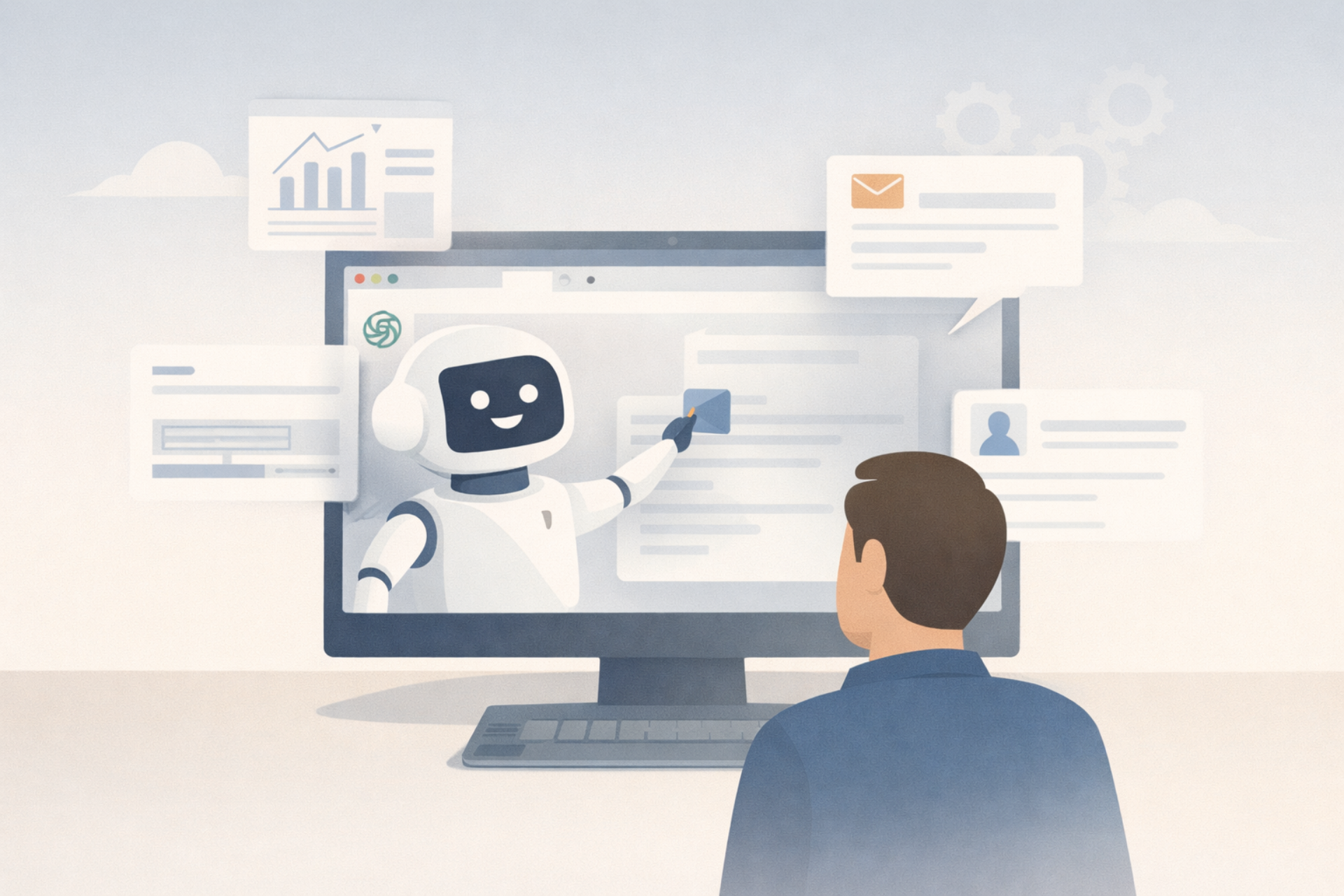
April 10, 2026 OpenAI is rolling out a ChatGPT-powered internet browser designed to research, plan, and execute tasks across a user’s workflow. Early reports suggest the tool can handle up to 80 per cent of a one-person business’s operations.
The product, referred to as Atlas, embeds ChatGPT directly into the browsing experience and introduces an “agent mode” that allows it to take actions within live sessions under user control. Instead of switching between tabs, copying outputs and stitching together tools, users can delegate tasks and receive completed work in context.
The practical use cases are broad but grounded in everyday workflows. The browser can scan the web for content ideas, draft scripts, organise outputs into documents, audit landing pages, and generate test plans. It can also handle operational tasks such as inbox clean-up, tool comparison before purchase, and reconstructing workflows based on browsing history.
What changes is not just speed, but continuity. Traditional AI usage still requires users to move between tools and manually reconnect context. An AI-native browser keeps that context intact, allowing research, writing, editing, and optimisation to happen in one environment without resetting the workflow.
This directly targets a common constraint for solopreneurs: context switching. A single operator often handles strategy, execution, marketing, and administration. Even small interruptions between these tasks compound into lost time and slower output. By keeping the entire process inside the browser, the system reduces that overhead.
The “agent” layer is where the model moves beyond assistance. Within defined guardrails, ChatGPT can execute sequences such as analysing pages, rewriting content inline, or preparing structured outputs based on live data. The emphasis remains on supervised actions rather than full autonomy, but the direction is clear.
The shift does not stop with OpenAI. Perplexity AI has launched its Comet browser on mobile, and Opera has expanded AI features that integrate directly into search and tab management. Together, these moves point to a broader transition: the browser itself becoming the primary AI workspace.
For professionals, the implication is less about any single feature and more about the aggregation of small efficiencies. Research that takes minutes instead of hours, edits that happen inline, and decisions supported by live context begin to stack. Over time, that changes how much a single person can realistically manage.
The result is a different model of work. Instead of adding another tool to the stack, AI-native browsers collapse the stack into one place—where the work not only starts, but increasingly gets done.