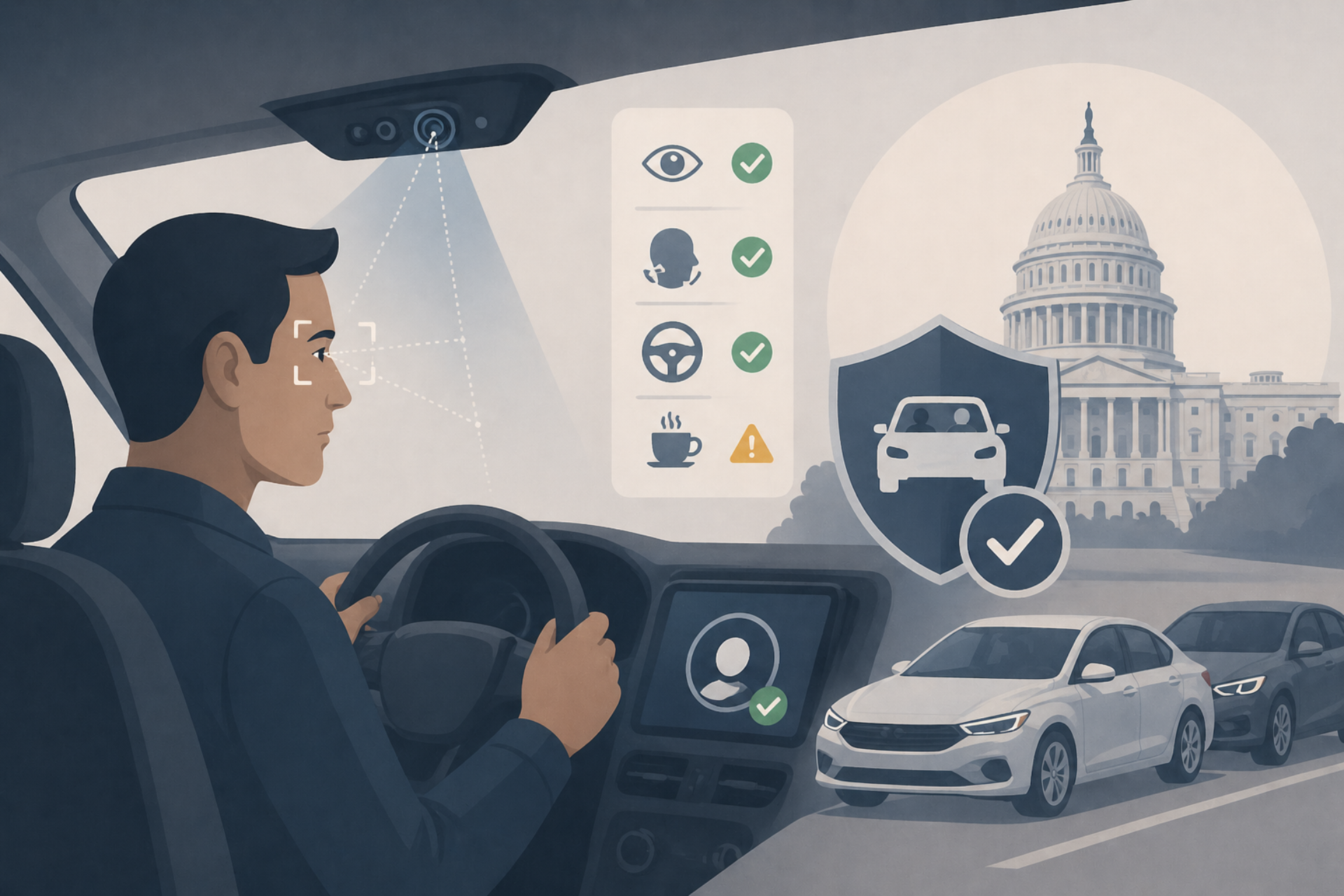
April 29, 2026 The U.S. government is moving to require advanced driver monitoring systems in all new passenger vehicles under a federal safety mandate tied to the 2021 infrastructure law. The rule would compel automakers to install technology capable of detecting impairment or fatigue and intervening, marking a significant shift in how vehicles assess driver behaviour.
The requirement stems from Section 24220 of the Infrastructure Investment and Jobs Act, which directs the National Highway Traffic Safety Administration (NHTSA) to finalize standards for “advanced impaired driving prevention technology.” These systems are designed to passively monitor drivers using sensors and onboard analytics rather than requiring active participation like traditional breathalyzer interlocks.
At the core of the mandate are infrared cameras and sensors positioned inside the vehicle, often near the steering column or A-pillars. These systems track indicators such as eye movement, pupil dilation and head position to assess alertness. If the system determines a driver may be impaired or fatigued, it can prevent the vehicle from starting or restrict driving functions such as speed.
Implementation is expected to target the 2026 to 2027 timeframe for new vehicles, although the final rule has faced delays beyond its initial November 2024 deadline. Once formalized, automakers are expected to have a two- to three-year window to comply. Existing vehicles are not affected, but new models introduced after the deadline would need to include the technology as standard equipment.
The rollout aligns with broader trends in vehicle software integration. Because many modern vehicles support over-the-air updates, these monitoring systems could evolve post-purchase, potentially expanding their capabilities without requiring hardware changes.
The mandate has raised concerns around privacy and cost. While the legislation focuses on in-vehicle safety functions, questions remain about how biometric data may be handled by manufacturers. Industry observers note that although external data sharing is not explicitly required, the possibility of storing or transmitting driver data introduces questions about downstream use, including by insurers or third parties.
Cost is another factor. Estimates suggest the technology could add between $100 and $500 per vehicle, with automakers likely passing those costs on to consumers. This comes at a time when vehicle prices remain elevated across many markets.
Automakers have also raised concerns about technical reliability. Industry groups have pointed to the risk of false positives, where systems could incorrectly identify impairment and limit vehicle operation. Manufacturers have warned that such issues could affect customer acceptance and influence purchasing decisions, particularly if buyers opt for older vehicles without the technology.
Federal officials have framed the measure as a safety initiative, with projections that the technology could help prevent thousands of deaths annually by reducing impaired driving incidents. The policy introduces a new layer of automation into the driving experience, where vehicles move beyond passive transport to actively evaluating driver fitness in real time.