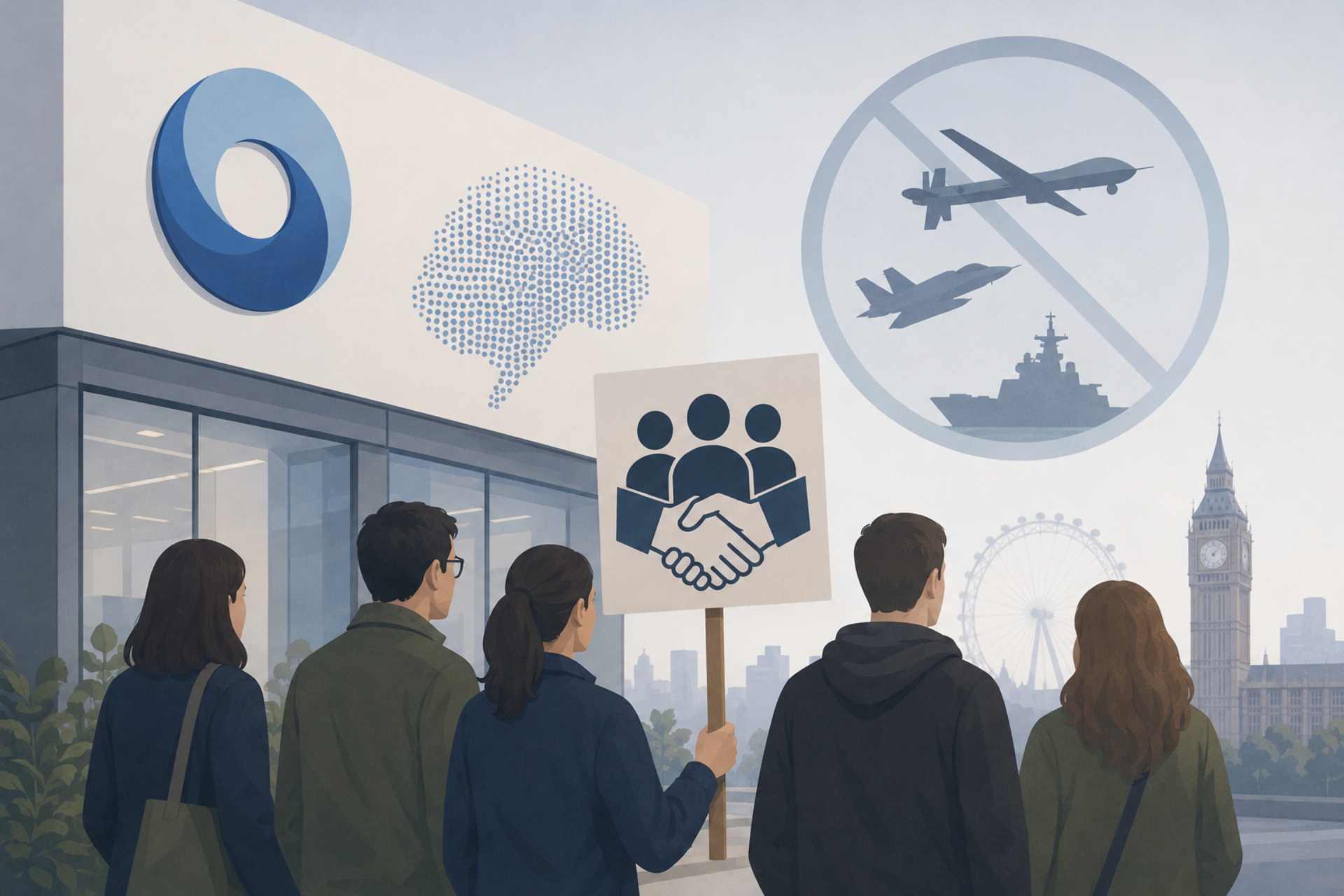
May 7, 2026 Employees at Google DeepMind in London are attempting to unionize amid growing internal opposition to the company’s military and defence-related AI partnerships. Workers involved in the effort say the move is aimed in part at blocking DeepMind technology from being used by the U.S. and Israeli militaries and forcing greater transparency around how Google deploys its AI systems.
The employees have sent a letter to Debbie Weinstein requesting that Communication Workers Union and Unite the Union be formally recognized as joint representatives for DeepMind workers in the UK.
The organizing push reflects a broader shift underway inside the AI industry, where workers are increasingly challenging how frontier AI models are commercialized and deployed. Employees involved in the campaign argue that Google’s public messaging around responsible AI no longer aligns with its expanding defence partnerships and changes to its ethics policies.
“Fundamentally, the push for unionization is about holding Google to its own ethical standards on AI, how they monetize it, what the products do, and who they work with,” said John Chadfield in comments to WIRED. “Through the process of unionization, workers are collectively in a much stronger place to put [demands] to an increasingly deaf management.”
According to a DeepMind employee who spoke anonymously to WIRED out of concern about retaliation, organizing efforts accelerated earlier this year after Alphabet Inc. removed language from its AI ethics guidelines that had previously pledged not to use AI for weapons development or surveillance purposes.
“A lot of people here bought into the Google DeepMind tagline ‘to build AI responsibly to benefit humanity,’” the employee said. “The direction of travel is to further militarization of the AI models we’re building here.”
The concerns intensified further after reports that Google had entered into agreements allowing the United States Department of Defense to use its AI systems for “any lawful government purpose.” The Pentagon later confirmed agreements with seven major AI companies, including Google, OpenAI, Microsoft and SpaceX, to deploy AI capabilities on classified government networks.
That “any lawful government purpose” language has become a particular flashpoint for AI workers. Roughly 600 Google employees in the United States reportedly signed a protest letter objecting to the agreement.
“We think the [any-lawful-purpose] clause is vague enough to be effectively meaningless,” the DeepMind employee told WIRED.
Google says no formal unionization vote has taken place yet. In a statement, Google spokesperson Kristen Morea said the company had received the unions’ recognition request and remained committed to employee dialogue.
“At this stage in the process, there has been no vote to unionise,” Morea said. “We have always valued constructive dialogue with employees and we’ll remain focused on creating a positive and successful workplace.”
The company has also defended its government and national security partnerships publicly. Google spokesperson Jenn Crider recently told The New York Times that the company was “proud to be part of a broad consortium of leading AI labs and technology and cloud companies providing AI services and infrastructure in support of national security.”
She added that Google remains committed to ensuring AI is not used for “domestic mass surveillance or autonomous weaponry without appropriate human oversight.”
The London effort builds on earlier labour organizing attempts inside Google. In 2021, workers in the United States formed the Alphabet Workers Union, although Alphabet has never formally recognized the organization for collective bargaining purposes. Even without official recognition, the union has occasionally succeeded in negotiating improvements for contractors and temporary workers.
The DeepMind organizers appear to be pursuing broader demands. According to employees involved in the campaign, workers may seek commitments around Google’s military relationships, including contracts connected to the Israeli military, as well as stronger transparency into how AI products are deployed and safeguards related to layoffs driven by automation.
The unions involved say the movement may not stop with Google. Since early 2026, both OpenAI and Anthropic have significantly expanded operations in London, helping turn the city into one of the largest AI research hubs outside the United States.