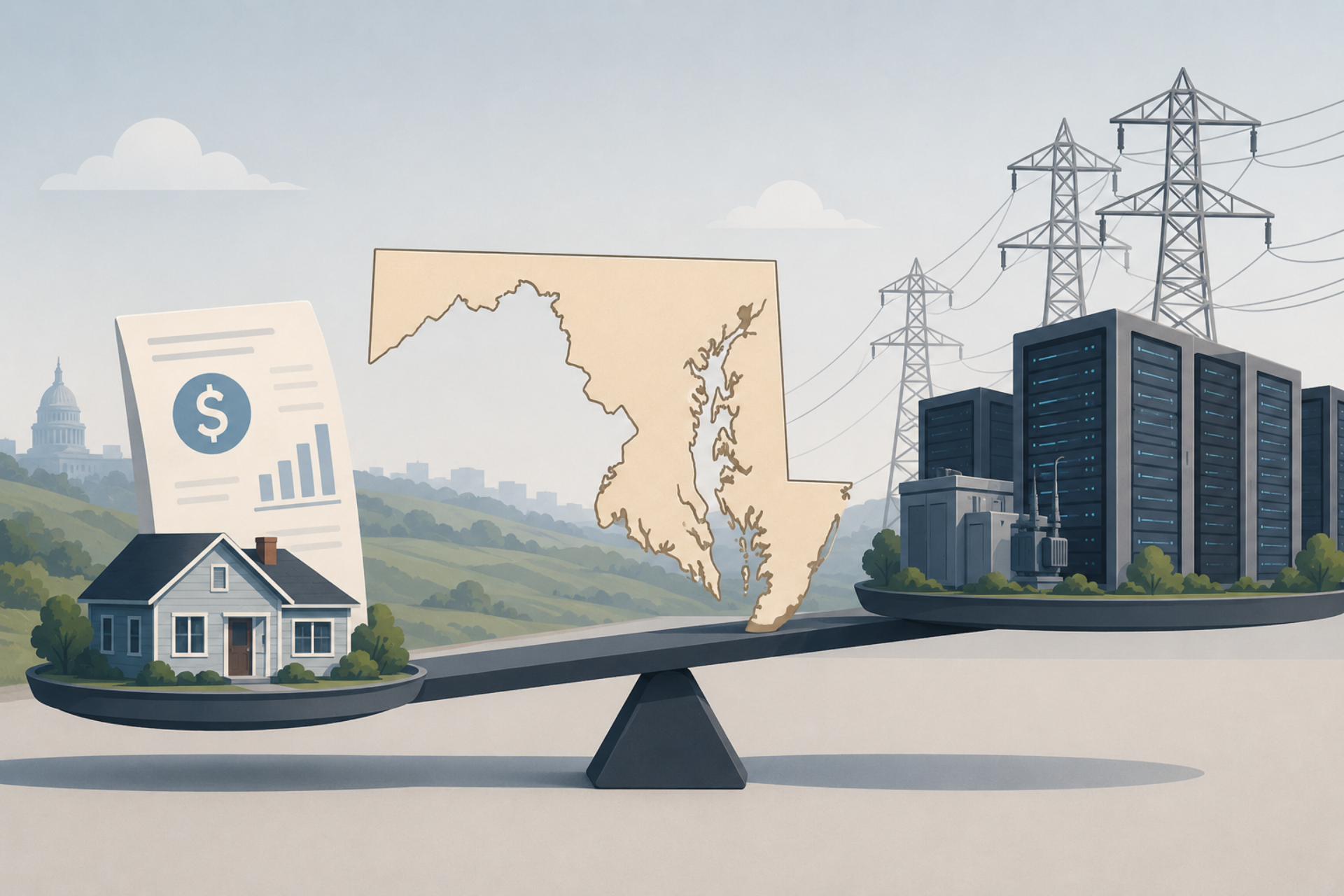
May 11, 2026 The Maryland Office of People’s Counsel has filed a complaint with the Federal Energy Regulatory Commission arguing that Maryland residents should not be forced to pay roughly $2 billion in electricity grid upgrades largely driven by growing data centre demand. The state says the costs could add another $1.6 billion to Maryland utility bills over the next decade, including an estimated $345 per residential customer.
The dispute centres on PJM Interconnection, the largest electricity transmission operator in the United States. PJM oversees power distribution across 13 states and Washington, D.C., serving roughly 65 million people. The company has proposed roughly $22 billion in transmission upgrades to prepare for rising electricity demand from AI infrastructure and hyperscale data centres.
Maryland officials argue the formula PJM uses to divide those costs unfairly shifts the financial burden onto states that are not seeing the largest growth in data centre construction.
“Without FERC action, Maryland customers face paying billions for transmission infrastructure that PJM is advancing to benefit data centers,” Maryland People’s Counsel David S. Lapp said in a statement. “PJM’s cost allocation rules are broken. Maryland customers have neither caused the need for these billions in new transmission projects nor will they meaningfully benefit from them.”
According to the filing, Maryland’s projected electricity demand growth is significantly smaller than states such as Virginia, Ohio, Pennsylvania and Illinois, where many large-scale AI and cloud infrastructure projects are concentrated. Virginia in particular has become one of the world’s largest data centre hubs due to the continued expansion of Northern Virginia’s cloud corridor.
Maryland argues that if new transmission projects are being built primarily to support AI infrastructure in other states, those costs should either remain local to the benefiting regions or be paid directly by the technology companies driving the demand.
The complaint also references the “ratepayer protection pledge” promoted by President Donald Trump, which called on large technology firms to shoulder more of the infrastructure costs associated with their AI expansion plans rather than shifting them onto households and small businesses.
The filing highlights growing uncertainty around projected electricity demand from AI systems. Maryland officials argue utilities may still profit from large infrastructure expansions even if anticipated data centre growth ultimately falls short, while ordinary customers remain responsible for the long-term costs.
The conflict reflects a broader backlash against AI infrastructure projects across the United States, where communities are increasingly raising concerns about electricity consumption, water use and environmental strain tied to hyperscale data centres.
According to the information provided in the filing, roughly 69 jurisdictions across the U.S. have now introduced some form of moratorium or restriction on new data centre developments. Surveys also show nearly half of Americans oppose having a data centre built near their communities.
Those tensions are becoming especially visible in states already dealing with water shortages and energy strain.
In Georgia, residents in Fayetteville recently discovered that a massive Quality Technology Services campus had consumed more than 29 million gallons of water without initially being billed for it. County officials later said two industrial-scale water hookups feeding the site were either improperly connected or not tied to the company’s account during a transition to smart meters.
The retroactive bill totalled nearly $150,000.
The facility, located about 20 miles south of Atlanta, is one of the largest data centre developments in the country. The 615-acre campus is expected to eventually contain up to 16 buildings. Local residents said they became alarmed after noticing declining water pressure while also being asked by county officials to conserve water during drought conditions.
“We get this notification from Fayette County water system saying you need to stop watering your lawns to help conserve water,” local resident James Clifton said. “So the first thing they do is lean on the individuals and the citizens to stop water consumption when we have QTS that’s just absolutely draining us.”
Georgia officials said the company later paid all retroactive charges. QTS maintained that the unusually high water usage was tied to construction activities such as concrete work, dust control and site preparation, not ongoing cooling operations. The company said its operational facilities use closed-loop cooling systems designed to minimize water consumption.
Still, the incident intensified local opposition to further data centre expansion. Last month, the Fayetteville City Council voted to ban new data centres across all city zoning districts.
Back in Maryland, officials say their challenge is ultimately about who should absorb the cost of the AI infrastructure boom now reshaping electricity grids across North America.