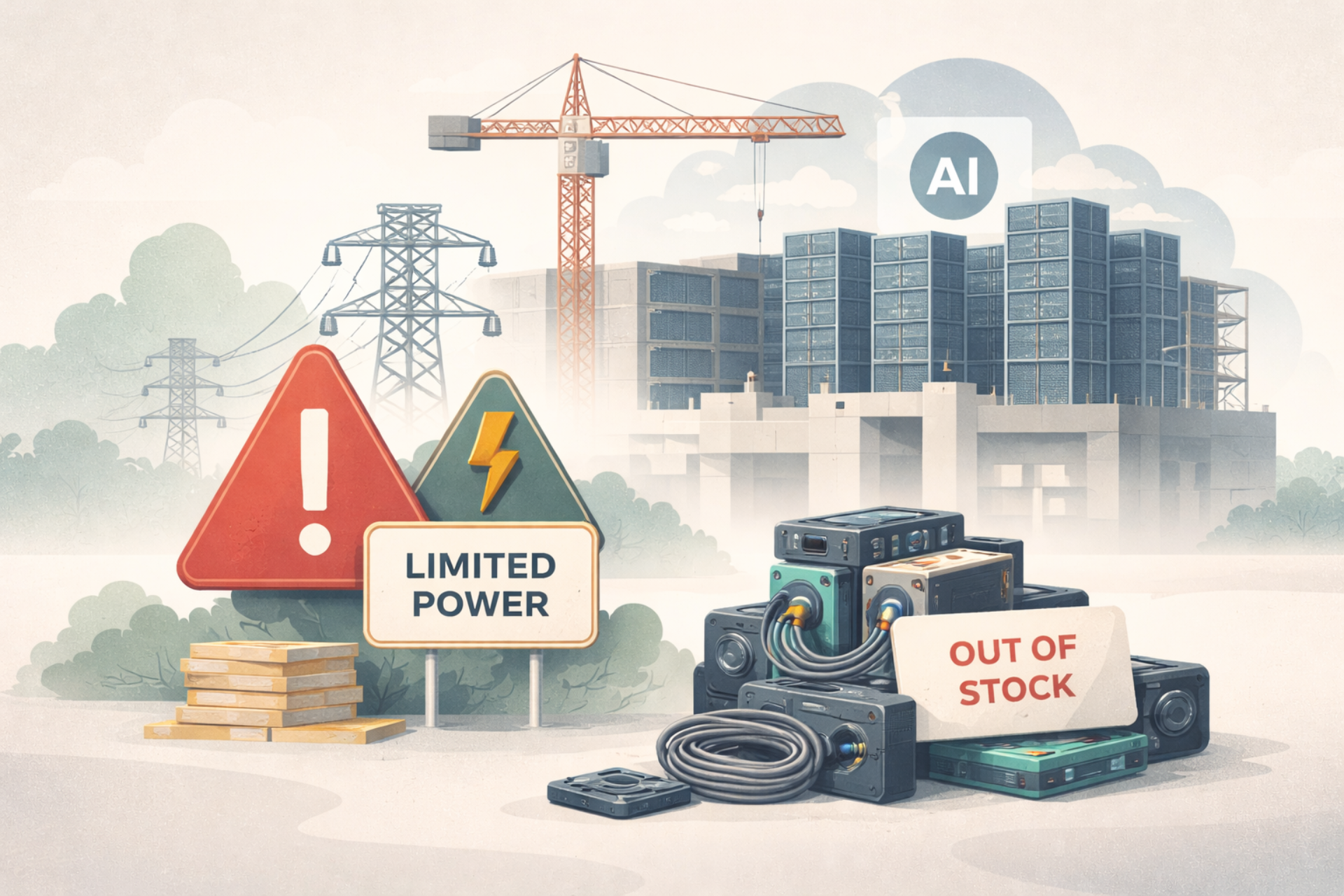
April 7, 2026 AI companies in the United States are struggling to keep up with data centre construction, with a significant share of projects falling behind schedule. Analysts estimate that between 30 per cent and 50 per cent of planned AI data centres this year could be delayed or cancelled due to shortages in power and critical hardware.
The constraints are already visible in the numbers. Of roughly 140 projects expected to deliver at least 16 gigawatts of capacity by the end of 2026, only about 5 GW are currently under construction. Another 16 GW remains in early “announced” stages with no clear progress, while typical build timelines stretch between 12 and 18 months.
This is not a new pattern. Last year, 26 per cent of announced capacity was delayed, and another 10 per cent saw commercial operations pushed back. Looking ahead, projects slated for 2027 exceed 25 GW, but less than 10 GW has actually broken ground.
Power availability is one of the biggest bottlenecks. AI workloads require large, continuous energy supply, putting pressure on local grids and drawing scrutiny from nearby communities. Rising energy costs have become a concern in areas hosting these facilities, even as the projects promise job creation and economic activity.
Hardware supply is also tightening. The surge in AI infrastructure has already diverted production of memory, storage and CPUs away from consumer markets, pushing up prices for devices like PCs and gaming consoles. At the same time, more basic components such as transformers and industrial batteries are becoming harder to source, slowing construction timelines.
Domestic manufacturing has not kept pace. Despite policy efforts to reshore production, US capacity remains insufficient to meet demand, leaving companies reliant on imported components, including those from China.
The result is a growing gap between AI ambition and physical infrastructure. Companies are announcing large-scale buildouts, but execution is constrained by energy systems, supply chains and manufacturing limits.
For now, the expansion of AI capacity is not just a software or model challenge. It is an industrial one, shaped by how quickly power, equipment and construction can scale alongside demand.