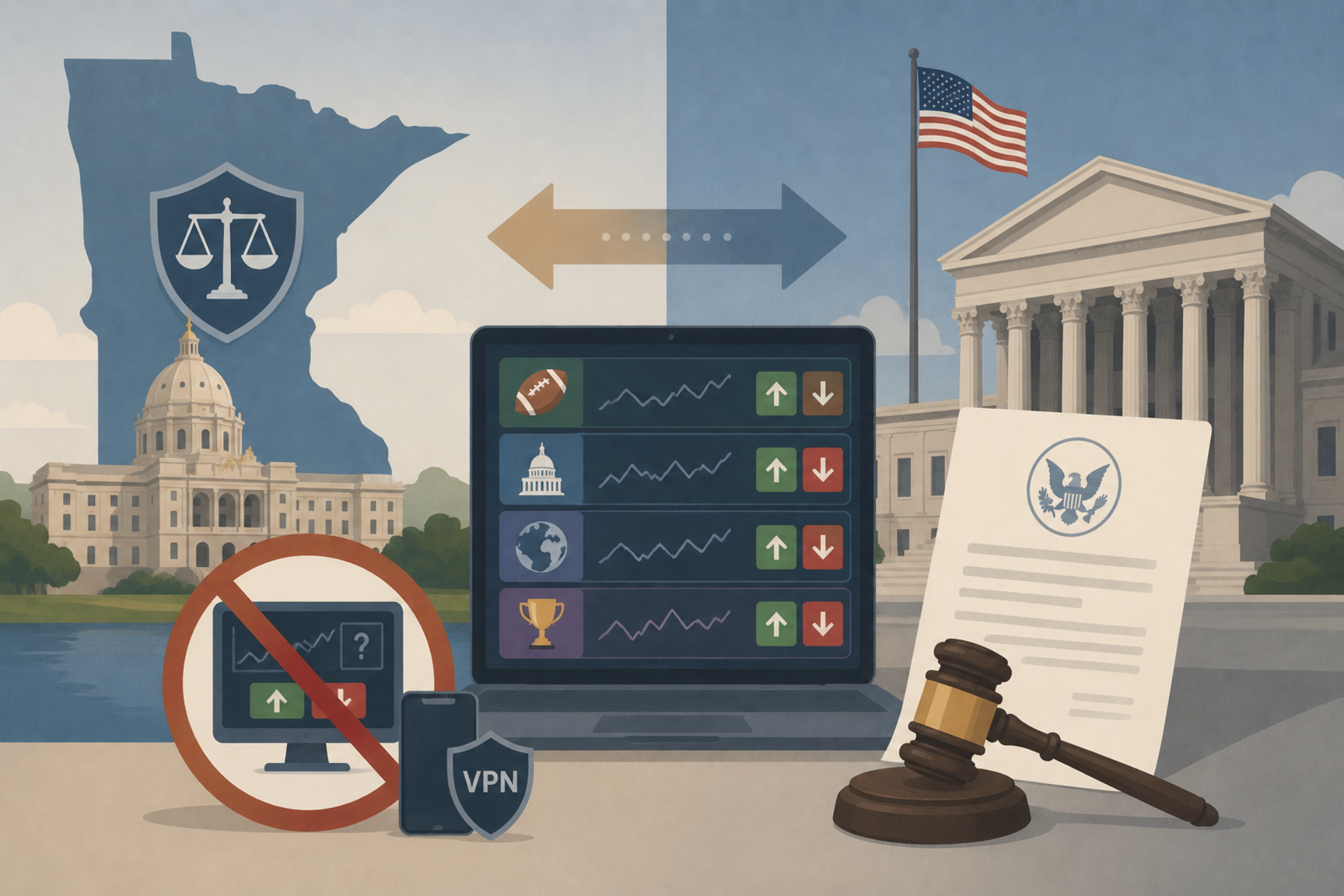
May 20, 2026 Minnesota has become the first U.S. state to ban prediction market platforms, marking a major escalation in how governments are trying to regulate the fast-growing industry. The Trump administration has responded by filing a lawsuit to block the law, setting up a broader legal battle over whether states or federal regulators control prediction markets.
The law, signed by Minnesota Governor Tim Walz, makes it a crime to host or advertise prediction market services within the state. It defines these platforms as systems that allow users to place wagers on future outcomes, ranging from sports and elections to entertainment events and even word choices or global developments.
The scope of the ban goes further than just the platforms themselves. It also targets supporting tools, including virtual private networks (VPNs), that could allow users to bypass location restrictions and continue accessing these services. Once the law takes effect in August, companies operating in the space, such as Kalshi and Polymarket, will be forced to exit Minnesota or risk felony charges.
Supporters of the measure argue that the state should have authority over gambling-related activities within its borders. Minnesota lawmakers framed the law as a way to protect public safety, particularly in areas involving children and vulnerable users.
At the same time, the law includes a narrow carve-out. Certain event contracts tied to risk management, such as those used as insurance against financial loss, are still permitted, along with traditional securities and commodities trading. An updated version of the bill also allows weather-related trading after pushback from the agricultural sector, which has long relied on such tools to hedge against crop risks.
The federal government, through the Commodity Futures Trading Commission (CFTC), is pushing back strongly. The agency argues that prediction markets fall under its jurisdiction and should be regulated at the federal level, not by individual states. In its lawsuit, the CFTC warned that the Minnesota law could criminalize activities that are currently legal under federal oversight.
The agency also pointed to longstanding uses of event-based contracts, such as weather-related hedging by farmers, as evidence that these markets serve legitimate economic purposes. According to the CFTC, the state’s approach risks undermining both innovation and established financial tools.
The dispute highlights a deeper regulatory conflict that is already playing out across the country. More than a dozen states have introduced similar legislation targeting prediction markets, and multiple lawsuits have been filed over the issue. In one case in Nevada, a judge ruled that certain prediction market activity was effectively indistinguishable from sports betting, prompting companies like Kalshi to suspend operations there.
Despite growing scrutiny, the industry itself continues to expand rapidly. Prediction markets now handle billions of dollars in weekly trading volume, much of it tied to sports-related outcomes. On some platforms, sports betting accounts for the overwhelming majority of activity, even in states where traditional sports gambling remains illegal.
With the law set to take effect in August and federal challenges already underway, Minnesota’s move is likely to become a defining test case in determining how prediction markets are governed in the United States.