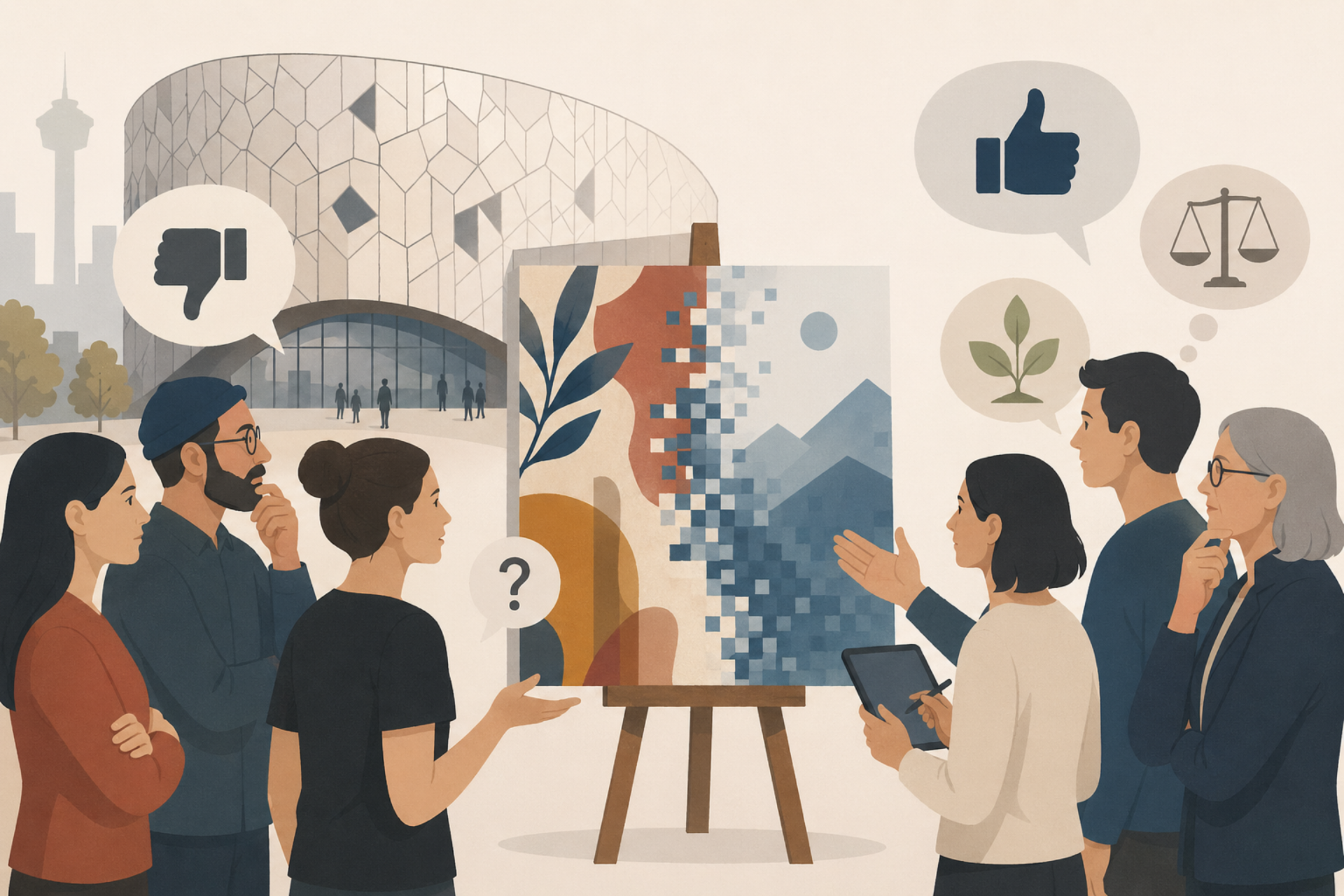
April 28, 2026 The Calgary Public Library has launched a 10-week paid residency for artists who use artificial intelligence, prompting widespread criticism from parts of the local creative community. The programme, offering up to $8,000 in compensation, is designed to explore how AI is used in artistic practice and to engage the public in discussions about its implications.
The residency, open to one artist “in any discipline who [uses] AI ethically as a collaborative partner in their creative process,” will run from June 29 to Sept. 4, with applications closing April 7. Programming director Millicent Mabi said the initiative aims to support community understanding of AI through workshops, public programming, and one-on-one consultations.
“We are looking for artists who are answering, or trying to answer, the questions that artificial intelligence raises in relation to creativity and art,” she said.
The announcement has generated hundreds of responses online, many critical of the concept. Calgary illustrator and tattoo artist Melanie Luther said she initially thought the posting was a joke, describing the idea of an “AI artist” as contradictory. She raised concerns about authorship and training data, arguing that generative tools rely on existing work.
“This can’t be really something that an artist can take ownership of as like, ‘oh, I made this.’ You didn’t though,” she said.
The criticism reflects broader concerns around generative AI, including environmental impact and questions of originality. Mabi acknowledged the pushback, saying the library is aware that perspectives vary and that creating space for discussion is part of the intent. “We truly value the community’s feedback, and we’re taking it into consideration,” she said.
Academic perspectives highlight the complexity of the issue. University of Waterloo computer science professor Maura Grossman said ethical AI art may be possible if models are trained on licensed or permission-based datasets. However, she noted that many creators view AI-generated work as conflicting with the idea of art as personal expression, while others see it as a tool that lowers barriers to creation.
Grossman also pointed to a divide in how art is defined. For some, AI challenges the authenticity of creative output; for others, it expands access for people without formal training. “You might say it’s great, because somebody who has zero creativity may be able to go onto a tool and create something that they could never have created before,” she said.